


- Home
- About
- Personal Injury
- Car Accidents
- Truck Accidents
- Motorcycle Accidents
- Pedestrian Accidents
- Defective Products
- Premises Liability
- Catastrophic Injuries
- Medical Malpractice
- Nursing Home Negligence
- Sexual Abuse
- Educational Abuse
- Wrongful Death
- Scooter Accidents
- Underinsured Motorist Accidents
- Uninsured Motorist Accidents
- Workers’ Compensation
- Case Results
- Scholarship
- Blog
- Contact
7 Concussion Warning Signs Parents Miss After a Child's Car Accident
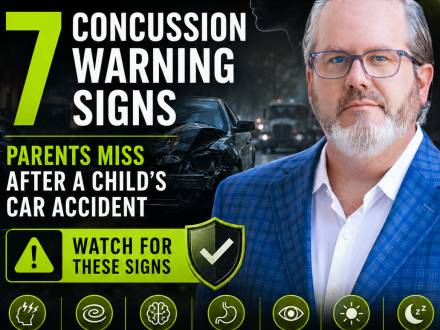 A car accident involving a child creates an immediate shift from normal life into uncertainty, fear, and rapid decision-making. In those first hours, most parents focus on what they can see—cuts, bruises, whether their child is walking or talking normally. But the most serious injuries are often the ones that do not show up on the surface.
This is why so many parents later search for signs of a concussion after my car accident I should not ignore, often after symptoms have already begun to quietly develop.
The challenge is that concussions in children rarely follow a clear pattern. A child may seem "fine" right after the crash, even playful or responsive, and still be experiencing a brain injury that evolves over the next 24 to 72 hours. Headaches, mood changes, sleep disturbances, or subtle confusion can be mistaken for shock, stress, or emotional overload from the accident itself.
Seldom discussed—but critically important—is how often concussion symptoms are dismissed because the child "looked normal at the hospital" or "didn’t lose consciousness." Medical research shows neither of these is a reliable indicator of safety. That gap between appearance and reality is where most missed diagnoses occur.
For parents, the pressure is immediate and deeply personal: make the right call without overreacting or underestimating danger. This article breaks down the warning signs that are most commonly overlooked, so you can recognize what truly matters in real time—not after the situation has already escalated.
The Core Problem
The real issue isn’t injury visibility — it’s interpretation under pressure
After a child’s car accident, parents are not just dealing with a medical situation. They are operating under emotional overload. Fear, urgency, and responsibility collide at the same time, and this combination quietly affects how symptoms are read and understood.
This is where the real problem begins. Most missed cases involving signs of a concussion after my car accident I should not ignore are not caused by ignorance—they are caused by misinterpretation. Parents assume that if a child is talking, walking, or behaving "normally," the danger has passed. But that assumption is shaped by stress, not medical reality.
In the immediate aftermath of a crash, the brain is not processing information clearly. Parents often default to visible cues because they feel concrete and reassuring. Unfortunately, concussions rarely offer that kind of clarity.
Why symptoms are often misread or dismissed
The most common blind spot is confusing emotional recovery with neurological stability. A child may appear calm, tired, or slightly emotional and still be experiencing early brain injury symptoms.
Common misinterpretations include:
-
"They’re just shaken up" instead of recognizing cognitive slowing
-
"They’re tired from the accident" instead of noticing abnormal sleep patterns
-
"They seem fine now" instead of tracking delayed symptom onset
These assumptions feel reasonable in the moment. That is exactly why they are so dangerous.
When parents search for concussion warning signs after a child’s car accident or mild head injury symptoms in children after trauma, what they are really trying to resolve is uncertainty—not just information.
Expert insight: concussions often evolve, not appear
One of the most overlooked clinical realities is that concussions are often progressive, not immediate. The injury can begin at the moment of impact, but the symptoms may intensify as the brain reacts over hours or even days.
This means a child who seems "okay" right after the accident is not necessarily in the clear. In fact, that early normal appearance can create a false sense of safety, leading parents to stop observing too soon.
The core pressure parents face
At its root, this is a decision-making problem under uncertainty. Parents are trying to avoid two equally frightening outcomes:
-
Overreacting and taking the child through unnecessary medical stress
-
Underreacting and missing a potentially serious brain injury
This tension is exactly why subtle concussion signs are so often overlooked—and why structured awareness becomes critical in the hours after the accident.
The Timing Trap Most Parents Are Never Told About
Why "the first clear check" is often misleading
One of the least discussed realities after a child’s car accident is that the initial medical check—or even a few hours of observation—can create a false sense of security. Parents often believe that if a doctor briefly examines their child and finds no obvious injury, they can safely rule out danger.
But with brain injuries, especially those involving signs of a concussion after my car accident I should not ignore, timing is everything. Symptoms are not fixed at the moment of impact—they unfold as the brain’s chemistry reacts to the injury.The hidden dynamic: "false stabilization" after trauma
After a crash, a child’s body releases stress hormones like adrenaline. These chemicals temporarily mask pain, fatigue, and even early neurological symptoms. This creates what can be described as a "false stabilization window," where the child appears more alert, responsive, or normal than they actually are.
During this window, even experienced caregivers may underestimate early concussion indicators or miss subtle concussion warning signs after a child’s car accident such as slight confusion, irritability, or unusual tiredness.
The danger is not just the symptoms themselves—it is the timing mismatch between injury onset and symptom visibility.
Why discharge or reassurance can create risk at home
Another overlooked factor is "anchoring bias." Once a parent hears "everything looks fine" from a medical professional, that reassurance becomes the mental anchor. Later symptoms are then unconsciously downgraded or explained away.
This is especially risky because many concussion symptoms in children worsen at home, not in clinical settings. Sleep changes, emotional instability, and cognitive slowing often become clearer only after stimulation decreases and the child returns to a quiet environment.
Expert insight: brain injury symptoms are delayed by biology, not behavior
The World Health Organization explains that traumatic brain injury symptoms may appear immediately or evolve over time as swelling, chemical imbalance, and neural disruption develop:
https://www.who.int/news-room/fact-sheets/detail/traumatic-brain-injury
This biological delay means the absence of early symptoms does not equal safety. It only reflects where the brain is in its injury-response cycle.
What this means for parents in real time
For parents trying to interpret mild concussion signs after a car accident, the key challenge is resisting early reassurance. The real risk period often begins after the initial calm moment—when symptoms slowly emerge without warning.
Understanding this timing gap helps parents avoid one of the most common and preventable mistakes: stopping observation too soon.
What Happens When Concussion Signs Are Missed
The risk is not just the injury—it’s the delay in recognizing it
When parents overlook or misunderstand signs of a concussion after my car accident I should not ignore, the consequences are rarely immediate disaster. Instead, they often unfold gradually, in ways that feel confusing and easy to dismiss until they become serious.
The real danger lies in assuming "it will pass on its own."
Financial consequences: repeated care instead of early treatment
When concussion symptoms are missed early, families often end up in a cycle of repeated medical visits—urgent care, ER trips, follow-ups, and specialist consultations that could have been reduced with earlier recognition.
For many parents already dealing with accident-related expenses like vehicle repairs, missed workdays, and transportation disruptions, this adds unexpected financial strain. A delayed diagnosis often means more appointments, more imaging, and longer recovery support needs.
Emotional consequences: guilt and second-guessing
Perhaps the most lasting impact is emotional. Parents often replay the early hours after the accident, wondering if they missed subtle concussion warning signs after a child’s car accident.
Common emotional patterns include:
-
Guilt for "not noticing sooner"
-
Anxiety about long-term brain effects
-
Constant monitoring of every small behavior change
-
Fear of making another mistake
This emotional load can persist even after the child physically recovers.
Long-term consequences: learning and behavior changes
When concussions are not identified early, children may return to school or normal activities too soon. This can worsen symptoms and prolong recovery.
In some cases, parents notice:
-
Difficulty concentrating in class
-
Memory lapses or slower learning
-
Increased irritability or emotional sensitivity
-
Reduced academic performance
A child who once recovered quickly may instead experience lingering effects that disrupt daily life for weeks or months.
Legal and practical consequences: documentation gaps
While not always immediately obvious, delayed recognition can also affect how the injury is documented medically. This can complicate insurance claims or follow-up care planning, especially when symptoms appear inconsistent or are reported later.
A Practical Decision Framework for Parents After a Car Accident
Step 1: Treat the first 72 hours as a "watch window," not a clearance period
After a child’s car accident, the most important shift in thinking is this: no early observation period is final. Even if your child seems stable, the risk of signs of a concussion after my car accident I should not ignore increases during the first 1–3 days.
During this time, your goal is not to "confirm safety," but to actively observe changes.
Step 2: Use the "COMPARE" rule instead of isolated symptoms
Parents often make the mistake of evaluating symptoms in isolation. Instead, compare behavior to the child’s normal baseline:
-
Cognitive clarity: Are they thinking and responding normally compared to before?
-
Attention span: Are they unusually distracted or slow?
-
Personality shifts: Are they more irritable, quiet, or emotional than usual?
-
Energy levels: Do they fatigue faster than normal activities would suggest?
This comparison method is more reliable than asking, "Do they seem okay?"
Step 3: Monitor progression, not just presence
One of the most overlooked principles in identifying mild concussion signs after a car accident is that worsening matters more than appearance.
Red flag pattern:
-
Symptoms start mild → then increase in intensity
-
Behavior becomes less predictable over time
-
Sleep or focus begins to deteriorate instead of improve
If symptoms escalate, treat it as urgent—even if initial signs seemed minor.
Step 4: Avoid the "false reassurance trap"
Do not rely solely on:
-
"They didn’t lose consciousness"
-
"The ER said they were fine"
-
"They seem normal now"
These are not reliable indicators of brain safety in children. Concussion symptoms often develop outside clinical observation windows.
Step 5: Act early when in doubt
A key rule used in pediatric head injury guidance is simple: when uncertain, prioritize evaluation over observation. Early assessment reduces long-term complications and removes guesswork for parents.
You can review pediatric concussion safety guidance from the CDC here:
https://www.cdc.gov/traumatic-brain-injury/about/index.html
Core takeaway for parents
Managing post-accident uncertainty is not about predicting every symptom—it is about following a structured process. By focusing on comparison, progression, and timing, parents can confidently identify concussion warning signs after a child’s car accident without relying on guesswork.
The core reality parents face
The hardest part is that none of these consequences come from a single mistake. They come from hesitation, uncertainty, and the natural tendency to "wait and see."
But with brain injuries, waiting is often the risk itself.
Strong Outcome Looks Like for Parents
The difference is not luck—it’s timing and clarity
When parents correctly identify signs of a concussion after my car accident I should not ignore, the outcome is usually not dramatic—it is controlled, stable, and predictable. The child receives timely evaluation, symptoms are managed early, and recovery follows a structured path instead of a confusing spiral of uncertainty.
In contrast, a weak outcome usually begins with the same moment of confusion—but no clear framework for decision-making. Parents wait, hope symptoms resolve, and only act once the condition becomes harder to ignore.
Strong outcome: clarity, control, and reduced emotional load
In a strong outcome scenario, parents experience three key shifts:
Clarity and control:
They understand what symptoms matter and what can be safely monitored. Instead of guessing, they follow a structured approach to concussion warning signs after a child’s car accident.
Financial stability:
Early evaluation often prevents repeated emergency visits, unnecessary testing, and extended recovery complications. Costs become more predictable and contained.
Reduced emotional pressure:
Instead of constant fear and second-guessing, parents feel grounded in a clear process. They are no longer reacting to every small behavior change as a potential crisis.
Weak outcome: uncertainty, escalation, and emotional fatigue
In weaker outcomes, patterns often look very different:
-
Symptoms are dismissed early as "stress" or "shock"
-
Medical care is delayed until symptoms intensify
-
Parents experience repeated cycles of anxiety and emergency decisions
-
Recovery takes longer and feels less predictable
The emotional burden becomes heavier because every new symptom raises doubt: "Did I miss something earlier?"
The long-term difference: prevention vs. reaction
The strongest outcomes are built on early recognition of mild concussion signs after a car accident, not reactive treatment after symptoms escalate. This proactive approach reduces disruption to school, family routines, and parental work responsibilities.
According to the National Institute of Neurological Disorders and Stroke, early identification and proper management of brain injury significantly improves recovery outcomes and reduces complications:
https://www.ninds.nih.gov/health-information/disorders/traumatic-brain-injury
What success actually feels like for parents
A strong outcome is not just medical recovery—it is emotional relief. Parents can return to normal routines knowing they acted early, made informed decisions, and avoided preventable complications.
Instead of lingering doubt, there is confidence: the situation was handled correctly, at the right time, with the right level of care.
FAQs
1. What are the earliest signs of a concussion after my car accident I should not ignore in a child?
The earliest signs often include subtle behavior changes like irritability, confusion, or unusual tiredness. A child may also complain of a headache or seem "off" even if they appear physically fine. These early symptoms are easy to miss because they can look like stress or emotional shock. The key is to compare their behavior to their normal baseline rather than relying on appearance alone.
2. How long after a crash can concussion symptoms start showing?
Symptoms linked to signs of a concussion after my car accident I should not ignore may appear immediately or be delayed by 24 to 72 hours. This delay happens because brain chemistry changes gradually after the injury. A child who seems fine at first may still develop symptoms later. That is why monitoring over several days is essential.
3. Can a child have a concussion even if they did not hit their head?
Yes, a concussion can occur from sudden acceleration or deceleration during a crash, even without a direct head impact. The brain can move inside the skull, causing disruption. Parents often underestimate this because there is no visible injury. However, symptoms can still develop in the same way as with a direct hit.
4. What concussion warning signs after a child’s car accident are most commonly missed?
Commonly missed signs include mood changes, difficulty concentrating, sleep disturbances, and slow responses. These symptoms are often mistaken for emotional trauma or fatigue after the accident. Parents may overlook them because they do not seem severe at first. However, they can indicate early brain injury that needs attention.
5. Should I let my child sleep after a car accident?
Yes, sleep is generally safe, but the child should be observed for unusual difficulty waking or worsening symptoms. Sleep alone does not indicate safety or danger. The concern arises if sleep patterns become abnormal or the child is excessively drowsy. Monitoring is more important than restricting sleep entirely.
6. What happens if concussion symptoms are ignored after a car accident?
If signs of a concussion after my car accident I should not ignore are missed, symptoms can worsen over time. This may lead to prolonged recovery, learning difficulties, or emotional changes in the child. Parents may also experience increased medical visits and stress due to delayed intervention. Early recognition typically leads to simpler and more predictable recovery.
7. How do I know if my child’s behavior change is concussion-related or just emotional shock?
Emotional shock usually improves within a short period, while concussion-related symptoms tend to persist or worsen. If behavior changes are combined with headaches, confusion, or sleep issues, a concussion is more likely. Observation over time is key to distinguishing the two. When in doubt, treat it as a medical concern rather than normal stress.
8. What is the biggest mistake parents make after a car accident involving a child?
The biggest mistake is assuming that no visible injury means no internal injury. Many parents stop monitoring too early once the child appears stable. This can lead to missed mild concussion signs after a car accident that develop later. Continued observation is critical even when the child initially seems fine.
9. When should I seek urgent medical attention for possible concussion signs?
Immediate attention is needed if symptoms worsen, include repeated vomiting, severe headache, confusion, or difficulty staying awake. These are stronger indicators that the brain injury may be more serious. Waiting in these situations can increase risk. It is always safer to seek evaluation when symptoms escalate quickly.
10. Can concussion symptoms affect school performance later on?
Yes, untreated or missed concussion symptoms can impact concentration, memory, and learning ability. A child may struggle with focus or become easily fatigued during school tasks. These issues often appear weeks after the accident if early symptoms were overlooked. Early identification helps reduce long-term academic disruption.
Conclusion
A child’s car accident is never just a moment of impact—it is the beginning of a critical observation period where the most important injuries are often the least visible. As this article has shown, the challenge for parents is not only recognizing obvious trauma, but understanding the subtle and delayed nature of signs of a concussion after my car accident I should not ignore.
The real difficulty lies in the hidden dynamics: symptoms that evolve over time, early reassurance that can feel misleading, and emotional pressure that makes it easy to mistake neurological changes for stress or fatigue. These factors often create uncertainty at exactly the moment when clarity matters most.
Parents who act early tend to move forward with structure and confidence. Those who wait often find themselves dealing with escalating symptoms, repeated medical visits, and ongoing doubt about whether something was missed.
The difference is simple but powerful: staying in uncertainty keeps decisions reactive and stressful, while moving forward with informed awareness creates control, protection, and peace of mind.
If you are currently unsure whether your child’s symptoms are normal or potentially concerning after a crash, speaking with a legal and medical guidance team early can help you understand your options and avoid preventable mistakes. A confidential conversation can provide clarity, protect your child’s recovery path, and help you make informed decisions at a time when every choice matters
Kisner Law Scholarship Program


Kisner Law is Committed to Bettering Your Future.
Please complete the form below or contact us at 240-459-0097 for a free consultation.
 The use of the Internet or this form for communication with the firm or any individual member of the firm does not establish an attorney-client relationship. Confidential or time-sensitive information should not be sent through this form.
I have read and understand the Disclaimer and Privacy Policy.










Free Consultations 240-459-0097
From our office in Hyattsville, Maryland, Kisner Law represents injury victims and their families throughout the Anne Arundel, Montgomery County, and Prince George's County areas, including, but not limited to Annapolis, Beltsville, Bowie, College Park, Crofton, Greenbelt, Landover, Lanham, Laurel, Largo, Mount Rainier, Riverdale Park, Silver Spring, Takoma Park, and Upper Marlboro. We also serve clients across the bordering counties as well as those in Washington, D.C.
Results listed are not a guarantee or indication of future case results.
Kisner Law
8401 Corporate Drive, Suite 650, Hyattsville, MD 20785
240-459-0097



Follow us on Social Media: