


- Home
- About
- Personal Injury
- Car Accidents
- Truck Accidents
- Motorcycle Accidents
- Pedestrian Accidents
- Defective Products
- Premises Liability
- Catastrophic Injuries
- Medical Malpractice
- Nursing Home Negligence
- Sexual Abuse
- Educational Abuse
- Wrongful Death
- Scooter Accidents
- Underinsured Motorist Accidents
- Uninsured Motorist Accidents
- Workers’ Compensation
- Case Results
- Scholarship
- Blog
- Contact
You Were Hurt, But They Say You Share the Blame. Can You Still Recover in Maryland?
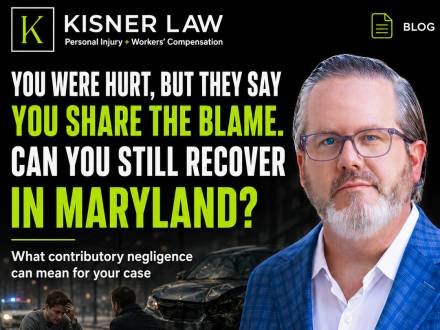
I was injured in a car accident but they claim I share the blame can I still recover in Maryland—this is the question that often surfaces right after the shock of a pedestrian or bicycle collision begins to settle. In the moment after impact, most people are focused on pain, treatment, and simply understanding what happened. But very quickly, another concern takes over: Will I be blamed for this too?
In Maryland, this fear is not unfounded. The state’s fault rules are unusually strict, and even a small suggestion that you "might have contributed" to the accident can change everything about your case. For pedestrians and cyclists, this creates a deeply unfair feeling situation—being injured first, then questioned second.
What many people don’t realize is that these cases are not decided only by what happened on the road. They are often shaped later by interpretations, assumptions, and how the story is reconstructed through reports, insurance reviews, and selective evidence. A seldom-discussed reality is that small details—like where you were standing, how fast a driver claims they were going, or whether a crosswalk signal was visible—can become the deciding factor in whether compensation is allowed at all.
This article breaks down how Maryland actually treats shared blame, why insurance companies focus heavily on it, and what it really means for your ability to recover after a serious injury.
Core Problem
The Real Issue Is Not the Crash—It’s How Fault Gets Redefined Afterward
Most people think the main problem after a pedestrian or bicycle accident is proving that the driver caused the injury. But in Maryland, that is only the starting point. The real issue begins when fault is reinterpreted after the fact—often in ways that feel unexpected and unfair.
When someone says, "I was injured in a car accident but they claim I share the blame can I still recover in Maryland," they are usually reacting to a second version of the event being built around them. This version is not based only on what they remember, but on selective details pulled from reports, witness accounts, and insurance analysis.
Why Your Own Experience Often Feels "Wrong" Legally
Pedestrians and cyclists naturally rely on their lived experience: I was hit while crossing, I had the right of way, I was careful.
But Maryland law does not decide cases based on personal certainty. It focuses on whether any action can be interpreted as contributing to the accident—even slightly.
This creates a blind spot. Many injured people assume that being "mostly right" is enough. In reality, the system may treat "mostly right" and "partially wrong" as the same thing when determining compensation.
The Hidden Pressure: Turning Facts Into Fault
The core pressure in these cases comes from interpretation, not just evidence. Insurance companies and defense arguments often reconstruct the moment of impact in ways that assign partial responsibility to the injured person. Even small uncertainties—like reaction time or positioning—can be framed as contributing factors.
This is where the semantic issue of shared blame in a Maryland car accident claim becomes critical. It is not just about what happened—it is about whether anything can be framed as your mistake.
Expert Insight Most People Miss
A key but overlooked dynamic is this: Maryland’s system does not weigh fault on a scale—it uses a threshold. Even minimal assigned fault can completely block recovery, rather than simply reducing compensation. This creates a high-stakes environment where small narrative shifts in the case can decide everything.
For pedestrians and cyclists, this means the real battle is not just proving injury—it is preventing any version of the story that assigns them responsibility.
Hidden Dynamic or Overlooked Factor
The First 48 Hours Often Decide How Fault Is Framed
One of the least discussed realities in Maryland accident cases is that fault is not just determined by what happened—it is heavily shaped by what gets recorded first. This early phase, often the first 24 to 72 hours after a crash, quietly influences how the entire story will later be interpreted.
For someone thinking, "I was injured in a car accident but they claim I share the blame can I still recover in Maryland," this timing issue is critical. The concern is not only about evidence, but about how quickly interpretations of that evidence begin to form.
Why Timing Matters More Than Memory
Human memory is fluid right after a traumatic event. Details may be unclear, emotional, or incomplete. But during this same period, insurance companies, police reports, and witness statements begin locking in a version of events that can become very difficult to challenge later.
A major hidden factor is that early statements often carry more weight than later clarifications. Even small comments like "I didn’t see the car until the last second" can be used to suggest partial responsibility, even if the full context tells a different story.
This is why the semantic concern of shared blame after a pedestrian accident in Maryland is often shaped before most injured people even realize they are in a legal dispute.
How Pedestrians and Cyclists Are Uniquely Exposed
Pedestrians and cyclists face a specific disadvantage: their movement is harder to reconstruct objectively compared to vehicles. Unlike drivers, they usually do not have dashcams, onboard data, or structured records of their actions. This makes early interpretations—especially from drivers or insurers—far more influential.
According to the AAA Foundation for Traffic Safety, many crash reconstructions rely heavily on early reports and environmental assumptions, especially when physical data is limited.
Source: https://aaafoundation.org
The Hidden Mechanism Most People Miss
The overlooked dynamic is this: once a preliminary fault narrative forms, later evidence is often interpreted through that lens instead of replacing it. In practice, this means the first version of the story can quietly become the "default truth," even before all facts are fully examined.
For injured pedestrians and cyclists, this creates a narrow window where timing is just as important as evidence itself
Stakes and Consequences
When "Shared Blame" Becomes Financially Devastating
If the allegation that you share fault is not properly challenged or understood, the consequences in Maryland can be severe. For someone thinking, "I was injured in a car accident but they claim I share the blame can I still recover in Maryland," the most dangerous assumption is believing that partial injury automatically leads to partial compensation.
In reality, even a small shift in how responsibility is assigned can completely erase financial recovery.
Financial Consequences: One Finding Can Eliminate Everything
If you are found even slightly responsible, medical bills, rehabilitation costs, and lost income may not be covered at all. Imagine a cyclist who cannot work for three months due to a leg injury. If the insurer successfully argues shared blame, those lost wages and hospital bills may become entirely your responsibility.
For many pedestrians, this creates immediate pressure—credit card debt, delayed rent payments, and reliance on family support that was never planned.
Legal Consequences: The "All-or-Nothing" Risk
Maryland’s approach creates a strict outcome structure. There is no middle ground where blame is split fairly. A pedestrian accident shared fault Maryland claim can go from strong to completely denied based on small details like crossing position or timing.
This makes early decisions—what you say, how you describe the incident, and what evidence is preserved—legally significant in ways most people do not anticipate.
Emotional Consequences: Feeling Blamed While Injured
One of the most damaging effects is psychological. Many injured pedestrians and cyclists feel as if they are being blamed for something they are already suffering from. This can lead to hesitation, frustration, and even withdrawal from the claims process.
Some people stop pursuing compensation altogether because the process feels like a second injury—this time emotional rather than physical.
Long-Term Consequences: The Cost of Delay or Misunderstanding
Delays or mistakes in handling shared blame issues often lead to permanent financial strain. Medical recovery may continue for months or years, but compensation opportunities do not remain open indefinitely. The result is a long-term burden carried silently—unpaid medical debt and reduced quality of life.
In short, misunderstanding how shared fault works in Maryland does not just affect a claim—it reshapes your financial and personal future.
Framework or Guidance Path
A Clear Decision Framework for Shared Fault Cases in Maryland
If you are asking, "I was injured in a car accident but they claim I share the blame can I still recover in Maryland," you need more than reassurance—you need a structured way to evaluate your situation. Maryland’s system is unforgiving, so clarity and sequence matter more than guesswork.
This framework helps you think in stages, not emotions.
Step 1: Secure the "Unfiltered Facts" Immediately
Start by collecting everything that exists outside interpretation:
- Photos of the scene (before anything is moved, if possible)
- Witness names and contact details
- Any video footage (traffic cameras, doorbells, dashcams)
- Your own written timeline within 24 hours
Why it matters: Early records prevent others from rewriting the story later.
Step 2: Identify Where Fault Might Be "Shifted"
Ask a simple question: What detail could someone use to suggest I contributed to the accident?
For example:
- Crossing outside a marked crosswalk
- Limited visibility at the time of impact
- Speed or direction assumptions about movement
This step helps you anticipate how shared blame in a Maryland pedestrian accident claim may be constructed.
Why it matters: You cannot respond to arguments you never saw coming.
Step 3: Separate Facts From Interpretation
Divide your information into two categories:
- Facts: What can be proven (photos, timestamps, physical damage)
- Interpretations: What others claim happened
Most disputes in Maryland are won or lost in this gap.
Step 4: Avoid Early Assumptions and Casual Statements
Do not casually explain or "fill in gaps" when speaking to insurers. Small, uncertain phrases can later be reframed as admissions of fault.
Why it matters: In contributory negligence systems, even minor perceived fault can affect recovery.
Step 5: Compare Your Case Against Objective Standards
Review whether your actions were consistent with normal pedestrian or cyclist behavior under traffic rules. The National Highway Traffic Safety Administration (NHTSA) provides general safety behavior guidelines that help clarify expected road conduct.
Source: https://www.nhtsa.gov/road-safety
Why it matters: Objective standards help separate perception from legal risk.
Final Principle: Control the Narrative Early
In Maryland, timing and framing are as important as facts. The earlier you structure your understanding, the harder it is for a "shared blame" narrative to take hold.
Strong Outcome Looks Like
What Success Actually Looks Like After a Maryland Shared Fault Claim
For someone thinking, "I was injured in a car accident but they claim I share the blame can I still recover in Maryland," a strong outcome is not just about winning a settlement—it is about restoring stability, control, and predictability after a disruptive event.
In the best-case scenario, your case is built early with clear facts, consistent evidence, and a well-documented timeline. This prevents the "shared blame" narrative from gaining traction in the first place. As a result, responsibility remains correctly placed on the driver, and your recovery is not reduced or denied due to assumptions.
Strong Outcome: Stability, Clarity, and Protection
A strong outcome typically looks like this:
- Financial stability: Medical expenses, rehabilitation costs, and lost wages are covered without long-term debt.
- Clarity and control: You understand what is happening at each stage instead of reacting to surprise accusations of fault.
- Time saved: Fewer delays, fewer disputes, and faster resolution because evidence is organized early.
- Emotional relief: You are not constantly defending your actions or questioning whether you will be unfairly blamed.
- Long-term protection: Your financial future is not derailed by unpaid medical bills or reduced earning ability.
This is the difference between a managed recovery and a prolonged legal struggle.
Weak Outcome: Confusion, Delay, and Financial Strain
In contrast, a weak outcome often follows a different pattern:
- The pedestrian accident shared fault Maryland argument is accepted or not effectively challenged.
- Medical bills accumulate without compensation.
- Insurance negotiations drag on with repeated delays.
- Stress increases as uncertainty replaces clarity.
- The injured person may settle early for far less than the actual cost of recovery.
This often leads to long-term financial pressure that extends far beyond the accident itself.
Why Preparation Changes Everything
The difference between strong and weak outcomes is rarely luck. It is usually timing and preparation. Early evidence collection, careful communication, and structured documentation reduce the chances of fault being misinterpreted.
According to the U.S. Department of Transportation, early reporting and accurate documentation of roadway incidents significantly improve investigative accuracy and outcome reliability in traffic-related cases.
Source: https://www.transportation.gov
The Future State You Are Really Seeking
The real goal is not just compensation—it is peace of mind. A strong outcome allows you to move forward without financial instability, constant doubt, or fear that a single allegation of shared blame will erase your recovery.
FAQs
1. If I was injured in a car accident but they claim I share the blame, can I still recover in Maryland?
Yes, but it depends on whether any fault can be assigned to you. Maryland follows a strict rule where even a small amount of responsibility may prevent recovery. This is why these cases are highly sensitive to how the accident is interpreted. The key issue is not just what happened, but how your actions are framed afterward.
2. What does it really mean when insurance says I share blame in a Maryland accident claim?
It usually means the insurer believes you may have contributed in some way to the accident. This could include timing, visibility, or movement before impact. Even if you feel the driver was clearly at fault, they may still try to assign partial responsibility to reduce or deny compensation.
3. Can a pedestrian still recover if they were partially at fault in Maryland?
In many cases, recovery becomes very difficult if any fault is assigned to the pedestrian. Even minor contributions to the accident can block compensation entirely. This is why pedestrian cases require careful attention to detail and early evidence protection.
4. What happens if I say the wrong thing after a bicycle accident in Maryland?
Early statements can be used later to suggest shared responsibility. Even casual comments like "I didn’t see the car" may be interpreted as contributing fault. This can affect how your entire case is evaluated, even if your statement was incomplete or taken out of context.
5. How do I know if I’m being unfairly blamed after a car accident in Maryland?
A common sign is when the story suddenly shifts focus from what the driver did to what you "might have done wrong." If questions center on your movement, timing, or visibility rather than the impact itself, shared blame is likely being explored.
6. Does waiting too long hurt my ability to recover if I share blame is alleged?
Yes, delays can make it harder to preserve evidence that supports your version of events. Over time, witnesses become harder to reach, and physical evidence may be lost. In Maryland, where fault rules are strict, timing can significantly affect the strength of your claim.
7. Why do insurance companies focus so much on shared fault in Maryland cases?
Because even small amounts of alleged fault can eliminate compensation entirely. This gives insurers a strong incentive to find any detail that suggests partial responsibility. It is less about blame in a moral sense and more about legal leverage.
8. Can I still recover medical expenses if I was partly responsible in the accident?
In Maryland, medical recovery is tied to whether you are found at fault at all. If shared blame is established, recovery may be reduced to zero. This makes the fault determination process extremely important in injury cases.
9. What mistakes make shared blame more likely in a Maryland injury claim?
Common mistakes include giving unclear statements, failing to document the scene, or assuming the situation is obvious. Small inconsistencies can be used to argue that you contributed to the accident. Careful documentation and consistency are critical.
10. What should I focus on first if I was injured and blame is being questioned?
Focus on securing facts—photos, witness details, and a clear timeline of events. Avoid making assumptions or filling in gaps when you are unsure. In Maryland, protecting early evidence is one of the most important steps in preventing unfair shared blame conclusions.
Conclusion
When you are dealing with a serious injury, the question "I was injured in a car accident but they claim I share the blame can I still recover in Maryland" is not just legal—it is deeply personal. It determines whether your recovery will be supported or whether you will be left carrying the financial and emotional burden alone.
The core issue is not only what happened at the scene, but how your actions are later interpreted through Maryland’s strict fault system. Small details can shift the entire outcome, and early narratives often carry more weight than people expect. This creates a situation where timing, documentation, and clarity are just as important as the accident itself.
The real stakes are high: medical debt, lost income, emotional strain, and long-term financial instability can all follow if shared blame is unfairly assigned or not properly challenged.
You are essentially standing at a fork in the road. One path leads to uncertainty—where decisions are delayed, assumptions go unchallenged, and the outcome is shaped without your input. The other path leads to clarity—where the facts are organized early, risks are understood, and your position is protected with informed strategy.
What you choose next can significantly influence your recovery and your future stability.
If you are facing this situation right now and unsure how shared blame may affect your claim, it is important to get clear answers before making decisions that cannot be undone. A confidential conversation can help you understand your position, identify risks early, and move forward with a more informed and protected approach based on your specific circumstances.
Kisner Law Scholarship Program


Kisner Law is Committed to Bettering Your Future.
Please complete the form below or contact us at 240-459-0097 for a free consultation.
 The use of the Internet or this form for communication with the firm or any individual member of the firm does not establish an attorney-client relationship. Confidential or time-sensitive information should not be sent through this form.
I have read and understand the Disclaimer and Privacy Policy.








Free Consultations 240-459-0097
From our office in Hyattsville, Maryland, Kisner Law represents injury victims and their families throughout the Anne Arundel, Montgomery County, and Prince George's County areas, including, but not limited to Annapolis, Beltsville, Bowie, College Park, Crofton, Greenbelt, Landover, Lanham, Laurel, Largo, Mount Rainier, Riverdale Park, Silver Spring, Takoma Park, and Upper Marlboro. We also serve clients across the bordering counties as well as those in Washington, D.C.
Results listed are not a guarantee or indication of future case results.
Kisner Law
8401 Corporate Drive, Suite 650, Hyattsville, MD 20785
240-459-0097



Follow us on Social Media: