


- Home
- About
- Personal Injury
- Car Accidents
- Truck Accidents
- Motorcycle Accidents
- Pedestrian Accidents
- Defective Products
- Premises Liability
- Catastrophic Injuries
- Medical Malpractice
- Nursing Home Negligence
- Sexual Abuse
- Educational Abuse
- Wrongful Death
- Scooter Accidents
- Underinsured Motorist Accidents
- Uninsured Motorist Accidents
- Workers’ Compensation
- Case Results
- Scholarship
- Blog
- Contact
How a Rideshare Passenger's Injury Settlement Is Really Calculated in Maryland: The Numbers Insurers Hope You Never Run
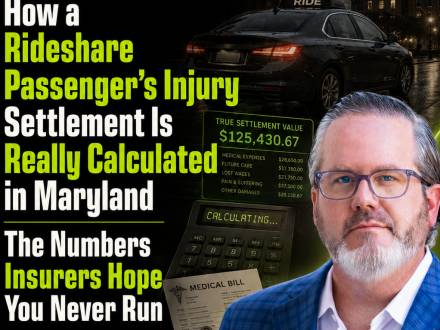
If you’re trying to understand how is my car accident settlement amount calculated in Maryland, especially after being injured as a rideshare passenger in an Uber or Lyft, you’re likely already feeling the pressure of uncertainty. Medical bills start arriving before you’ve even finished treatment. Insurance adjusters begin asking questions that sound simple but carry hidden weight. And somewhere in the middle of it all, you’re expected to make decisions that could affect your financial recovery for years.
The truth is, most people assume there is a straightforward formula behind settlement numbers. There isn’t. In rideshare cases, the calculation is shaped by overlapping insurance policies, timing of medical care, and how your injuries are documented from day one. These details matter far more than most passengers realize.
What’s rarely explained—until it’s too late—is that insurers don’t just evaluate what happened to you. They evaluate how your case looks on paper in real time. Small gaps in treatment, delayed reporting, or unclear medical records can quietly reduce what your claim is considered "worth."
This article breaks down those hidden layers in plain language. You’ll see how Maryland rideshare injury settlements are actually built, what most passengers overlook in the early stages, and why the numbers often shift long before any formal negotiation begins. The goal is simple: give you clarity before decisions are made under pressure.
The Core Problem: You’re Not Dealing With One Claim, You’re Dealing With a Shifting System
The real issue most passengers miss
The surface question—how is my car accident settlement amount calculated in Maryland—sounds like it should have a clear formula. Add medical bills, lost wages, pain and suffering, and you get a number. That assumption is where most rideshare passengers get misled.
The deeper reality is this: your settlement is not calculated once. It is continuously shaped by a system that shifts depending on insurance layers, timing, and how your injury story develops over time.
In Uber or Lyft accidents, you are not dealing with a single insurer making one decision. You are dealing with a chain of coverage that activates differently depending on whether the driver was offline, logged into the app, or carrying you as a passenger. Each stage changes who pays—and how much they are willing to recognize your claim is worth.
Why passengers misjudge settlement value
Most injured passengers assume:
- The biggest number is based on hospital bills
- The insurance company will "add things up fairly"
- The process is mostly mathematical
But in reality, the calculation is shaped by interpretation, not arithmetic.
A claim for Maryland rideshare injury compensation is evaluated through documentation, timing, and perceived credibility. Two passengers with identical injuries can receive very different outcomes simply because one sought treatment immediately and consistently, while the other waited a few days or missed follow-ups.
Expert insight most people overlook
One of the most underestimated dynamics is this: insurance companies don’t wait for the full picture—they build a valuation early, often within days of the crash. That early internal valuation becomes the anchor point for everything that follows.
If your medical treatment, liability clarity, or documentation is incomplete at that stage, your settlement range may already be lowered before negotiations truly begin.
Why this matters right now
This is where pressure builds for rideshare passengers. You’re injured, unsure, and already being contacted. Without realizing it, every early decision—what you say, when you seek treatment, how you describe pain—feeds into how your claim is initially categorized.
Understanding this system is the first step to preventing a low-value outcome.
The Hidden Timing Trap That Quietly Lowers Settlement Value
Early valuation doesn’t stay flexible—it quietly "freezes"
One of the least discussed realities behind how is my car accident settlement amount calculated in Maryland is that your claim is often valued before your recovery is even complete. This creates a timing problem most rideshare passengers never see coming.
After an Uber or Lyft crash, insurers don’t wait for your full medical picture. Instead, they create an early internal estimate based on initial reports, emergency records, and the first wave of documentation. That estimate becomes a reference point—even if your condition later worsens.
Why timing matters more than most passengers realize
Here’s how the system quietly works:
- Day 1–7: Insurer collects crash data and initial injury reports
- Early phase: A preliminary "claim value range" is assigned internally
- Weeks later: Medical updates arrive, but they don’t fully reset the earlier valuation
- Negotiation stage: Adjustments happen, but they are anchored to the original figure
This means your case is not recalculated from scratch as new information appears. Instead, it is adjusted from an early baseline.
The overlooked misconception
Many passengers believe that continued treatment automatically increases settlement value. But the hidden dynamic is more complicated.
A common pattern in Maryland rideshare injury compensation cases is that insurers treat delays, gaps in treatment, or missing documentation as confirmation that early assumptions were correct. In other words, silence in the medical timeline can be interpreted as "stability," even when you are still in pain.
This is why two nearly identical injury cases can diverge significantly in value—not because of the injury itself, but because of how consistently the injury is documented over time.
Why this matters in rideshare claims specifically
Rideshare cases intensify this timing issue because multiple insurers and liability phases are involved. Each layer reacts to the earliest available snapshot of your condition, not the evolving reality.
To understand how these systems interact, the National Highway Traffic Safety Administration (NHTSA) highlights how crash injury reporting timelines influence outcomes and safety assessments across transportation systems:
National Highway Traffic Safety Administration – Crash Data and Injury Reporting
The key takeaway
The real risk is not just injury—it is early narrative formation. Once that narrative is set, every later update is filtered through it, not treated as a completely new evaluation.
What’s Really at Stake When the Settlement Is Misunderstood
Financial consequences: small mistakes, long-term losses
When people search how is my car accident settlement amount calculated in Maryland, they’re usually trying to avoid being underpaid. But the real financial risk in rideshare injury cases is not just a low offer—it’s accepting an incomplete valuation without realizing what was left out.
For example, a passenger injured in an Uber crash may receive an early offer that covers ER bills and a few days of lost income. It can feel reasonable in the moment. But if ongoing physiotherapy, delayed symptoms (like back or neck pain), or reduced work capacity appear later, those costs are often not included unless they were properly documented early.
The result: out-of-pocket medical expenses and income loss that were never accounted for in the final number.
Legal consequences: weakened leverage without realizing it
A less obvious risk is how quickly your position can weaken without formal legal awareness. In many Maryland rideshare injury compensation claims, insurers interpret early acceptance of partial payment or inconsistent treatment as agreement with their valuation range.
This doesn’t just reduce negotiation power—it can narrow the entire framework of what they are willing to consider later.
Once that perception is set, it becomes harder to argue for full compensation even if your condition worsens.
Emotional consequences: pressure disguised as progress
Many rideshare passengers feel relief when any offer arrives. After days of stress, uncertainty, and pain, a settlement check can feel like closure.
But that emotional relief can be misleading. If the compensation does not reflect the full extent of the injury, the emotional cost shifts forward—frustration, regret, and the feeling of being "stuck with the consequences."
This is especially common for working professionals or parents who cannot afford prolonged disruption and accept early resolution just to regain stability.
Long-term consequences: the "future-you" problem
The most serious impact appears months later. Injuries that seemed minor at first can evolve. Medical costs increase. Work capacity changes. But the settlement is already closed.
At that point, there is no adjustment mechanism for the gap between what was paid and what is still needed.
Understanding how is my car accident settlement amount calculated in Maryland is ultimately about avoiding this mismatch between early assumptions and long-term reality.
A Clear Decision Framework for Understanding and Protecting Your Settlement Value
The "5-Step Settlement Clarity Model" for Rideshare Injury Claims
If you’re trying to understand how is my car accident settlement amount calculated in Maryland, the goal is not to guess a number—it’s to follow a structured process that prevents early mistakes from reducing your final outcome. In rideshare cases, clarity comes from sequence, not speed.
Below is a practical framework that reflects how strong Maryland rideshare injury compensation claims are actually built.
Step 1: Lock in medical documentation immediately
Seek consistent medical care and follow-up treatment without gaps.
Why it matters:
Insurers rely heavily on early medical records to define injury severity. Missing or delayed documentation can lower perceived seriousness.
What to avoid:
- Waiting days or weeks to see a doctor
- Skipping follow-up appointments when symptoms persist
Step 2: Establish a complete accident timeline
Document what happened, when symptoms began, and how they evolved.
Why it matters:
Settlement calculations depend on whether your injury story is consistent and traceable.
What to avoid:
- Changing descriptions of pain or timing
- Informal or inconsistent reporting to insurers
Step 3: Understand insurance layers before engaging deeply
Rideshare claims involve multiple coverage phases (driver, app active, passenger onboard).
Why it matters:
Knowing which coverage applies helps you understand potential settlement ceilings early.
What to avoid:
- Assuming only one insurance policy is responsible
- Accepting early interpretations without verification
Step 4: Track all financial and life impact losses
This includes lost wages, reduced working capacity, transportation costs, and ongoing care.
Why it matters:
These damages directly shape settlement valuation beyond medical bills.
What to avoid:
- Focusing only on hospital expenses
- Ignoring delayed or indirect financial effects
Step 5: Delay final decisions until recovery stabilizes
Do not finalize settlement discussions until the medical picture is clearer.
Why it matters:
Early closure often locks in incomplete compensation.
What to avoid:
- Pressure-driven acceptance of early offers
- Treating initial numbers as final
Authority Insight for Context
The Centers for Disease Control and Prevention (CDC) highlights how injury outcomes evolve over time and why early-stage assessments often underestimate long-term impact:
CDC – Injury Prevention & Control
Key takeaway
The calculation behind how is my car accident settlement amount calculated in Maryland is not a single formula—it is a staged evaluation process. The more structured your approach, the less likely you are to lose value through timing, documentation gaps, or early assumptions.
Strong Settlement Outcome Actually Looks Like in a Maryland Rideshare Case
The difference between a "quick payout" and a complete resolution
A strong outcome in a rideshare injury claim is not just about receiving money—it’s about receiving a settlement that actually reflects the full reality of your injury, your disruption, and your recovery timeline. When people search how is my car accident settlement amount calculated in Maryland, what they are really trying to understand is whether they will be protected or left exposed later.
A weak outcome often looks fine at first: a fast offer, a simple payout, and the feeling that the case is "done." But months later, gaps begin to appear—ongoing physical therapy that wasn’t covered, lost income that was underestimated, or symptoms that were dismissed too early.
A strong outcome, on the other hand, is structured and complete from the beginning.
A strong outcome actually includes
Financial stability with no hidden gaps
All categories of loss are accounted for—medical treatment (current and future), lost wages, reduced earning capacity, and ongoing care needs.
Control over timing—not pressure
The claim is resolved after your medical condition stabilizes, not during early uncertainty. This prevents undervaluation caused by incomplete information.
Lower emotional load
Instead of ongoing stress about whether bills will resurface, the resolution brings closure and predictability. The passenger is no longer "waiting for the next surprise cost."
Long-term protection
A well-structured Maryland rideshare injury compensation outcome reduces the risk of future financial strain tied to the same accident.
Weak vs. strong outcomes: the real contrast
- Weak outcome: quick payment, unresolved future treatment costs, and lingering uncertainty
- Strong outcome: full valuation of injury impact, structured resolution, and long-term financial clarity
The key difference is not luck—it is whether the settlement reflects the entire timeline of harm, not just the early snapshot insurers often rely on.
Why timing and preparation change everything
Proper documentation, consistent treatment, and resisting early closure pressure directly shape whether your outcome is partial or complete. The system rewards clarity over speed, even when urgency feels overwhelming.
For context on how injury burden and recovery timelines affect long-term outcomes, the World Health Organization provides detailed global research on injury impact and recovery variability:
World Health Organization – Injuries and Violence Prevention
The future state you’re actually aiming for
A strong outcome means you are no longer questioning the fairness of your settlement. You are not revisiting medical bills months later. You are not adjusting your life around unexpected financial strain.
Instead, you have clarity, closure, and a settlement that matches the real scope of your recovery—not just the early estimate.
FAQs
1. How is my car accident settlement amount calculated in Maryland for a rideshare accident?
Your settlement is calculated based on medical expenses, lost income, pain and suffering, and the insurance coverage available in your specific rideshare situation. In Maryland rideshare cases, the calculation also depends on which insurance layer applies at the time of the crash. It is not a fixed formula, and timing can significantly affect the final value. Early documentation and consistent treatment often increase accuracy in valuation.
2. What factors most affect how my car accident settlement amount is calculated in Maryland?
The biggest factors include injury severity, length of medical treatment, fault determination, and insurance policy limits. In rideshare accidents, additional layers like Uber or Lyft commercial coverage can also impact the result. Even small details like treatment delays or inconsistent reporting can reduce the evaluated amount. Each factor contributes to how insurers assign value to your claim.
3. Why do rideshare passengers sometimes get lower settlements than expected in Maryland?
Many passengers underestimate how quickly insurers evaluate claims after an accident. If early medical records are incomplete or symptoms are not clearly documented, insurers may assign a lower baseline value. Another common issue is accepting early offers before the full extent of injuries is known. This often results in compensation that does not match long-term needs.
4. Does waiting too long to file a claim affect my settlement in Maryland?
Yes, delays can negatively impact how your claim is viewed. If too much time passes, insurers may argue that injuries are less serious or unrelated to the accident. This can reduce the perceived strength of your case. Acting early helps preserve evidence and strengthens your position in negotiations.
5. How does insurance coverage affect my car accident settlement amount in Maryland?
Insurance coverage determines the maximum available compensation. In rideshare accidents, coverage may shift depending on whether the driver was offline, online, or carrying a passenger. Each phase has different policy limits. Understanding this structure is essential to estimating realistic settlement outcomes.
6. What mistakes reduce a rideshare injury settlement in Maryland?
Common mistakes include delaying medical treatment, missing follow-ups, giving inconsistent statements, and accepting early settlement offers. These actions can weaken the perceived severity or credibility of your claim. Even small gaps in documentation can lead to reduced compensation. Avoiding these mistakes helps maintain the strength of your case.
7. How long does it take to determine a fair settlement in Maryland car accident cases?
The timeline varies depending on injury severity and treatment duration. Most fair evaluations only happen after medical treatment stabilizes. Rideshare cases can take longer because multiple insurance layers must be reviewed. Rushing the process often leads to incomplete settlement calculations.
8. Can emotional stress or trauma affect my settlement calculation in Maryland?
Yes, emotional distress is often considered under pain and suffering damages. However, it must be documented through consistent reporting or treatment records. If emotional impact is not clearly recorded, it may not be fully reflected in the settlement. This is why comprehensive documentation is important.
9. What should I avoid doing when trying to calculate my car accident settlement amount in Maryland?
Avoid relying on early estimates or assuming there is a fixed payout formula. Do not ignore medical advice or delay treatment, as this can weaken your claim. Also avoid discussing your case casually with insurance adjusters without understanding the implications. Careful documentation and patience lead to more accurate outcomes.
10. How can I make sure my rideshare settlement reflects the full value of my injuries?
The key is consistency in medical treatment, clear documentation of symptoms, and understanding how insurance layers affect valuation. A strong settlement reflects the full timeline of your injury, not just early reports. Avoid rushing into decisions before your condition stabilizes. This approach ensures your compensation aligns more closely with your actual losses.
Conclusion
Understanding how is my car accident settlement amount calculated in Maryland is ultimately about seeing beyond the surface numbers. A rideshare injury claim is not evaluated through a simple formula. It is shaped by timing, documentation, insurance layers, and how your injury is recorded in the early stages of the process.
The hidden dynamic is that settlement value often begins forming long before most passengers realize it. Early medical records, initial reports, and first impressions can quietly influence the direction of your entire claim. That is why small delays, incomplete treatment, or rushed decisions can have long-term financial consequences that are difficult to reverse later.
For a rideshare passenger, the difference between staying uncertain and moving forward with clarity is significant. Uncertainty often leads to early assumptions, missed details, and undervalued outcomes. Clarity, on the other hand, allows you to recognize what your claim is truly built on—and avoid decisions that limit your recovery.
When you understand the structure behind your settlement, you are no longer reacting to pressure. You are making informed choices based on how the system actually works, not how it appears in the moment.
If you are dealing with a rideshare injury and want to better understand what your situation may truly involve, consider reaching out for a confidential conversation. Speaking early can help you avoid common mistakes, protect the value of your claim, and make decisions with greater clarity and confidence as you move forward.
Kisner Law Scholarship Program


Kisner Law is Committed to Bettering Your Future.
Please complete the form below or contact us at 240-459-0097 for a free consultation.
 The use of the Internet or this form for communication with the firm or any individual member of the firm does not establish an attorney-client relationship. Confidential or time-sensitive information should not be sent through this form.
I have read and understand the Disclaimer and Privacy Policy.










Free Consultations 240-459-0097
From our office in Hyattsville, Maryland, Kisner Law represents injury victims and their families throughout the Anne Arundel, Montgomery County, and Prince George's County areas, including, but not limited to Annapolis, Beltsville, Bowie, College Park, Crofton, Greenbelt, Landover, Lanham, Laurel, Largo, Mount Rainier, Riverdale Park, Silver Spring, Takoma Park, and Upper Marlboro. We also serve clients across the bordering counties as well as those in Washington, D.C.
Results listed are not a guarantee or indication of future case results.
Kisner Law
8401 Corporate Drive, Suite 650, Hyattsville, MD 20785
240-459-0097



Follow us on Social Media: