


- Home
- About
- Personal Injury
- Car Accidents
- Truck Accidents
- Motorcycle Accidents
- Pedestrian Accidents
- Defective Products
- Premises Liability
- Catastrophic Injuries
- Medical Malpractice
- Nursing Home Negligence
- Sexual Abuse
- Educational Abuse
- Wrongful Death
- Scooter Accidents
- Underinsured Motorist Accidents
- Uninsured Motorist Accidents
- Workers’ Compensation
- Case Results
- Scholarship
- Blog
- Contact
Do Pedestrians Always Have the Right of Way in Maryland? The Myth That Could Cost You Everything
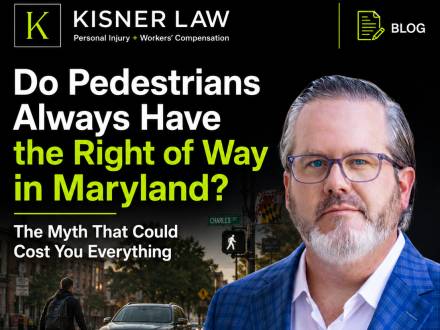
I was struck while walking do pedestrians have the right of way in Maryland" is often the first question people ask in the confusing hours after a pedestrian or cycling accident. In that moment, you are not thinking about legal theory—you are dealing with pain, shock, hospital visits, missed work, and the fear that the accident might somehow be blamed on you.
Most people assume the answer is simple: pedestrians always have the right of way. That belief feels logical, especially when you are the one who was hit. But in Maryland, the reality is more complicated—and misunderstanding it can directly affect your ability to recover compensation or even prove what really happened.
The urgent problem is this: right-of-way rules do not automatically decide fault. Instead, Maryland law looks at behavior, timing, signals, and whether each person acted reasonably in that exact moment. That means even small details—like where you were crossing or how visible you were—can suddenly matter in a big way.
Seldom discussed, but critical, is how insurance companies often focus less on who was "right" and more on whether they can argue shared responsibility to reduce payouts. This is where many injured pedestrians and cyclists lose ground without realizing it.
This article breaks down what actually matters under Maryland law, what most people misunderstand after a crash, and how to make sense of your situation when everything feels uncertain and fast-moving.
The Core Problem: Why the "Right of Way" Question Is Misleading
The real issue is not right of way—it’s misunderstanding how fault is decided
When someone searches "I was struck while walking do pedestrians have the right of way in Maryland," they are usually trying to answer one emotional question: "Was I in the wrong?" That instinct is understandable after a crash, especially when injuries, insurance calls, and confusion start piling up at the same time.
But the core problem is that most people assume traffic rules automatically decide legal responsibility. They don’t.
In Maryland, "right of way" is only one piece of a much larger picture. What actually determines the outcome is whether each person acted reasonably in that exact moment, not just whether a rule technically gave someone priority.
Why this misunderstanding puts injured pedestrians at risk
Pedestrians and cyclists often carry a hidden assumption: if I was hit, the driver must be at fault.
This belief creates a dangerous blind spot. After a crash, even small details can shift how responsibility is interpreted:
- Whether you stepped into the road suddenly or within a crosswalk
- Whether the driver had time to react
- Whether visibility was clear or limited
- Whether signals or traffic flow were being followed correctly
None of these factors feel important in the moment of impact—but legally, they become central.
This is where many injured people lose control of their own narrative. They focus on the injury (which is real and immediate), while the legal system focuses on behavior and timing.
Expert insight most people miss
A critical but seldom-discussed dynamic in Maryland pedestrian cases is this: fault is not assigned based on who had the right of way, but on whether either party can be shown to have acted even slightly carelessly.
This matters because Maryland applies a strict rule that can completely block recovery if the injured person is found even minimally responsible. As a result, insurance companies often reconstruct the event frame-by-frame, looking for the smallest detail that can shift interpretation.
Why this matters right now
In the hours and days after a crash, your version of events is still forming—memories are unclear, and pressure from insurers can begin quickly. If you rely only on the assumption of "right of way," you may unintentionally overlook facts that matter far more in determining what happens next.
Understanding this gap early is what protects your ability to make informed decisions when everything feels uncertain.
The Hidden Timing Trap That Shapes Your Entire Case
Why the first 24–72 hours matter more than most people realize
After a pedestrian or cycling accident, most people are focused on recovery, not paperwork or legal strategy. But one of the least discussed realities in Maryland injury cases is this: the timeline immediately after the crash can quietly shape how your entire situation is interpreted later.
If you are thinking "I was struck while walking do pedestrians have the right of way in Maryland," you are likely still in the early phase where insurance companies begin building their version of events—often before you even understand the full extent of your injuries.
During this period, adjusters may contact you quickly, asking for statements or clarification. It feels routine, but it is not neutral. Early descriptions—especially when pain, shock, or medication are involved—can later be used to question consistency, memory, or even credibility.
The overlooked system dynamic: "narrative locking"
One rarely discussed factor in pedestrian and cyclist cases is something legal professionals often see but the public does not: the early version of events tends to become the "default narrative" in the claim file.
Once that narrative is recorded—through a brief statement, police summary, or initial report—it can become surprisingly influential. Even if later evidence shows a clearer or more accurate picture, insurers may still rely heavily on the earliest account because it appears "contemporaneous."
This is especially important in Maryland because fault disputes are not just about what happened—they are about whether any small inconsistency can suggest shared responsibility.
Why this creates real pressure for injured pedestrians and cyclists
For someone injured while walking or cycling, the pressure is subtle but real:
- You may feel rushed to "explain" what happened
- You may not yet understand your injuries fully
- You may assume cooperation speeds things up
- You may not realize your words are being analyzed for fault allocation
This creates a mismatch between intention and consequence: you are trying to be helpful, while the system is quietly evaluating liability risk.
Expert insight: timing is treated as evidence
The Insurance Institute for Highway Safety highlights that pedestrian crash outcomes are influenced by complex situational and behavioral factors, including reaction timing and visibility conditions, not just traffic rules alone.
https://www.iihs.org/topics/pedestrians
This matters because timing is not just about the crash itself—it includes when and how you describe it afterward.
Why this matters for your situation right now
If you are still asking whether pedestrians have the right of way in Maryland, you are likely still in the phase where early decisions carry disproportionate weight. Understanding this timing dynamic helps you avoid unintentionally locking in a version of events that does not fully reflect what actually happened.
The Stakes and Consequences: What’s Really on the Line After a Pedestrian Crash
Financial consequences: when "minor fault" becomes major loss
If you are asking "I was struck while walking do pedestrians have the right of way in Maryland," the biggest hidden risk is assuming that injury automatically leads to compensation. In reality, even a small allegation of shared fault can change everything.
In Maryland, if an insurance company argues that you were even slightly responsible—by stepping outside a crosswalk, crossing at the wrong time, or being "hard to see"—your claim can be reduced or completely denied. For many injured pedestrians and cyclists, this means:
- Medical bills coming out of pocket
- Lost wages during recovery with no replacement income
- Physical therapy or follow-up care delayed or skipped due to cost
For someone living on a monthly salary or supporting a family, even a short gap in income can quickly turn into financial instability.
Legal consequences: how small details reshape the entire case
Legally, the issue is not just "who hit whom," but whether your actions can be framed as contributing to the incident. This is where many people misunderstand pedestrian right-of-way Maryland rules—they assume protection equals automatic liability for the driver.
But if fault is contested, insurers may focus on timing, visibility, or movement patterns to argue shared responsibility. That shift can completely alter the outcome of a claim, even when injuries are serious.
Emotional consequences: blame, confusion, and self-doubt
One of the most overlooked impacts is emotional. Many injured pedestrians begin replaying the incident in their mind, asking:
- "Should I have waited longer?"
- "Did I step out too soon?"
- "Will they say it was my fault?"
This internal pressure is amplified when insurance companies question your account. It creates a sense of doubt at exactly the moment you need clarity and stability.
Long-term consequences: the hidden cost of uncertainty
The long-term impact is not just financial—it is structural. Delayed or denied compensation can affect your ability to:
- Return to work at full capacity
- Access consistent medical treatment
- Rebuild financial stability after missed income
In some cases, people accept early low settlements just to resolve uncertainty, not realizing the long-term costs.
Why this matters in the decision moment
Right after a crash, everything feels urgent and unclear. But how you understand your situation in these early stages often determines whether your recovery is supported or strained for months or even years.
A Clear Decision Framework After a Pedestrian or Cycling Accident in Maryland
Step 1: Stabilize the situation before you interpret it
If you are thinking "I was struck while walking do pedestrians have the right of way in Maryland," the first mistake to avoid is trying to immediately assign blame or interpret fault while you are still in shock.
Focus first on:
- Getting medical attention (even if injuries feel minor)
- Moving to a safe location if possible
- Not engaging in detailed explanations at the scene
Why this matters: early physical and emotional shock can distort memory, and those early impressions often become part of official records later.
Step 2: Separate facts from assumptions
At this stage, your goal is not to decide who was right or wrong—it is to preserve accurate information.
Write down or record:
- Where you were crossing or riding
- Traffic signal status (if known)
- Weather and visibility conditions
- Exact sequence of events as best as you remember
This helps avoid the common trap in pedestrian right-of-way Maryland cases where assumptions replace factual clarity.
Step 3: Avoid early narrative pressure
Do not rush to give detailed statements to insurance representatives before you understand your injuries and circumstances fully.
Why this matters:
Early statements can unintentionally become the "default version" of events, even if later evidence shows a clearer picture.
The National Highway Traffic Safety Administration emphasizes that pedestrian crash analysis depends heavily on environmental and behavioral context, not just traffic rules.
https://www.nhtsa.gov/road-safety/pedestrian-safety
Step 4: Identify risk factors early
Ask yourself:
- Could visibility or timing be questioned?
- Was there any ambiguity in crossing location?
- Could a driver argue you were hard to see or unexpected?
These questions help you understand how the situation may be interpreted—not just how it felt.
Step 5: Make decisions based on clarity, not urgency
The most important rule: do not make legal or insurance decisions under pressure.
Instead:
- Gather facts
- Track medical documentation
- Wait until the full picture is clearer before agreeing to settlements or fault assumptions
Why this framework matters
In Maryland pedestrian and cyclist cases, outcomes are shaped less by the question "do pedestrians have the right of way" and more by how clearly the situation can be documented and understood.
This framework helps you move from confusion to control—step by step, without rushing into decisions that may affect your long-term recovery
Strong Outcome Actually Looks Like After a Pedestrian or Cycling Accident
Strong outcome vs. weak outcome: the real difference is control, not luck
When someone searches "I was struck while walking do pedestrians have the right of way in Maryland," what they are really hoping for is certainty—financial protection, medical support, and a sense that the situation will be handled fairly.
But outcomes in these cases are not determined by the accident alone. They are shaped by how clearly the facts are preserved, how early risks are recognized, and how well the situation is managed after the crash.
What a strong outcome looks like in real life
A strong outcome is not just "winning a claim." It looks like stability returning step by step:
- Medical treatment is properly documented and covered
- Lost income is accounted for without long-term disruption
- Insurance discussions are based on facts, not assumptions
- The injured person is not unfairly blamed for the incident
- Decisions are made with time and clarity—not pressure
In a strong outcome, the person does not feel rushed or cornered. They understand what is happening and why, even if the situation is complex.
Importantly, in Maryland pedestrian right-of-way Maryland law scenarios, strong outcomes often depend on early clarity—not reacting after narratives have already been shaped.
What a weak outcome looks like (and why it happens)
Weak outcomes usually do not come from one big mistake—they come from small, early misunderstandings:
- Accepting blame assumptions too early
- Providing incomplete or rushed statements
- Missing key evidence from the scene
- Underestimating how fault is evaluated under Maryland rules
The result is often financial strain, delayed recovery support, or reduced compensation that does not reflect the real impact of the injury.
The hidden factor that separates the two outcomes
One of the most important but least discussed differences is timing. Early documentation and careful communication often determine whether the case is evaluated as a clear incident or a disputed one.
According to the Centers for Disease Control and Prevention, pedestrian injuries remain a major source of emergency care in the United States, highlighting how frequently these situations involve complex recovery needs and long-term care considerations.
https://www.cdc.gov/transportationsafety/pedestrian_safety/index.html
The future state the reader is actually trying to reach
At its core, a strong outcome is about returning to normal life without ongoing uncertainty:
- Bills are manageable
- Recovery is supported
- Responsibility is clearly understood
- There is no lingering confusion about rights or fault
The difference between stress and stability often comes down to whether the situation was handled with structure or left to assumption.
And for anyone dealing with "I was struck while walking do pedestrians have the right of way in Maryland," that clarity becomes the foundation for every decision that follows.
FAQs
1. If I was struck while walking, do pedestrians have the right of way in Maryland?
Not always. Pedestrians have the right of way in certain places like marked crosswalks, but Maryland law does not give automatic protection in every situation. Fault depends on whether both the pedestrian and driver acted reasonably at the time of the incident. Even small details, like crossing location or signal timing, can affect the outcome.
2. If I was hit in a crosswalk, does that mean the driver is automatically at fault?
No. Even in a crosswalk, fault is not automatic. Investigators look at visibility, traffic signals, driver reaction time, and pedestrian behavior. A crosswalk helps your position, but it does not guarantee full liability on the driver.
3. How quickly should I act after a pedestrian accident in Maryland?
You should act immediately, especially in terms of medical care and documenting what happened. The first few days often shape how the incident is recorded and interpreted later. Delays can make it harder to prove key facts or clarify confusion in the event.
4. Can I lose compensation even if I was mostly not at fault?
Yes. Maryland follows a strict rule where even a small amount of fault can affect your ability to recover compensation. This is why understanding details early is critical. Many people assume "mostly not at fault" is enough, but legally it may not be.
5. What is the biggest mistake people make after asking "I was struck while walking do pedestrians have the right of way in Maryland"?
The biggest mistake is assuming the answer to right of way automatically determines legal outcome. People often delay documenting evidence or give early statements without understanding the consequences. These early decisions can later influence how responsibility is assigned.
6. Why do insurance companies question pedestrian claims?
Insurance companies often look for any detail that suggests shared responsibility. This can include timing, crossing behavior, or visibility issues. Their goal is not just to understand the incident, but to evaluate whether compensation can be reduced or denied.
7. Does it matter where I was standing or walking when I was hit?
Yes, location is extremely important. Whether you were in a crosswalk, at an intersection, or mid-block can significantly affect how the case is evaluated. Small location differences can change how right of way rules apply.
8. What should I avoid saying after a pedestrian accident?
Avoid making statements that suggest fault or uncertainty about what happened. Even casual comments can be taken out of context later. It is better to stick to basic facts until the situation is fully understood.
9. How does Maryland law treat pedestrians compared to drivers?
Maryland law expects both pedestrians and drivers to act with reasonable care. Pedestrians are not automatically protected in every situation, and drivers are not automatically blamed. Responsibility is determined based on behavior and circumstances, not assumptions.
10. What should I focus on first if I was struck while walking?
Focus first on medical care, safety, and documenting what you can remember. Legal and insurance questions come after stability is established. Trying to resolve liability too early can lead to confusion and mistakes that affect your outcome.
Conclusion
Being able to answer "I was struck while walking do pedestrians have the right of way in Maryland" is not just about understanding traffic rules—it is about understanding how responsibility is actually evaluated after an accident. The most common misunderstanding is assuming that right of way automatically determines fault. In reality, Maryland cases often turn on timing, behavior, visibility, and how each detail is interpreted after the fact.
As this article has shown, the real risk is not just the crash itself, but the hidden dynamics that follow: early statements shaping the narrative, insurance companies analyzing small details for shared responsibility, and strict fault rules that can significantly impact recovery. These factors often work quietly in the background while injured pedestrians and cyclists are focused on healing.
The stakes are high. Financial stability, access to care, and long-term recovery can all be influenced by how clearly the situation is understood and documented in the early stages. Staying in uncertainty often leads to rushed decisions and avoidable setbacks. Moving forward with clarity allows for better protection, more control, and more informed choices during a stressful time.
If you are dealing with the aftermath of a pedestrian or cycling accident and still trying to make sense of what happened, speaking early can help you avoid the most common mistakes—especially those that affect how your situation is later interpreted. A confidential conversation can give you the clarity needed to understand your position, protect your interests, and make informed decisions without unnecessary pressure or confusion.
Kisner Law Scholarship Program


Kisner Law is Committed to Bettering Your Future.
Please complete the form below or contact us at 240-459-0097 for a free consultation.
 The use of the Internet or this form for communication with the firm or any individual member of the firm does not establish an attorney-client relationship. Confidential or time-sensitive information should not be sent through this form.
I have read and understand the Disclaimer and Privacy Policy.









Free Consultations 240-459-0097
From our office in Hyattsville, Maryland, Kisner Law represents injury victims and their families throughout the Anne Arundel, Montgomery County, and Prince George's County areas, including, but not limited to Annapolis, Beltsville, Bowie, College Park, Crofton, Greenbelt, Landover, Lanham, Laurel, Largo, Mount Rainier, Riverdale Park, Silver Spring, Takoma Park, and Upper Marlboro. We also serve clients across the bordering counties as well as those in Washington, D.C.
Results listed are not a guarantee or indication of future case results.
Kisner Law
8401 Corporate Drive, Suite 650, Hyattsville, MD 20785
240-459-0097



Follow us on Social Media: