


- Home
- About
- Personal Injury
- Car Accidents
- Truck Accidents
- Motorcycle Accidents
- Pedestrian Accidents
- Defective Products
- Premises Liability
- Catastrophic Injuries
- Medical Malpractice
- Nursing Home Negligence
- Sexual Abuse
- Educational Abuse
- Wrongful Death
- Scooter Accidents
- Underinsured Motorist Accidents
- Uninsured Motorist Accidents
- Workers’ Compensation
- Case Results
- Scholarship
- Blog
- Contact
Hit by a Car in a Crosswalk in Maryland? Why You're Not Automatically in the Clear
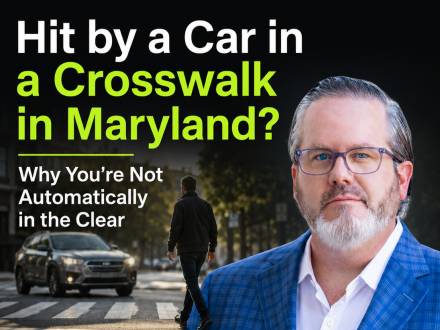
If you are thinking, "I was hit by a car in a crosswalk in Maryland who is at fault," you are likely trying to make sense of a moment that already feels overwhelming. One second you were following the rules of the road, and the next you were dealing with pain, confusion, and urgent questions about medical bills, insurance calls, and what happens next.
Most people assume a crosswalk automatically means the driver is at fault. In reality, Maryland law does not treat these situations as automatic or simple. Fault can shift depending on timing, signals, visibility, and even small details about how the crossing happened. That uncertainty often surprises pedestrians and cyclists who believed they were fully protected by the law.
What many accident victims are not told early on is this: even when you feel clearly in the right, insurance companies and investigators may reconstruct the event differently. A few seconds, a signal change, or a disputed movement can reshape the entire legal outcome.
This article breaks down those hidden realities in plain language. You will learn why crosswalk accidents are more complex than they appear, what actually determines fault in Maryland, and how these cases are evaluated behind the scenes—before decisions are ever made about compensation or liability.
The Core Problem
The real issue isn’t just "who hit whom"—it’s how fault gets reconstructed
When someone says, "I was hit by a car in a crosswalk in Maryland who is at fault," the instinct is to treat it like a simple yes-or-no question. But the real problem starts earlier: most people assume the location alone decides responsibility. In practice, it doesn’t.
What actually gets analyzed is a sequence of actions—seconds before and after impact. That means your case is not built on what you felt in the moment, but on how your movement, timing, and visibility can be interpreted later by insurers or investigators. This gap between lived experience and legal reconstruction is where most confusion begins.
Why victims misread their own situation
After a crash, pedestrians and cyclists often remember one clear truth: they were in the crosswalk and had the right to be there. But that certainty can unintentionally blind them to other details that matter legally, such as signal timing, stepping off the curb a fraction too early, or being partially outside the marked area.
This is why the keyword question—"I was hit by a car in a crosswalk in Maryland who is at fault"—does not have a fixed answer. It depends on how the event is later interpreted through evidence, not how it felt in real time.
The overlooked dynamic: "interpretation replaces intention"
One of the most misunderstood realities in Maryland pedestrian cases is this: your intention does not determine fault—your interpreted behavior does.
Even if you were cautious, if the evidence suggests you appeared to enter late, move unpredictably, or become less visible at a critical moment, the legal narrative can shift.
This is where many injured pedestrians are caught off guard. They focus on fairness. The system focuses on reconstructability.
The pressure point most people don’t anticipate
The real pressure begins after the accident, when statements, reports, and insurer questions start shaping a version of events that may not match your memory. Small inconsistencies—like timing or positioning—can take on outsized importance.
Understanding this early is crucial because it changes how you communicate, what you document, and how you protect your position before it becomes fixed in the record.
A Hidden Dynamic or Overlooked Factor
The timing problem most people never think about
When someone asks, "I was hit by a car in a crosswalk in Maryland who is at fault," they usually imagine a clear sequence: the pedestrian starts crossing, the driver fails to stop, and liability follows. But one of the least discussed realities is that these cases often turn on timing reconstruction, not just what actually happened.
After a crash, investigators and insurance companies try to rebuild the event second by second. This includes estimating vehicle speed, pedestrian walking pace, signal phase changes, and even driver reaction time. What feels like a sudden, unavoidable impact can become a debate over fractions of time.
The hidden factor: perception vs. measurable movement
A major but rarely explained issue is the gap between human perception and physical measurement. In real time, a pedestrian experiences the crossing as continuous and immediate. But in legal analysis, that same moment is broken into measurable segments: when the walk signal changed, when the driver had a "reasonable chance" to react, and when each party became visible.
This is where many injured pedestrians face unexpected challenges. Even in a marked crosswalk, insurers may argue that the driver had insufficient time to avoid impact based on reconstructed timing models.
Why Maryland cases are especially sensitive to this
Because Maryland follows a strict contributory negligence rule, even a small dispute about timing can significantly affect the outcome. If reconstruction suggests a pedestrian entered slightly late or outside a safe interval—even by seconds—it can influence how fault is assigned.
This is why two people can describe the same incident differently, yet arrive at completely different legal conclusions.
The overlooked technical layer: data and reconstruction tools
Modern investigations may also rely on vehicle data systems and traffic signal logs to reconstruct the moment of impact. These tools can sometimes contradict human memory, not because anyone is dishonest, but because they measure events in ways people do not naturally perceive.
Research from the Insurance Institute for Highway Safety highlights how driver reaction time and visibility constraints play a major role in pedestrian crash outcomes:
https://www.iihs.org/topics/pedestrians
Why this matters for your situation
If you are dealing with a crosswalk collision, the real risk is not just what happened in the moment—it is how that moment can be mathematically reinterpreted later. Understanding this early helps explain why fault is often more contested than expected, even when the pedestrian appears clearly injured and in a crosswalk.
The Stakes and Consequences
Financial consequences: small mistakes can become major losses
If you are asking, "I was hit by a car in a crosswalk in Maryland who is at fault," the underlying concern is usually financial survival after the accident. Medical bills begin immediately—ambulance transport, emergency treatment, scans, follow-ups—often before any fault is decided.
The biggest risk is not just the cost of care, but who gets blamed for the accident. If even partial fault is assigned to you under Maryland’s strict rules, compensation can be reduced or completely denied. That means lost wages, ongoing treatment, and rehabilitation costs may fall entirely on you.
A common scenario: a pedestrian returns to work too soon because income stops, only to worsen their injuries and increase long-term medical costs.
Legal consequences: how early missteps shape the entire claim
One of the most damaging mistakes is assuming the situation is automatically clear because you were in a crosswalk. In reality, early statements to insurance companies or inconsistencies in describing timing can be used later to challenge your version of events.
Even a small detail—like whether you were already crossing when the car approached—can shift how liability is interpreted. In Maryland, this matters more than in many other states because shared fault can eliminate recovery entirely.
Emotional consequences: stress that builds after the impact
Beyond physical injury, many pedestrians experience ongoing anxiety after the crash. You may replay the moment repeatedly, questioning what you did wrong or whether you could have avoided it.
This emotional strain often intensifies when insurance companies begin questioning your account. The uncertainty around crosswalk accident fault in Maryland creates a feeling of instability, where nothing feels fully resolved even weeks after the incident.
Long-term consequences: the "future-you" impact
The long-term impact often appears months later. Missed work opportunities, reduced physical ability, or ongoing pain can reshape daily life. For someone supporting a family or working physically demanding jobs, even a partial limitation can affect career stability and financial security.
What feels like a single moment—being hit in a crosswalk—can become a long-term turning point if fault is misunderstood or mishandled early
A Framework or Guidance Path
The "Crosswalk Collision Clarity Framework" (Maryland Edition)
If you are trying to understand "I was hit by a car in a crosswalk in Maryland who is at fault," the fastest way to reduce confusion is to shift from emotion-based thinking to a structured decision process. This framework is designed to help you organize what actually matters in the first days after the crash.
Step 1: Secure the immediate facts (first 24 hours)
What to do:
Write down everything you remember—time, location, signal status, direction of travel, and witness names. If possible, preserve photos or video of the scene.
Why it matters:
Memory fades quickly, but fault analysis depends heavily on early factual consistency.
What to avoid:
Do not guess or "fill in gaps" when speaking to insurers. Uncertain details can later be treated as contradictions.
Step 2: Identify right-of-way conditions
What to do:
Determine whether you were:
-
In a marked crosswalk
-
Following a pedestrian signal
-
Already mid-crossing when the vehicle approached
Why it matters:
In crosswalk accident fault Maryland cases, right-of-way is a starting point—but not the final answer.
Step 3: Preserve external evidence
What to do:
Look for traffic cameras, nearby business footage, dashcams, or witnesses.
Why it matters:
Objective evidence often overrides conflicting memories and becomes central in reconstructing timing and movement.
Step 4: Avoid early fault assumptions
What to avoid:
Do not assume:
-
"I was in the crosswalk, so I’m automatically protected"
-
"The driver must be fully at fault"
Why it matters:
Maryland’s strict fault rules mean even small disputes about behavior can significantly change outcomes.
Step 5: Focus on consistency in communication
What to do:
Keep your description of events stable across all conversations with insurers and investigators.
Why it matters:
Inconsistent statements often become the main reason claims are reduced or denied.
Authority Insight
The National Safety Council highlights that pedestrian safety outcomes depend heavily on visibility, timing, and driver reaction conditions rather than location alone:
https://www.nsc.org/road-safety
This framework helps transform a confusing situation into a structured evaluation, reducing the risk of early mistakes that can affect your claim
A Strong Outcome Looks Like
What a strong outcome actually looks like after a Maryland crosswalk crash
When someone searches "I was hit by a car in a crosswalk in Maryland who is at fault," they are rarely just asking about blame—they are trying to understand what a stable, secure outcome looks like after their life has been disrupted.
A strong outcome is not only about proving the driver made a mistake. It is about building a case where your actions are clearly understood, consistently documented, and not misinterpreted in a way that shifts responsibility onto you.
Strong outcome vs. weak outcome: what changes everything
Strong outcome (what you want):
-
Your right-of-way is clearly supported by evidence (signals, footage, witnesses)
-
The driver’s failure to yield or pay attention is well documented
-
Your statements remain consistent from day one
-
Insurance companies accept liability without prolonged dispute
-
Medical costs, lost wages, and recovery needs are properly covered
-
You regain emotional control faster because uncertainty is reduced
Weak outcome (what often happens when details are missed early):
-
Conflicting interpretations of timing or position
-
Insurers argue partial responsibility based on small details
-
Delays in compensation while fault is debated
-
Financial pressure increases due to unpaid bills
-
Emotional stress continues because the case feels "stuck"
The difference between these outcomes often has less to do with the crash itself and more to do with how quickly clarity is created afterward.
Why timing and preparation change everything
In crosswalk accident fault Maryland cases, the strongest outcomes usually come from early organization—not reaction. Preserving evidence quickly, avoiding inconsistent statements, and understanding how fault is evaluated all reduce the chance of misinterpretation later.
A strong outcome is essentially this: the facts stay intact long enough to be understood correctly.
The future state most people actually want
Beyond compensation, most injured pedestrians want something simpler: certainty and closure. They want to move through recovery without constant second-guessing or financial unpredictability.
The U.S. Department of Transportation emphasizes that pedestrian safety outcomes improve significantly when risks are identified early and behavioral patterns are understood clearly:
https://www.transportation.gov/mission/health/pedestrian-and-bicycle-safety
That same principle applies here. The more structured and consistent your case is from the beginning, the more predictable and controlled the outcome becomes.
A strong resolution is not just legal—it is practical stability returning to daily life.
FAQs — Crosswalk Accidents in Maryland
1. If I was hit in a crosswalk in Maryland, who is at fault?
If you are asking "I was hit by a car in a crosswalk in Maryland who is at fault," the answer depends on more than just where the accident happened. Fault is based on signals, timing, visibility, and whether either party acted carelessly. Even pedestrians in a crosswalk are not automatically considered free from responsibility. Each detail of the moment can shift how liability is evaluated.
2. Does being in a crosswalk guarantee the driver is at fault?
No, being in a crosswalk does not automatically make the driver fully responsible. While drivers often have a duty to yield, investigators still examine whether the pedestrian entered at the correct time or followed traffic signals. This is why crosswalk accident fault Maryland cases are rarely as straightforward as people assume.
3. What if I was hit while the pedestrian signal said "walk"?
Even if you had the "walk" signal, fault is still analyzed based on driver behavior and reaction time. However, insurers may still examine whether visibility or sudden movement played a role. The signal helps your position, but it does not automatically end the inquiry.
4. Can I still recover compensation if I was partially at fault?
In Maryland, partial fault can significantly affect your case because of strict legal rules. Even a small degree of responsibility can reduce or eliminate compensation. This is why understanding I was hit by a car in a crosswalk in Maryland who is at fault requires careful attention to detail from the start.
5. Why do insurance companies question crosswalk accidents so heavily?
Insurance companies often look for any detail that suggests shared responsibility. They may analyze timing, pedestrian movement, or visibility conditions to reduce payout exposure. This is standard practice, not a reflection of wrongdoing, but it can strongly affect outcomes.
6. What evidence is most important after a crosswalk accident?
The most important evidence includes photos of the scene, witness statements, traffic camera footage, and medical records. These help establish a clear timeline of events. The more consistent and early the documentation, the stronger your position tends to be.
7. What should I avoid saying after being hit in a crosswalk?
Avoid making uncertain statements like "I think" or guessing details about timing or speed. These can later be used to challenge your credibility. Stick to what you clearly remember, especially in early conversations with insurers.
8. How long do I have to understand or act on my legal options?
Time is important because evidence can disappear quickly, including surveillance footage and witness memory. Delays can make it harder to reconstruct what happened accurately. Acting early helps preserve clarity in crosswalk accident fault Maryland cases.
9. Why do crosswalk accidents become legally complicated even when the driver clearly hit me?
Because legal responsibility is not based only on impact. It also considers whether each person followed traffic rules and had time to react. Even clear physical contact does not automatically resolve fault.
10. What is the biggest mistake people make after a crosswalk accident?
The biggest mistake is assuming fault is obvious and not protecting early evidence or consistency in statements. Many people focus only on injury recovery and overlook how quickly the legal narrative is shaped. This can affect the final outcome even when their position seems strong.
Crosswalk Accidents Are Decided by Clarity, Not Assumptions
Being hit in a crosswalk is disorienting because it challenges something most people trust: that following the rules guarantees protection. But as this article has shown, if you are asking "I was hit by a car in a crosswalk in Maryland who is at fault," the answer is rarely automatic. It depends on timing, signals, visibility, and how the event is later reconstructed—not just how it felt in the moment.
The hidden reality is that small details can reshape the entire outcome. A few seconds, a disputed movement, or an unclear statement can shift responsibility in ways most pedestrians never anticipate. That is where uncertainty grows, and where cases often become more difficult than expected.
You now also see the contrast clearly: staying in uncertainty means relying on assumptions while others define the narrative. Moving forward with clarity means understanding how fault is evaluated and protecting your position before key details are lost or misinterpreted.
What matters most is not rushing, but acting with awareness.
If you are dealing with the aftermath of a crosswalk accident in Maryland and still unsure about fault, a confidential conversation can help you understand where you actually stand before mistakes are made that cannot be undone. Reaching out is not about pressure—it is about gaining clarity, protecting your position, and making informed decisions at a moment when uncertainty can easily become costly.
Kisner Law Scholarship Program


Kisner Law is Committed to Bettering Your Future.
Please complete the form below or contact us at 240-459-0097 for a free consultation.
 The use of the Internet or this form for communication with the firm or any individual member of the firm does not establish an attorney-client relationship. Confidential or time-sensitive information should not be sent through this form.
I have read and understand the Disclaimer and Privacy Policy.









Free Consultations 240-459-0097
From our office in Hyattsville, Maryland, Kisner Law represents injury victims and their families throughout the Anne Arundel, Montgomery County, and Prince George's County areas, including, but not limited to Annapolis, Beltsville, Bowie, College Park, Crofton, Greenbelt, Landover, Lanham, Laurel, Largo, Mount Rainier, Riverdale Park, Silver Spring, Takoma Park, and Upper Marlboro. We also serve clients across the bordering counties as well as those in Washington, D.C.
Results listed are not a guarantee or indication of future case results.
Kisner Law
8401 Corporate Drive, Suite 650, Hyattsville, MD 20785
240-459-0097



Follow us on Social Media: