


- Home
- About
- Personal Injury
- Car Accidents
- Truck Accidents
- Motorcycle Accidents
- Pedestrian Accidents
- Defective Products
- Premises Liability
- Catastrophic Injuries
- Medical Malpractice
- Nursing Home Negligence
- Sexual Abuse
- Educational Abuse
- Wrongful Death
- Scooter Accidents
- Underinsured Motorist Accidents
- Uninsured Motorist Accidents
- Workers’ Compensation
- Case Results
- Scholarship
- Blog
- Contact
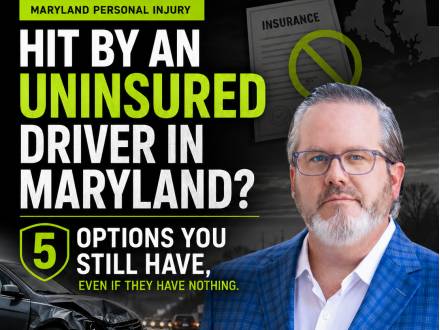
Hit by an Uninsured Driver in Maryland? 5 Options You Still Have, Even If They Have Nothing
I was hit by an uninsured driver in Maryland what are my options—this is the first question most people search the moment they realize the other driver cannot pay for the damage they caused. What follows is usually confusion, stress, and a sense that the system is about to leave them alone with the bill.
For many victims, the situation feels unfair from the start. You did everything right—car insurance, safe driving, following the rules—yet you’re suddenly facing medical bills, repair costs, and time off work because someone else had no coverage. The immediate pressure is not just financial; it is the fear that recovery might depend on factors completely outside your control.
What most people don’t realize right away is that these cases are not actually about the uninsured driver at all. They are about how your own insurance policy is structured—and whether you know how to activate the protections built into it. Seldom discussed in typical legal advice is the fact that timing, wording of your claim, and early communication with insurers can significantly shape your financial outcome long before any formal dispute begins.
This article breaks down the real options available in Maryland, in plain language, so you can understand what actually works, what doesn’t, and what decisions matter most right now—not weeks or months later.
The Core Problem
The real issue is not the accident—it’s the lack of an "at-fault payer"
When someone thinks, "I was hit by an uninsured driver in Maryland what are my options," they usually assume the problem is the crash itself. In reality, the deeper issue is something most people don’t recognize immediately: there is no functioning system automatically assigned to pay for your losses.
In a normal accident, the at-fault driver’s insurance acts as the financial bridge between your damage and recovery. But when that driver is uninsured, that bridge simply does not exist. The result is not just inconvenience—it is a sudden shift in financial responsibility onto you, even though you did nothing wrong.
Why victims misread the situation at first
Most people believe the legal process will "force" the other driver to pay. This is a critical blind spot. The emotional logic is understandable: if someone caused harm, they should cover it. But the practical reality is different. Many uninsured drivers have no assets, no stable income, and nothing that can realistically be recovered through court enforcement.
So when victims search variations like what are my options after being hit by an uninsured driver in Maryland, they are often still thinking in the wrong direction—focused on the driver instead of the insurance structure that actually controls recovery.
The hidden pressure point: your own policy becomes the case
Here is the expert insight most people overlook: these cases are not "against the other driver" in practice—they are claims against your own insurance policy.
That shift changes everything. Your insurer becomes the key decision-maker, evaluator, and sometimes even the opposing negotiator. Many victims underestimate this early, which leads to incomplete documentation, delayed reporting, or statements that weaken their claim without them realizing it.
What this really means for your situation
The core problem is not just damage or injury—it is navigating a system where recovery depends on understanding insurance rules you were never taught to read. That gap in understanding is what creates delays, stress, and reduced compensation outcomes.
Once you see that structure clearly, the next steps become far more predictable—and far more manageable.
The Timing Trap Most Victims Don’t See Coming
Your claim is evaluated long before you understand it is "being evaluated"
When people search "I was hit by an uninsured driver in Maryland what are my options," they usually assume the process begins when they formally file a claim. In reality, one of the most overlooked dynamics is that the insurance company starts assessing your case immediately after the crash is reported—even before you have gathered full documentation or fully understood your injuries.
This creates a timing imbalance that most victims are not prepared for.
The hidden system behavior: early information shapes the entire claim
From the insurer’s perspective, the first 24–72 hours are critical. They are not just recording facts—they are building an internal "credibility profile" of the claim. Early statements, missing details, gaps in medical treatment, or delayed reporting can unintentionally shape how the entire case is valued later.
This is especially important in uninsured motorist situations in Maryland, where your own insurer evaluates the claim under policy rules rather than traditional fault negotiation.
A key but rarely discussed reality is this: your claim does not improve with time—it becomes harder to strengthen after early inconsistencies are recorded.
Why victims unintentionally weaken their own position
Many injured drivers delay medical care because symptoms feel minor at first. Others assume they can "explain everything later." But insurance systems interpret these gaps differently—often as uncertainty about injury severity or accident connection.
This is where the pressure builds for victims searching variations like Maryland uninsured driver accident options—because the system is already forming conclusions while they are still trying to understand what happened.
The expert insight most people miss
Even though this is your own insurance company, it does not function like a passive helper. It operates like a structured evaluator. That means timing, consistency, and documentation are not administrative tasks—they are core determinants of compensation value.
Understanding this timing dynamic changes how you respond in the first few days after the accident. Instead of reacting slowly or informally, you begin building a structured record from the very beginning.
For broader consumer guidance on how auto insurance claims generally operate and why prompt reporting matters, see:
https://www.usa.gov/car-insurance
This early-window behavior is one of the most underestimated factors in uninsured driver cases—and often the difference between a weak claim and a fully supported recovery.
The Real Stakes and What Happens If You Get It Wrong
Financial consequences: costs shift from insurance to your life
When someone thinks "I was hit by an uninsured driver in Maryland what are my options," they are usually focused on immediate repairs or medical bills. But the real financial risk appears when the claim is handled poorly or too slowly.
If documentation is incomplete or coverage is not activated correctly, you may end up paying out of pocket first—then waiting months for partial reimbursement, if any. For example, a working professional injured in a rear-end crash might lose weeks of income due to neck or back pain. Without properly triggered uninsured motorist coverage, that lost income becomes personal financial damage, not an insured loss.
Legal consequences: missed protection windows
A common mistake is assuming you can "fix things later." In reality, delays in reporting or inconsistent statements can limit how much your insurer is required to pay. In Maryland uninsured driver accident situations, policy language often includes strict notice requirements.
Missing these early steps can result in reduced settlement offers or disputes over whether injuries are truly accident-related. Even when your case is valid, procedural mistakes can weaken your position significantly.
Emotional consequences: stress replaces stability
Victims often underestimate the emotional burden of prolonged uncertainty. Imagine a parent juggling medical appointments, car repairs, and work responsibilities while also arguing with an insurance adjuster about coverage. The mental load builds quickly.
Instead of focusing on recovery, the victim becomes stuck in a cycle of paperwork, follow-ups, and financial anxiety. This emotional pressure often leads people to accept lower settlements just to "end the stress," even when it doesn’t fully cover their losses.
Long-term consequences: the hidden financial ripple effect
If claims are mishandled, the impact can extend far beyond the initial accident. Medical debt may accumulate. Credit scores may be affected. Future insurance premiums may increase depending on how claims are categorized.
A typical scenario: a mid-income worker in Maryland accepts an early settlement without understanding long-term treatment needs. Months later, recurring pain requires physical therapy that is no longer covered. The result is out-of-pocket costs that could have been avoided with proper claim handling.
The core takeaway
The real danger is not just the accident—it is how easily short-term decisions can lock in long-term financial strain. Misunderstanding your options after an uninsured driver crash does not just slow recovery; it can permanently reduce what you are able to recover.
A Clear Decision Framework After an Uninsured Driver Crash
The "5-Step Protection Path" for Maryland Accident Victims
If you’re thinking "I was hit by an uninsured driver in Maryland what are my options," the fastest way to regain control is not guessing—it is following a structured sequence. Most financial loss in these cases happens because steps are done out of order or skipped entirely.
This framework is designed to reduce uncertainty and help you act in a logical, low-risk sequence.
Step 1: Stabilize and document before anything else
Your first priority is safety and evidence.
-
Get medical attention, even if symptoms seem minor
-
Call the police and ensure a report is filed
-
Take photos of vehicles, injuries, and the scene
Why it matters: Early documentation becomes the foundation of your entire claim. Without it, insurers may question the cause or severity of injuries.
Step 2: Identify your insurance safety net
Review your policy for:
-
Uninsured Motorist (UM) coverage
-
Underinsured Motorist (UIM) coverage
-
Medical Payments coverage
Why it matters: In uninsured driver situations, your own policy is the primary recovery source.
Step 3: Report—but do not overshare
Notify your insurer quickly, but stick to facts:
-
What happened
-
Where and when it occurred
-
Immediate injuries and damage
Avoid speculation or emotional assumptions.
Why it matters: Early statements shape how your claim is interpreted.
Step 4: Build a structured evidence file
Gather:
-
Medical records and bills
-
Wage loss proof
-
Repair estimates
-
Follow-up treatment documentation
Why it matters: Strong documentation directly increases claim value.
Step 5: Evaluate before accepting any offer
Do not rush settlement discussions. Compare:
-
Immediate payout vs. future medical needs
-
Policy limits vs. actual damages
Why it matters: Early settlements often underestimate long-term costs.
What to avoid
-
Delaying medical care
-
Giving inconsistent statements
-
Accepting quick settlements under pressure
Authority Reference
For general consumer guidance on auto insurance rights and protections, see:
https://www.consumerfinance.gov/consumer-tools/auto-loans/
Core insight
For anyone dealing with Maryland uninsured driver accident options, the goal is not speed—it is sequence. When you follow the right order, you reduce uncertainty, protect your claim value, and regain control over an otherwise confusing process.
What a Strong Outcome Looks Like After an Uninsured Driver Crash
The difference between recovery and long-term financial strain
When someone first searches "I was hit by an uninsured driver in Maryland what are my options," the goal is usually simple: get the car fixed, cover medical bills, and move on. But the outcome quality depends heavily on how early decisions are made and whether the insurance process is handled strategically.
A strong outcome is not just a payout—it is a structured recovery where financial, medical, and emotional stability are restored without long-term disruption.
Strong outcome: controlled recovery with full protection activated
In the best-case scenario, the victim:
-
Activates UM/UIM coverage correctly and early
-
Receives compensation aligned with actual medical and financial losses
-
Avoids out-of-pocket debt for accident-related expenses
-
Completes medical treatment without interruption due to cost concerns
-
Maintains financial predictability throughout the process
In this outcome, the person asking Maryland uninsured driver accident options is no longer reacting—they are managing a structured process with clarity and control.
They also experience:
-
Faster claim resolution due to organized documentation
-
Lower emotional stress because uncertainty is reduced early
-
Protection of savings and credit stability
Weak outcome: reactive decisions and hidden long-term costs
In contrast, a weak outcome often looks like this:
-
Delayed reporting leads to claim disputes
-
Early settlement is accepted before injuries fully develop
-
Medical bills shift to personal debt
-
Insurance negotiations become stressful and prolonged
-
Future treatment is paid out-of-pocket
The result is not just financial loss—it is ongoing instability that continues months or even years after the crash.
What creates the difference
The gap between strong and weak outcomes is rarely about the severity of the crash. It is about:
-
Timing of reporting
-
Completeness of documentation
-
Understanding insurance structure early
-
Avoiding rushed decisions under pressure
When these factors are handled correctly, victims shift from uncertainty to control.
Authority Reference
For general safety context on crash outcomes, injury prevention, and post-accident impact understanding, see:
https://www.nhtsa.gov/road-safety
The future state most victims actually want
The ideal outcome is simple but powerful: financial stability restored, medical needs covered, and no lingering uncertainty about who pays what. Instead of carrying stress forward, the person regains predictability, protection, and peace of mind—without absorbing someone else’s negligence.
FAQs
1. What should I do first if I was hit by an uninsured driver in Maryland what are my options?
If you were hit by an uninsured driver in Maryland, your first step is to ensure medical safety and report the accident to the police. After that, document everything carefully, including photos, witness details, and damage reports. The next critical step is notifying your insurance company so your Uninsured Motorist (UM) coverage can be evaluated. Acting quickly helps prevent gaps that insurers may later question.
2. Can I still get compensation if the driver who hit me has no insurance in Maryland?
Yes, in most cases you can still receive compensation through your own insurance policy. When people ask what their options are after a Maryland uninsured driver accident, the key resource is usually UM or UIM coverage. This coverage is designed specifically to protect you when the at-fault driver cannot pay. The success of your claim depends heavily on documentation and timely reporting.
3. How long do I have to file a claim after being hit by an uninsured driver in Maryland?
Time limits vary based on your insurance policy, but delays can seriously weaken your claim. If you are searching "I was hit by an uninsured driver in Maryland what are my options," understand that insurers expect prompt notice—often within days. Waiting too long can create disputes about injury timing or damage cause. Acting early protects your eligibility and strengthens your position.
4. What happens if I delay medical treatment after the accident?
Delaying medical treatment can make your claim more difficult to prove. Insurance companies may argue that your injuries were not caused by the accident or are not as severe as reported. Even if symptoms seem minor at first, it is important to get checked quickly. Early medical records are one of the strongest forms of evidence in uninsured driver cases.
5. Will my insurance rates go up if I use uninsured motorist coverage?
In many cases, using uninsured motorist coverage does not automatically result in a rate increase. This type of claim is generally considered "not at fault," but policies differ by provider. When people ask about Maryland uninsured driver accident options, this is a common concern, but it is usually less financially damaging than paying out-of-pocket. Always review your specific policy terms for clarity.
6. What damages are covered if I was hit by an uninsured driver in Maryland?
If you were hit by an uninsured driver in Maryland, UM coverage may include medical expenses, lost wages, vehicle repairs, and sometimes pain-related damages depending on your policy. The exact coverage depends on your insurance limits and plan structure. Many victims underestimate how much their policy can cover until they review it closely. Proper documentation ensures you access the full available benefits.
7. Why does my own insurance company handle my claim if the other driver is at fault?
When the other driver has no insurance, your policy steps in as the financial protection system. This is why people asking "I was hit by an uninsured driver in Maryland what are my options" often end up dealing directly with their insurer. Your company effectively acts as the payer in place of the uninsured driver. This shifts the focus from fault to coverage interpretation.
8. What mistakes should I avoid after being hit by an uninsured driver in Maryland?
The most common mistakes include delaying medical care, giving inconsistent statements, and accepting early settlement offers without understanding full damages. These actions can reduce the value of your claim significantly. When exploring Maryland uninsured driver accident options, the biggest risk is acting too quickly without full information. Careful documentation and patience usually lead to stronger outcomes.
9. Can I sue an uninsured driver in Maryland for damages?
Yes, you can technically sue an uninsured driver, but collecting compensation is often difficult if they have no assets or income. This is why most recovery instead comes through insurance coverage rather than direct legal action. People searching "I was hit by an uninsured driver in Maryland what are my options" are usually better protected through UM claims than lawsuits. Legal action alone rarely solves the financial problem.
10. What is the most important thing to understand about uninsured driver accidents in Maryland?
The most important thing is that recovery depends more on your insurance policy than on the other driver. Many victims assume fault determines compensation, but uninsured cases work differently. Understanding your coverage early changes the entire outcome of your claim. This is the key to avoiding financial stress after the accident.
Conclusion
When you’re dealing with the aftermath of a crash and thinking "I was hit by an uninsured driver in Maryland what are my options," the situation can feel unfair and overwhelming. The real challenge is not just the accident itself, but the fact that recovery depends on understanding insurance systems that are not designed to be intuitive. Most of the risk comes from delays, incomplete documentation, and misunderstanding how uninsured motorist coverage actually works.
As this article has shown, the hidden dynamics matter just as much as the visible damage. Your own insurance policy often becomes the main source of recovery, and the timing of your actions can shape the entire outcome. The stakes are not only financial—they include long-term medical costs, emotional stress, and the possibility of accepting less compensation than you actually need.
You now face two paths. One is uncertainty—delaying decisions, reacting without a plan, and hoping things resolve on their own. The other is clarity—understanding your coverage, acting early, and following a structured approach that protects your financial and medical recovery.
The difference between those paths is often the difference between long-term stability and ongoing financial pressure.
If you are currently navigating an uninsured driver accident in Maryland and still unsure about your next steps, speaking with a legal professional can help you understand your coverage, avoid costly mistakes, and make informed decisions before time-sensitive issues affect your claim. A confidential conversation can bring clarity to your situation and help you move forward with confidence and protection.
Kisner Law Scholarship Program


Kisner Law is Committed to Bettering Your Future.
Please complete the form below or contact us at 240-459-0097 for a free consultation.
 The use of the Internet or this form for communication with the firm or any individual member of the firm does not establish an attorney-client relationship. Confidential or time-sensitive information should not be sent through this form.
I have read and understand the Disclaimer and Privacy Policy.










Free Consultations 240-459-0097
From our office in Hyattsville, Maryland, Kisner Law represents injury victims and their families throughout the Anne Arundel, Montgomery County, and Prince George's County areas, including, but not limited to Annapolis, Beltsville, Bowie, College Park, Crofton, Greenbelt, Landover, Lanham, Laurel, Largo, Mount Rainier, Riverdale Park, Silver Spring, Takoma Park, and Upper Marlboro. We also serve clients across the bordering counties as well as those in Washington, D.C.
Results listed are not a guarantee or indication of future case results.
Kisner Law
8401 Corporate Drive, Suite 650, Hyattsville, MD 20785
240-459-0097



Follow us on Social Media: