


- Home
- About
- Personal Injury
- Car Accidents
- Truck Accidents
- Motorcycle Accidents
- Pedestrian Accidents
- Defective Products
- Premises Liability
- Catastrophic Injuries
- Medical Malpractice
- Nursing Home Negligence
- Sexual Abuse
- Educational Abuse
- Wrongful Death
- Scooter Accidents
- Underinsured Motorist Accidents
- Uninsured Motorist Accidents
- Workers’ Compensation
- Case Results
- Scholarship
- Blog
- Contact
How a Single Maryland Rule Can Erase Your Entire 18-Wheeler Injury Claim, Even When the Trucker Was Wrong
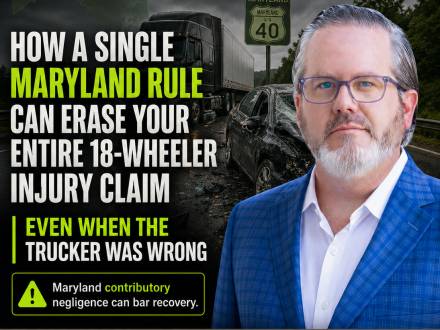
Understanding how Maryland contributory negligence can wipe out my injury claim is not just a legal technicality—it is often the single factor that determines whether an 18-wheeler crash victim receives compensation or walks away with nothing.
After a serious truck accident, most people assume the truth of the crash is enough. The truck hit you. The damage is severe. The fault feels obvious. But in Maryland, the law can work against that assumption in a way that feels completely counterintuitive.
Even when the truck driver clearly made a dangerous mistake, a claim can still be denied if the injured person is found to share even a small portion of blame. Not most of the blame. Not equal blame. Just some blame.
This is where many victims get caught off guard. In the chaos after a crash, small details—how a statement is phrased, how a police report is interpreted, or how an insurance adjuster frames a question—can quietly become the foundation for denying the entire case.
What is rarely discussed is how quickly fault narratives are built behind the scenes, often before a victim even understands the rules of the system they are entering.
Right now, while medical bills grow and recovery feels uncertain, the most important issue is not just what happened in the crash—it is how that story is legally interpreted.
This article breaks that down in plain language so you can understand where cases are won, where they are lost, and why timing and wording matter more than most people realize.
Core Problem: Why Strong Truck Accident Cases Collapse in Maryland
The real problem isn’t the crash — it’s how fault gets interpreted
Most 18-wheeler crash victims focus on the same question: "Who caused the accident?" But in Maryland, that is not the question that decides whether you get compensated.
The real issue is how easily your role in the crash can be reframed, minimized, or misunderstood.
This is where how Maryland contributory negligence can wipe out my injury claim becomes more than a legal phrase—it becomes the central risk hiding inside your case.
Even when a truck driver behaves dangerously, the claim does not live or die on their fault alone. It survives only if the injured person is shown to be completely blameless. That is the hidden standard most people never expect.
Why victims misread their own legal position
After a violent truck collision, most victims naturally assume:
- "I was just driving normally."
- "The truck hit me, so I’m safe legally."
- "At worst, this is shared responsibility."
But these assumptions overlook a critical reality: small, ordinary human reactions—braking late, changing lanes under pressure, reacting to sudden movement—can be reinterpreted later as "contributing factors."
This gap between lived experience and legal interpretation is where cases begin to weaken without the victim realizing it.
Expert insight: Maryland’s rule rewards precision, not fairness
One of the least understood dynamics is that Maryland’s system is not designed to weigh fairness between drivers. It is designed to test purity of fault.
That means the legal question is not "Who caused most of the harm?" but rather:
"Can the defense point to any credible action by the victim that contributed in even a small way?"
If the answer is yes, the entire claim can collapse.
This is why pure contributory negligence in Maryland truck accidents creates such an unforgiving outcome—even in cases that appear overwhelmingly in the victim’s favor.
Why this becomes a hidden trap after the crash
The most dangerous moment is not the collision itself—it is everything that happens immediately after:
- Casual statements made in shock
- Early police interpretations
- Insurance questions framed to provoke uncertainty
These moments shape the legal narrative long before a victim understands what is at stake.
And once that narrative takes hold, it becomes difficult to reverse.
The core takeaway
The real problem is not proving the truck driver was wrong. The real problem is preventing your actions from being turned into a reason to erase your entire claim.
That is the gap most victims don’t see until it is already being used against them
The Hidden Timing Dynamic That Quietly Decides Who Wins and Loses
The 72-hour "narrative window" most victims never hear about
One of the most overlooked realities in 18-wheeler crash cases is that the outcome is often shaped before any formal legal claim is even filed. In the first hours and days after the crash, insurance companies and trucking carriers begin building their version of events.
This early phase is critical because it can quietly influence how Maryland contributory negligence can wipe out my injury claim, even when the truck driver was clearly at fault in the actual collision.
What really happens immediately after a truck crash
Large trucking companies often deploy rapid-response teams whose job is not just to investigate—but to protect liability exposure. While the victim is still in the hospital or dealing with shock, the following begins:
- Statements from drivers are collected quickly
- Scene photos are reviewed before evidence changes
- Witnesses are contacted while memories are fresh
- Vehicle data is preserved selectively
At the same time, insurance adjusters begin shaping early assumptions about shared fault, sometimes based on incomplete or unclear information.
Why timing matters more than facts at first
The most dangerous misconception is that "truth automatically wins." In reality, early narratives often stick unless actively challenged.
A delayed or unclear explanation from the injured person can unintentionally create openings for insurers to argue contributory negligence in Maryland truck accident claims. Once that narrative is documented in reports or internal files, it becomes part of the case history—even if later evidence tells a different story.
This is not about dishonesty. It is about speed and framing.
Expert insight: evidence is not just collected—it is interpreted early
According to the Federal Motor Carrier Safety Administration (FMCSA), commercial carriers are required to maintain certain safety and operational records after serious incidents, including driver logs and vehicle data:
https://www.fmcsa.dot.gov/safety
However, what most victims do not realize is that raw data does not speak for itself. It is interpreted through early investigative assumptions. If fault is even partially suggested in those early interpretations, it can later be used to argue that the victim contributed to the crash.
Why this creates pressure on injured victims
Truck crash victims are usually:
- In pain or under medication
- Focused on recovery, not documentation
- Unaware that early silence or confusion can be misread later
This creates a gap where the legal narrative develops without their input.
The core hidden dynamic
The case is not only decided by what happened on the road—it is heavily influenced by how quickly and clearly the story is documented afterward.
And once the early version of events is set, it becomes much harder to undo
The Stakes: What Happens When Contributory Negligence Takes Hold
Financial consequences: when a strong case becomes worth nothing
For an 18-wheeler crash victim, the biggest shock is not the accident itself—it is discovering that a serious injury can still result in zero recovery.
If the defense successfully argues even a small level of fault under how Maryland contributory negligence can wipe out my injury claim, the entire case can be denied. That means:
- Emergency surgery bills remain unpaid
- Physical therapy comes out of pocket
- Lost wages are never replaced
For someone supporting a family or managing household expenses, this can quickly turn into missed rent, mounting debt, and reliance on credit just to survive basic recovery.
Legal consequences: losing before the case even fully begins
Once contributory negligence is introduced, the focus of the case shifts away from the truck driver’s actions. Instead, it becomes a debate about the victim’s smallest decisions in the moments before impact.
Even minor interpretations—like a delayed reaction or lane positioning—can be framed as contributory negligence in a Maryland truck accident claim. And once that argument is accepted, there is often no partial recovery. The entire claim collapses.
This is what makes Maryland’s system uniquely unforgiving compared to most states.
Emotional consequences: shifting blame onto the injured person
One of the most difficult outcomes for victims is psychological. Instead of processing trauma from a violent crash, they are forced to relive it through accusations of fault.
Many victims begin to ask themselves:
- "Did I do something wrong?"
- "Could I have avoided this?"
- "Why is the system treating me like I caused it?"
This emotional burden often affects recovery speed, family relationships, and overall mental health during an already vulnerable time.
Long-term consequences: the "future-you" problem
The most overlooked impact is long-term stability. When a claim is denied:
- Medical conditions may go untreated or under-treated
- Financial recovery never stabilizes
- Work ability may permanently decline without compensation support
A single legal interpretation can shift a victim from short-term recovery to long-term financial instability.
Core takeaway
The real danger is not just the crash—it is misunderstanding how quickly fault arguments can erase everything, even in cases that seem obvious.
And once that happens, the consequences extend far beyond the courtroom into every part of daily life
A Practical Framework to Protect Your Claim After a Truck Crash
The "Three-Phase Protection Model" for Maryland truck accident victims
When people try to understand how Maryland contributory negligence can wipe out my injury claim, they often focus only on fault. But in reality, protection comes from structure—not assumptions.
This framework breaks the process into three clear phases so you can reduce risk and prevent your case from being quietly weakened.
Phase 1: Stabilize the facts (First 24–72 hours)
What to do
- Secure photos of vehicles, injuries, road conditions, and surroundings
- Identify witnesses before memories fade or contact is lost
- Keep a simple timeline of what happened while details are fresh
Why it matters
This prevents early confusion from becoming permanent "case facts" that could later be used to argue contributory negligence in a Maryland truck accident claim.
What to avoid
- Do not speculate about fault
- Do not give recorded statements without understanding consequences
- Avoid filling gaps in memory with guesses
Phase 2: Control communication (First 1–2 weeks)
What to do
- Keep all communication factual and minimal
- Confirm only necessary medical and accident details
- Document everything said to insurers or third parties
Why it matters
Early statements often become the foundation of liability arguments. Even unclear wording can later be interpreted against you under Maryland’s strict fault rules.
Risk reduction principle
If you are unsure about a detail, it is safer to say "I don’t know" than to assume.
Phase 3: Build structured clarity (Ongoing)
What to do
- Align medical records with accident mechanics
- Organize evidence chronologically
- Ensure consistency across reports, treatment notes, and witness accounts
Why it matters
Consistency is what prevents insurers from reframing your actions as shared fault.
Expert insight: clarity beats speed in high-risk claims
According to the Centers for Disease Control and Prevention (CDC), injury documentation and early medical reporting are critical in understanding trauma outcomes and cause-effect relationships:
https://www.cdc.gov/injury
In legal terms, this reinforces a simple truth: accurate documentation strengthens causation and reduces ambiguity—two factors that directly affect whether fault can be shifted onto the victim.
Core takeaway
This framework is not about legal complexity. It is about controlling uncertainty.
Because once uncertainty enters the story, it becomes much easier for insurers to argue Maryland contributory negligence rules in injury claims and reduce or eliminate compensation.
Strong Outcome Looks Like vs. a Lost Claim
The difference is not just money—it is control over your future
For most 18-wheeler crash victims, the goal is simple: recover physically and regain financial stability without the accident defining the next decade of their life. But in Maryland, the outcome often depends on whether how Maryland contributory negligence can wipe out my injury claim is properly understood and managed from the start.
A strong outcome is not just about winning a case. It is about preventing the system from shifting blame onto the injured person in the first place.
Strong outcome: stability, clarity, and protected recovery
In a well-managed case, the victim experiences:
Financial stability
Medical treatment is covered, lost wages are recovered, and long-term rehabilitation does not become a personal financial burden. The crash does not create lasting debt that compounds over years.
Clarity and control
The victim understands what is happening in their case. There is no confusion about fault narratives being built in the background. Decisions are made with guidance, not panic.
Reduced emotional burden
Instead of constantly worrying about being blamed, the victim can focus on recovery. The stress of uncertainty is significantly reduced.
Long-term protection
Future medical needs and financial risks are accounted for, reducing the chance of sudden instability years later.
Weak outcome: when contributory negligence takes over
In contrast, when contributory negligence in Maryland truck accident claims is successfully argued against the victim:
- Compensation is completely denied
- Medical bills remain unpaid
- Lost income is never recovered
- The victim carries long-term financial strain alone
Even worse, the emotional impact lingers—many victims feel they were "erased" from their own accident story.
What creates the difference
The gap between these two outcomes is rarely about the severity of the crash. It is about:
- Early documentation
- Timing of statements
- Clarity of evidence
- Control over narrative development
Small decisions early on can determine whether the case becomes structured and defensible—or vulnerable to fault arguments.
Authoritative context
The National Highway Traffic Safety Administration (NHTSA) highlights how large-truck crashes often involve complex causation factors that require careful reconstruction and documentation:
https://www.nhtsa.gov/road-safety/large-truck-crashes
This complexity is exactly why early clarity and structured evidence matter so much in determining outcomes.
Future state
A strong outcome means the crash becomes a closed chapter—not an ongoing financial and emotional burden. The victim regains stability, protects their assets, and avoids the long-term uncertainty that often follows poorly managed claims.
FAQs — Maryland Truck Accident Contributory Negligence Explained
1. How does Maryland contributory negligence wipe out my injury claim after an 18-wheeler accident?
Maryland’s rule is strict: if you are found even slightly responsible for the crash, your entire claim can be denied. This means how Maryland contributory negligence can wipe out my injury claim is not about major mistakes—it can be about small, interpretable actions. Even something like timing, positioning, or reaction can be used to argue shared fault. That is why early case handling is so important.
2. Can I still recover compensation if the truck driver was clearly at fault?
Yes, but only if you are shown to have zero contributing fault. Even when the truck driver caused most of the damage, the case can still fail if the defense identifies any action that contributed in part. This is why Maryland’s system feels very different from most other states. The focus is not just on the truck driver’s behavior, but also on yours.
3. What counts as contributory negligence in a Maryland truck accident claim?
Contributory negligence in Maryland truck accident claims can include things like sudden lane changes, delayed braking, or unclear driving decisions under pressure. These are often ordinary human reactions, but they can be reinterpreted later as contributing factors. The key issue is not intent—it is how actions are interpreted after the fact.
4. Why do insurance companies focus so much on my actions after a truck crash?
Because proving even slight fault on your side allows them to deny the entire claim. Insurance companies often analyze statements, reports, and timing details to build a shared-fault narrative. This is why early communication is often more important than people realize.
5. What is the biggest mistake victims make that affects contributory negligence cases?
The most common mistake is speaking too freely or too early about the accident without understanding how those statements may be used. Even honest uncertainty can later be interpreted as inconsistency. This is one of the main ways how Maryland contributory negligence can wipe out my injury claim becomes a real risk.
6. Does being partially at fault always mean I lose my truck accident case in Maryland?
In most situations, yes. Maryland follows a strict rule where partial fault can eliminate recovery entirely. This is different from many other states where compensation is simply reduced. That is why fault analysis is such a critical part of every case.
7. Why are truck accident cases more vulnerable to contributory negligence arguments?
Truck accidents involve complex movement, timing, and multiple contributing factors. This complexity gives room for different interpretations of what happened. Even small uncertainties can be used to argue shared responsibility in Maryland contributory negligence injury claims.
8. What should I avoid doing right after an 18-wheeler crash?
You should avoid making detailed statements about fault, guessing what happened, or agreeing to recorded interviews without understanding the implications. Early statements can become permanent parts of the case narrative. It is better to stick to facts you are completely sure about.
9. How fast can contributory negligence affect my case after the crash?
It can begin affecting your case within days. Early reports, insurance notes, and witness interpretations can all shape how fault is viewed. This is why timing is critical in Maryland truck accident claims.
10. What is the safest way to protect my claim from contributory negligence arguments?
The safest approach is to preserve evidence, avoid assumptions, and ensure your version of events remains consistent and fact-based. The goal is to prevent any confusion that could be interpreted as shared fault. Understanding how Maryland contributory negligence can wipe out my injury claim helps you avoid the most common early mistakes.
Conclusion — Why One Fault Finding Can Decide Everything
Understanding how Maryland contributory negligence can wipe out my injury claim changes how you see a truck accident case in a very real way. The issue is not only what the truck driver did—it is how every detail of your own actions may later be interpreted under a strict legal rule that allows no room for partial recovery.
What most victims do not see at first is how quickly the story forms. Early statements, rushed assumptions, and unclear details can quietly shift a strong case into one that is vulnerable. Once that shift happens, even serious injuries and obvious truck driver mistakes may not be enough to secure compensation.
The stakes are not abstract. They are financial stability, access to medical care, and the ability to recover without long-term debt. The difference between a protected claim and a denied one often comes down to timing, clarity, and understanding how fault is evaluated from the beginning.
Staying in uncertainty means leaving room for assumptions that can be used against you later. Moving forward with clarity means recognizing risks early and making informed decisions that protect your position before it is challenged.
If you are dealing with a serious 18-wheeler crash, the most important step is understanding where your case may be vulnerable before those vulnerabilities are used to reduce or deny your recovery. A confidential conversation can help you understand how the facts of your situation may be viewed under Maryland law, and what steps can help protect your ability to recover what you may be entitled to.
Kisner Law Scholarship Program


Kisner Law is Committed to Bettering Your Future.
Please complete the form below or contact us at 240-459-0097 for a free consultation.
 The use of the Internet or this form for communication with the firm or any individual member of the firm does not establish an attorney-client relationship. Confidential or time-sensitive information should not be sent through this form.
I have read and understand the Disclaimer and Privacy Policy.










Free Consultations 240-459-0097
From our office in Hyattsville, Maryland, Kisner Law represents injury victims and their families throughout the Anne Arundel, Montgomery County, and Prince George's County areas, including, but not limited to Annapolis, Beltsville, Bowie, College Park, Crofton, Greenbelt, Landover, Lanham, Laurel, Largo, Mount Rainier, Riverdale Park, Silver Spring, Takoma Park, and Upper Marlboro. We also serve clients across the bordering counties as well as those in Washington, D.C.
Results listed are not a guarantee or indication of future case results.
Kisner Law
8401 Corporate Drive, Suite 650, Hyattsville, MD 20785
240-459-0097



Follow us on Social Media: