


- Home
- About
- Personal Injury
- Car Accidents
- Truck Accidents
- Motorcycle Accidents
- Pedestrian Accidents
- Defective Products
- Premises Liability
- Catastrophic Injuries
- Medical Malpractice
- Nursing Home Negligence
- Sexual Abuse
- Educational Abuse
- Wrongful Death
- Scooter Accidents
- Underinsured Motorist Accidents
- Uninsured Motorist Accidents
- Workers’ Compensation
- Case Results
- Scholarship
- Blog
- Contact
How Long Stores Keep Slip-and-Fall Footage in Maryland, and the Clock You Don't Know Is Ticking
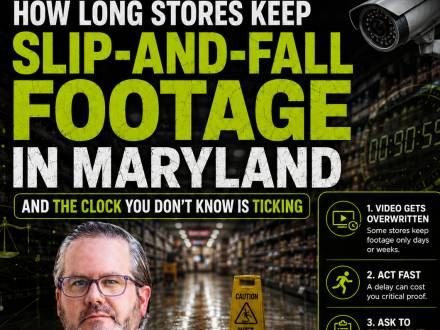
How long do stores keep security footage of my slip and fall is usually the first question people ask in Maryland after a sudden accident in a grocery store, restaurant, or retail aisle. It’s not just curiosity—it’s urgency. Because in the minutes after you fall, while you are still trying to understand what happened, a silent clock may already be running on the only objective evidence that can show the truth.
Most people assume store cameras automatically preserve footage for months. In reality, many systems are designed to overwrite recordings within days or a few weeks. That means the moment of your accident can quietly disappear long before you even realize you need it.
This creates a painful gap between what victims believe is being protected and what is actually happening behind the scenes. Stores are focused on routine operations, not long-term evidence storage, unless someone specifically requests preservation.
Seldom discussed in most legal explanations is this: the timing of your action often matters more than the severity of your injury when it comes to securing video evidence. A strong case can weaken quickly if footage is lost—not because the incident didn’t matter, but because the proof was never secured in time.
For shoppers and restaurant customers dealing with pain, confusion, and financial pressure, understanding this timeline is not optional. It is often the difference between having clarity about what happened and being left to reconstruct it without proof.
The Core Problem
The real issue isn’t the fall—it’s the evidence gap that forms immediately after it
When people search how long do stores keep security footage of my slip and fall, they are usually focused on the wrong problem. The fall already happened. The real issue is what happens to the proof of that fall in the hours and days that follow.
Most victims assume the system is stable and automatic—that if a camera captured the incident, the footage will simply "be there" when needed. But the core problem is not access. It is survival of the footage itself.
Stores are not built to preserve individual incidents. Their security systems are designed for continuous recording loops. That means older footage is constantly being replaced by new footage. From a technical standpoint, your accident is just another file in a queue waiting to be overwritten.
Why people misread the situation at the worst possible moment
After a slip-and-fall in a store or restaurant, most people are dealing with pain, embarrassment, or shock. In that state, they tend to believe they have more time than they actually do. This is the critical blind spot.
A common assumption is: "I’ll ask for the video later when I feel better or talk to someone."
But by the time that thought becomes action, the footage may already be gone.
This is where the semantic reality behind how long do retail stores keep surveillance footage after an accident becomes important: there is no universal timeline. Some systems overwrite in a week. Others in a month. The variability itself is the risk.
Expert insight most people miss: "absence of request equals permission to overwrite"
One of the least understood dynamics is this: unless a store is told to preserve footage, the system usually continues its normal overwrite cycle without interruption. In practice, that means silence works against the injured person.
There is no built-in safeguard that says, "this might be important—save it." The system does not recognize injury, severity, or intent. It only follows storage limits.
So the real vulnerability is not just delay—it is unawareness during the most critical decision window. The time when the evidence still exists but no action has yet been taken to protect it.
Why this misunderstanding matters
For the AVATAR—someone dealing with shock, financial worry, and uncertainty—the danger is not just the injury itself. It is the belief that the situation is stable when, in reality, the evidence may already be disappearing in the background.
Understanding this core problem reframes everything: the question is not just what happened, but whether the proof of what happened will still exist when it is finally needed.
Hidden Dynamic or Overlooked Factor
The system doesn’t just "store footage"—it prioritizes what it thinks is important
When people ask how long do stores keep security footage of my slip and fall, they usually imagine a simple storage timer: record, save, then delete after a fixed period. But the reality is more layered—and far less predictable.
Many modern retail and restaurant surveillance systems are not just passive recorders. They use motion-based compression, event tagging, and storage prioritization. In simple terms, the system may keep "active" or "flagged" footage longer while quietly shortening retention for everything else. The problem is that your incident is not automatically flagged as important unless someone in the store manually identifies it early.
The overlooked timing gap: internal awareness vs. technical deletion
Here’s the hidden dynamic most legal explanations skip: there is often a delay between the accident happening and the store recognizing it as something worth preserving.
Employees may not report the incident immediately. Managers may only review footage if a complaint escalates. And by the time anyone checks the system, the recording cycle may already be close to overwriting the relevant segment.
This creates a dangerous mismatch:
- The footage exists at the time of the fall
- But it is not yet "protected" in the system
- And the overwrite clock keeps running anyway
So when someone later searches how long do retail stores keep surveillance footage after an accident, they are really dealing with a system that does not wait for human awareness.
Why third-party systems make this even more unpredictable
Another rarely discussed factor is that many businesses outsource surveillance storage to third-party vendors. These systems often operate under standardized retention policies designed for cost efficiency—not legal preservation.
According to guidance on digital data management principles from the U.S. National Institute of Standards and Technology (NIST), https://www.nist.gov, data lifecycle controls depend heavily on configuration settings and organizational policy—not automatic legal safeguards.
In practice, this means two similar-looking stores on the same street may have completely different retention windows depending on who manages their system and how it is configured.
Why this matters for the AVATAR
For someone dealing with pain, confusion, and financial pressure after a fall, this creates a hidden risk: you are not just racing against time—you are racing against a system that does not recognize your situation until it is already too late.
The real danger is not ignorance of the accident. It is the delay between the accident and the system realizing it should matter
Stakes and Consequences
What happens when the footage is gone: the case becomes memory instead of evidence
If someone misunderstands how long do stores keep security footage of my slip and fall, the consequences usually don’t show up immediately. They appear later—when the evidence is already missing, and the story has to be rebuilt from memory alone.
A slip-and-fall in a Maryland grocery store or restaurant might seem straightforward in the moment. You remember the wet floor, the lack of signage, the sudden impact. But if the video is overwritten before it is preserved, that clear moment becomes disputed, delayed, and far more expensive to prove.
Financial consequences: stronger evidence vs. weaker negotiation power
Without footage, your claim often shifts from "here is what happened" to "this is what I remember happened." That difference has real financial weight.
For example, a shopper who slipped in a supermarket aisle may have:
- Emergency room bills
- Follow-up physiotherapy costs
- Lost wages from missing work shifts
If the store’s video clearly shows negligence, settlement discussions are often more straightforward. But if the footage is gone, insurers may challenge every detail, leading to lower offers or prolonged disputes.
For the AVATAR—often balancing rent, family expenses, or hourly income—this delay can turn into months of financial strain.
Legal consequences: the burden of proof becomes heavier
When surveillance footage is unavailable, the burden shifts almost entirely onto the injured person. Witnesses may forget details. Incident reports may be incomplete. Small inconsistencies become bigger obstacles.
A case that could have been visually clear may instead rely on fragmented documentation, making outcomes less predictable and more dependent on interpretation rather than facts.
Emotional consequences: uncertainty replaces clarity
There is also a psychological cost. Many people repeatedly think: "I know it was there on camera… why can’t I prove it?"
This creates frustration, self-doubt, and a sense of injustice that often lasts longer than the physical injury itself. The emotional strain comes not just from the fall, but from losing the ability to clearly demonstrate what happened.
Long-term consequences: a permanent gap in the story
Once footage is overwritten, it cannot be casually recovered. The incident becomes something reconstructed rather than shown. For future negotiations, medical claims, or legal discussions, that missing piece can permanently shape the outcome.
Even years later, the absence of early preservation becomes a limiting factor in how the event is understood and resolved.
Why this matters right now
The key risk is timing. Understanding how long do retail stores keep surveillance footage after an accident is not an abstract legal detail—it directly affects whether the strongest version of your case even exists in the first place
A Framework or Guidance Path
A simple decision framework for protecting security footage after a slip-and-fall
When people search how long do stores keep security footage of my slip and fall, what they really need is not just information—it’s a clear action path. The uncertainty after an accident makes decision-making harder, so the goal of this framework is to replace guessing with structure.
Step 1: Report the incident immediately (same day)
What to do: Notify store or restaurant management as soon as possible and ensure the incident is officially documented.
Why it matters: This is often the first internal trigger that signals the footage may need to be preserved.
What to avoid: Do not assume a verbal report is enough. If it is not written, it may not be treated as important later.
Step 2: Identify and request preservation of footage (within 24–72 hours)
What to do: Ask directly for the specific camera footage covering the time and location of your fall.
Why it matters: Many systems overwrite recordings within days or weeks. Early requests reduce the risk of deletion.
Semantic variation insight: This is often referred to as understanding how long do retail stores keep surveillance footage after an accident—but the real variable is when preservation is triggered, not just the default retention period.
Step 3: Collect independent evidence immediately
What to do: Take photos of the scene, your injuries, footwear, lighting, and any hazard. Gather witness names if available.
Why it matters: Even if video is lost, supporting evidence strengthens your account.
What to avoid: Relying only on store records or assuming they will "handle everything."
Step 4: Escalate preservation formally if needed
What to do: If there is any delay or uncertainty, a formal written preservation notice can be used to instruct the business not to delete footage.
Why it matters: This creates a clear expectation that the footage may be relevant to a legal claim.
Expert anchor insight: timing is a system trigger, not just a deadline
The most overlooked truth is that surveillance systems do not wait for legal awareness. They operate continuously unless interrupted by a preservation request.
That means your actions are not just collecting evidence—they are actively preventing its loss.
Authoritative reference
For general principles on preserving digital evidence and handling time-sensitive records, see guidance from the U.S. National Archives and Records Administration (NARA):
https://www.archives.gov
How to think clearly under pressure
- Act early, not perfectly
- Prioritize preservation over explanation
- Assume the footage is already on a timer
- Focus on what can still be secured, not what might already be lost
This framework turns uncertainty into a structured response, especially when dealing with something as time-sensitive as how long do stores keep security footage of my slip and fall.
Show What a Strong Outcome Looks Like
What changes when evidence is preserved early and correctly
When someone understands how long do stores keep security footage of my slip and fall and acts within that critical window, the entire trajectory of the situation changes. The difference is not just legal—it is practical, financial, and emotional.
In a strong outcome, the video footage is preserved before it is overwritten. That single action creates clarity. Instead of relying on memory, assumptions, or conflicting accounts, there is a clear visual record of what actually happened in the store or restaurant.
Strong outcome vs. weak outcome: what the difference actually looks like
Financial stability
- Strong outcome: Medical bills and lost wages are assessed with clear evidence showing how the injury occurred, leading to more predictable financial recovery discussions.
- Weak outcome: Without footage, the situation becomes disputed, often resulting in delayed resolution and increased out-of-pocket pressure.
Clarity and control
- Strong outcome: You know exactly what happened, when it happened, and how it is being evaluated. There is structure instead of uncertainty.
- Weak outcome: You are forced to rely on memory while the other side questions details, creating confusion and frustration.
Time saved
- Strong outcome: Early preservation reduces back-and-forth disputes and accelerates case evaluation.
- Weak outcome: Missing footage leads to repeated explanations, additional delays, and prolonged uncertainty.
Emotional load
- Strong outcome: The emotional burden decreases because there is visible proof supporting your experience. Doubt is reduced.
- Weak outcome: The absence of evidence creates ongoing stress—especially the feeling that something "important is missing but gone."
Long-term protection and predictability
- Strong outcome: The case has a stable foundation. Future negotiations or reviews are based on documented facts.
- Weak outcome: The case remains vulnerable to reinterpretation because key evidence no longer exists.
Why timing is the real advantage
The most important shift is understanding that outcomes are not determined only by what happened—but by how quickly evidence was protected after it happened. This is why knowing how long do retail stores keep surveillance footage after an accident is not just informational—it is strategic.
A delayed response doesn’t just risk evidence loss. It removes control from the injured person and transfers it to assumptions, gaps, and disputes.
Authoritative reference
For broader consumer protection principles related to evidence, documentation, and fair treatment in commercial settings, see the Federal Trade Commission (FTC):
https://www.ftc.gov
The future state the AVATAR is actually seeking
A strong outcome is not just compensation—it is certainty. It is knowing the facts are preserved, the timeline is clear, and the situation is no longer dependent on fading memory or missing footage. That clarity reduces stress, protects financial stability, and restores a sense of control after a sudden and disruptive event.
FAQs
1. How long do stores keep security footage of my slip and fall in Maryland?
Most stores keep surveillance footage for about 7 to 30 days, depending on their storage system and business size. Smaller retail stores and restaurants often overwrite footage more quickly due to limited storage. Larger chains may keep it longer, but there is no guaranteed standard. This is why timing is critical if you believe the footage matters to your situation.
2. What is the first thing I should do if I’m worried about store footage being deleted?
You should report the incident immediately and ask for the footage to be preserved. The keyword concern—how long do retail stores keep surveillance footage after an accident—matters because delays can result in automatic overwriting. Acting quickly helps ensure the footage is flagged before it is lost. Waiting even a few days can significantly reduce your chances of recovery.
3. Can I request security camera footage after a slip-and-fall accident?
Yes, you can request it, but stores are not always required to provide it immediately. They may also refuse informal requests unless a formal preservation request is made. The effectiveness of your request depends heavily on timing. The earlier you act, the more likely the footage still exists.
4. What happens if the store overwrites the footage of my accident?
If the footage is overwritten, it usually cannot be recovered in normal circumstances. This can make it harder to show exactly how the fall occurred. Without video, your case may rely more heavily on memory, witness accounts, or indirect evidence. This is why understanding how long do stores keep security footage of my slip and fall is so important.
5. Do stores have to legally keep footage of slip-and-fall incidents?
In most cases, stores are not automatically required to keep footage unless they are specifically notified to preserve it. Once a preservation request is made, they are expected not to delete relevant evidence. Without that notice, systems typically continue their normal overwrite cycle. This creates a narrow but critical timing window.
6. Why does timing matter so much in preserving store surveillance footage?
Timing matters because surveillance systems are designed for continuous recording, not long-term storage of specific incidents. Footage is often overwritten on a fixed cycle, regardless of what is shown in the video. If no one intervenes quickly, important evidence may disappear without anyone realizing it. This makes early action essential.
7. What if I don’t remember the exact time of my slip and fall?
Even if you are unsure of the exact time, you should still request preservation as soon as possible. Stores can often narrow down the footage using general timeframes or incident reports. Waiting to confirm details increases the risk of losing video. Acting first is more important than having perfect information.
8. Can security footage help prove fault in a slip-and-fall case?
Yes, footage can show key details such as spills, hazards, lighting conditions, or lack of warning signs. This visual evidence often provides clarity that written reports cannot. It can also reduce disputes about what actually happened. That is why people search how long do retail stores keep surveillance footage after an accident immediately after an incident.
9. What if the store says they don’t have the footage anymore?
If a store claims the footage is gone, it may have already been overwritten due to its storage cycle. This is common if too much time has passed. In such cases, other evidence like witness statements or photos becomes more important. However, the loss of video often makes the situation more difficult to prove clearly.
10. How quickly should I act after a slip-and-fall to protect evidence?
You should act immediately—ideally the same day or within a few days. The longer you wait, the higher the risk that footage will be automatically deleted. Many people underestimate how fast store systems overwrite recordings. Quick action significantly increases your chances of preserving critical evidence.
Conclusion
Understanding how long do stores keep security footage of my slip and fall ultimately comes down to one critical reality: the evidence you assume will be available is often the first thing to disappear. Behind the scenes, surveillance systems are constantly overwriting old recordings, and unless action is taken quickly, a single moment in time can be permanently lost.
The hidden dynamics are simple but easy to miss. Stores do not pause recording cycles for injuries. They do not automatically recognize legal importance. And they rarely preserve footage unless someone specifically triggers that process. This gap between what people expect and how systems actually work is where most cases become complicated.
The stakes are not abstract. They affect financial recovery, clarity about what happened, and the ability to move forward without doubt or confusion. Acting early creates structure and control. Waiting creates uncertainty, disputes, and missing evidence that cannot be replaced.
The contrast is clear: staying passive often leads to uncertainty and reconstruction of events through memory, while early, informed action preserves clarity and strengthens the foundation of your case from the beginning.
If you are dealing with a recent incident or are unsure whether important footage still exists, a confidential conversation can help you understand your options and avoid preventable mistakes. Reaching out early is not about pressure—it is about protecting clarity, preserving evidence, and making informed decisions before time takes that choice away.
Kisner Law Scholarship Program


Kisner Law is Committed to Bettering Your Future.
Please complete the form below or contact us at 240-459-0097 for a free consultation.
 The use of the Internet or this form for communication with the firm or any individual member of the firm does not establish an attorney-client relationship. Confidential or time-sensitive information should not be sent through this form.
I have read and understand the Disclaimer and Privacy Policy.










Free Consultations 240-459-0097
From our office in Hyattsville, Maryland, Kisner Law represents injury victims and their families throughout the Anne Arundel, Montgomery County, and Prince George's County areas, including, but not limited to Annapolis, Beltsville, Bowie, College Park, Crofton, Greenbelt, Landover, Lanham, Laurel, Largo, Mount Rainier, Riverdale Park, Silver Spring, Takoma Park, and Upper Marlboro. We also serve clients across the bordering counties as well as those in Washington, D.C.
Results listed are not a guarantee or indication of future case results.
Kisner Law
8401 Corporate Drive, Suite 650, Hyattsville, MD 20785
240-459-0097



Follow us on Social Media: