


- Home
- About
- Personal Injury
- Car Accidents
- Truck Accidents
- Motorcycle Accidents
- Pedestrian Accidents
- Defective Products
- Premises Liability
- Catastrophic Injuries
- Medical Malpractice
- Nursing Home Negligence
- Sexual Abuse
- Educational Abuse
- Wrongful Death
- Scooter Accidents
- Underinsured Motorist Accidents
- Uninsured Motorist Accidents
- Workers’ Compensation
- Case Results
- Scholarship
- Blog
- Contact
Injured While Delivering for DoorDash: Whose Insurance Pays, and the Coverage Gap No One Warns You About
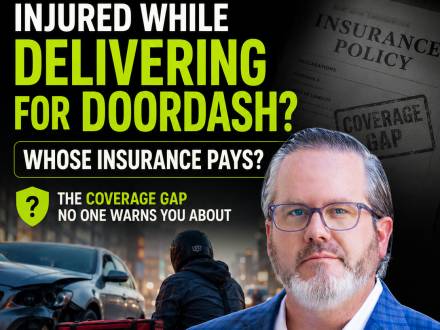
If you’re thinking, "I was injured in a crash while delivering for DoorDash whose insurance pays," you’re already in the middle of a problem most drivers only discover after things go wrong. In that moment, the app stops mattering, but the bills don’t. Medical costs, vehicle repairs, and lost income start piling up immediately—while you’re still trying to figure out which insurance company is even responsible.
The hardest part is that the answer is not straightforward. Coverage depends on what you were doing in the exact seconds before the crash, not just the fact that you were "working." That detail catches many gig drivers off guard, especially those who assume DoorDash automatically protects them like a traditional employer.
What most drivers are never told is that there are hidden gaps between personal insurance, DoorDash’s limited coverage, and third-party liability. These gaps don’t show up until after an accident—and by then, confusion often delays claims or weakens them.
This article breaks down those coverage layers in plain language, explains who typically pays, and shows why timing and app status can completely change your outcome. The goal is to give you clarity when everything feels uncertain, so you can make informed decisions instead of guessing under pressure.
Body Section 1 — Diagnose the Core Problem
The real issue isn’t the crash—it’s the uncertainty of coverage
When a driver asks, "I was injured in a crash while delivering for DoorDash whose insurance pays," they are usually focused on the accident itself. But the real problem starts earlier: confusion about what "being covered" actually means while working in the gig economy.
Most gig drivers assume coverage is tied to the job in a simple way—if you’re delivering, you’re protected. The reality is more fragmented. Insurance responsibility shifts depending on your exact app status at the moment of impact. That means two drivers doing almost the same job can have completely different outcomes after the same type of crash.
The blind spot: thinking "working = covered"
The biggest misunderstanding is assuming that being "on DoorDash" automatically activates full protection. In practice, coverage is conditional. It may depend on whether you had accepted an order, whether you were actively en route, or whether you were simply waiting for a request.
This is where many drivers get trapped. In a high-stress moment—pain, shock, financial pressure—they don’t realize the system is not designed around continuous protection. It is designed around narrow coverage windows.
Why drivers misdiagnose the problem
After an accident, most drivers immediately focus on fault: Who caused the crash? But in gig work insurance cases, fault is only part of the equation. The more important question is: Which insurance policy was active at that exact moment?
This shift in thinking is not intuitive. It creates hesitation, delayed reporting, and incomplete claims—mistakes that can reduce or even eliminate compensation.
Expert insight: the "coverage gap illusion"
A lesser-known dynamic is what can be called the coverage gap illusion. Drivers often believe there is always "some insurance" covering them at all times. In reality, there are transition points—such as between waiting for an order and actively delivering—where coverage can be partial, disputed, or temporarily absent.
These gaps are not widely understood, yet they determine the outcome of most claims.
Why this matters right now
For injured delivery drivers, this is not theoretical. It affects how quickly they can get medical care paid for, whether they can repair their vehicle, and how soon they can return to work. The uncertainty itself becomes the biggest financial threat—not just the accident.
The Hidden Timing Problem That Decides Who Pays
Insurance doesn’t just depend on what you were doing—but when the system recorded it
Most drivers searching "I was injured in a crash while delivering for DoorDash whose insurance pays" assume the answer depends on simple facts: whether they were online, whether they accepted an order, or whether they were actively delivering. But there is a far less discussed factor that often decides the outcome: system timing and data logging delays.
In gig work insurance disputes, coverage is not only based on your real-world actions—it is based on what the platform’s digital records show happened and when. That difference can completely change responsibility.
The overlooked dynamic: the "timestamp gap"
Every delivery app operates on internal logs that record when:
-
An order is accepted
-
Navigation begins
-
The delivery is marked active
-
The trip is officially ended
However, these actions are not always recorded in real time. Small delays in GPS syncing, network lag, or app refresh timing can create what experts sometimes refer to as a timestamp gap—a mismatch between what you were doing and what the system believes you were doing.
This matters because insurers often rely heavily on app-generated logs to decide coverage eligibility.
Why this creates real-world denial risks
If a crash happens during a transition moment—such as seconds before an order fully activates or immediately after acceptance—the system may not classify the driver as "actively delivering." That classification can shift responsibility away from DoorDash coverage and back toward personal insurance or even dispute territory between insurers.
This is where many gig drivers face unexpected denials. They believe they were clearly "on a delivery," but the recorded data suggests otherwise.
Expert insight: data beats memory in insurance disputes
A critical but rarely discussed reality is that insurance decisions prioritize platform data over driver testimony. Even if a driver is certain they were actively delivering, insurers often default to system logs unless there is strong contradictory evidence.
This is why understanding how timing, app status, and digital records interact is just as important as understanding fault in the crash itself.
For a broader understanding of how insurance claims are evaluated and documented, the Insurance Information Institute highlights how insurers rely on recorded evidence and claims data in determining coverage outcomes:
Insurance Information Institute — Claims and Coverage Basics
Why this matters for gig drivers
For delivery drivers dealing with injuries, vehicle damage, and lost income, even a few seconds of logging mismatch can determine whether they receive fast compensation or enter a prolonged dispute process. This hidden timing layer is one of the least visible—but most decisive—factors in gig worker insurance outcomes.
The Stakes and Consequences of Getting It Wrong
Financial consequences: when the income stops but the expenses don’t
For a gig driver, the most immediate risk after a crash is financial collapse. If you were injured in a crash while delivering for DoorDash whose insurance pays becomes unclear or disputed, you may be left paying out of pocket for ER visits, imaging scans, or follow-up treatment. At the same time, your income stops instantly because there is no paid leave in gig work.
A common real scenario is a driver who misses just two weeks of deliveries. That gap alone can mean rent pressure, missed utility payments, and reliance on loans or credit just to stay afloat. If the claim is delayed or denied due to coverage confusion, the financial strain multiplies quickly.
Legal and claims consequences: small mistakes, big delays
Misunderstanding delivery status or reporting the crash incorrectly can slow down or weaken your claim. For example, if you report the accident late or fail to document app activity, insurers may argue that you were not actively working. That single detail can shift responsibility away from DoorDash coverage entirely.
This is where many drivers lose time they cannot afford—weeks or even months spent in claim disputes while medical bills continue to grow.
Emotional consequences: pressure, stress, and decision fatigue
Beyond money and paperwork, there is constant uncertainty. Drivers often feel stuck asking: Was I even covered? Did I do something wrong? Why is no one giving a clear answer? This uncertainty creates stress at a time when physical recovery should be the priority.
For many gig workers supporting families, this emotional strain is amplified by guilt and pressure to return to work too soon, even before full recovery.
Long-term consequences: debt cycles and reduced earning ability
If coverage gaps are misunderstood or mishandled, the long-term impact can be severe. Medical debt can accumulate, credit can be affected, and vehicle damage may force drivers to take out high-interest loans or pause work entirely.
A single crash can therefore reshape a driver’s financial stability for months or even years.
Core takeaway
The key issue is not just the accident—it is the uncertainty of who pays what, and when. Without clarity, even a routine delivery crash can turn into a long-term financial setback tied directly to misunderstanding insurance responsibility in gig work.
A Practical Decision Framework After a DoorDash Crash
Step 1: Lock in your "moment of status" immediately
If you were injured in a crash while delivering for DoorDash whose insurance pays is the central question, everything starts with one fact: your app status at the exact moment of impact.
Immediately note whether you were:
-
Waiting for an order
-
En route to pick up
-
Actively delivering
This matters because insurance responsibility changes based on these categories. If you delay documenting this, insurers may rely only on system logs that can be incomplete or disputed later.
Step 2: Preserve digital and physical proof
Treat evidence as your strongest protection. Save screenshots of your delivery screen, GPS route, and order details. Also document vehicle damage and the accident scene.
Why it matters: gig insurance decisions often depend more on digital records than personal explanations.
Step 3: Report strategically, not randomly
Do not assume a single report is enough. In most cases, you may need to notify:
-
DoorDash support (for platform coverage activation)
-
Your personal auto insurer (if required)
-
Any third-party driver insurer (if another vehicle was involved)
The key is consistency—report facts exactly as they occurred without guessing about coverage.
Step 4: Avoid the most common mistake—early assumptions
One of the biggest risks is assuming you are either "fully covered" or "not covered" too early. This leads to incomplete claims or missed filings. Instead, treat coverage as something that must be verified through documentation, not assumed.
Step 5: Track claim progression, not just filing
After submission, monitor responses closely. Delays often indicate disputes between insurers about responsibility, not simple processing time.
Why this framework works
This structured approach helps drivers reduce uncertainty in high-stress situations. It turns confusion into a clear sequence of actions that align with how insurers actually evaluate claims: based on timing, status, and documentation.
For additional clarity on how insurance claims and consumer protections are handled in the U.S., the Federal Trade Commission provides general guidance on auto insurance disputes and consumer rights:
Federal Trade Commission — Consumer Auto Insurance Guidance
Core principle
The goal is not to guess coverage—it is to build a clear record that proves it.
A Strong Outcome Looks Like for a DoorDash Injury Claim
Strong outcome: clarity, coverage, and controlled recovery
In the best-case scenario, a driver who was injured in a crash while delivering for DoorDash whose insurance pays is no longer a mystery—they have a clear, documented path to compensation. Everything begins with properly captured app status, immediate reporting, and aligned claims across the correct insurers.
A strong outcome looks like this in practice:
-
Medical treatment is approved or reimbursed without prolonged disputes
-
Vehicle repair costs are covered without personal debt
-
Lost income is partially or fully compensated depending on coverage eligibility
-
The driver understands exactly which insurer is responsible and why
Most importantly, there is no prolonged uncertainty. The driver is not calling multiple companies trying to decode responsibility—they are instead following a structured claim process that is already moving forward.
Weak outcome: confusion, delay, and financial strain
In contrast, a weak outcome begins with uncertainty. Claims are filed late or inconsistently. App status is unclear or undocumented. Insurers dispute responsibility, and the driver is caught in the middle.
This often results in:
-
Weeks or months of delayed payments
-
Out-of-pocket medical expenses piling up
-
Repair delays that stop the driver from returning to work
-
Growing stress and forced borrowing to stay afloat
The difference is not the severity of the crash—it is the quality of documentation and timing.
What actually creates a strong outcome
Strong outcomes are rarely about luck. They come from three consistent behaviors:
-
Immediate action: documenting app status and reporting quickly
-
Accurate classification: clearly identifying delivery stage at the time of impact
-
Structured claims filing: engaging all relevant insurers without assumptions
These steps reduce ambiguity, which is the main reason claims fail or stall.
The future state drivers actually want
For gig workers, the ideal future is simple: predictability after uncertainty. They want to know that if something goes wrong, they are not financially erased by confusion in the system. They want stability—knowing bills, income loss, and repairs will not spiral out of control because coverage was properly triggered and documented.
For broader context on how insurance protections and consumer safeguards function in the U.S. system, the Consumer Financial Protection Bureau provides educational resources on managing financial recovery after unexpected events:
Consumer Financial Protection Bureau — Insurance and Financial Recovery Guidance
Core takeaway
A strong outcome is not just compensation—it is control over the process when everything else feels unstable.
FAQs — DoorDash Crash Injury and Insurance Coverage
1. I was injured in a crash while delivering for DoorDash whose insurance pays in most cases?
In most cases, the answer depends on your exact delivery status at the moment of the crash. If you were actively on a delivery, DoorDash’s contingent insurance may apply, but if you were waiting for an order or offline, personal insurance or another driver’s insurance may take priority. Many drivers are surprised to learn there is no single automatic policy covering all situations. The key factor is timing and app activity, not just that you were working.
2. What should I do first if I was injured in a DoorDash delivery accident?
The first step is to document everything immediately, including your app status, location, and time of crash. Then seek medical attention, even if injuries seem minor. Reporting quickly matters because delays can create disputes about whether you were actively delivering. Many claims issues start simply because drivers wait too long to record basic facts.
3. Why does DoorDash accident insurance feel confusing or inconsistent?
The confusion comes from the fact that coverage is not continuous—it changes based on delivery phases. A delivery driver might be partially covered at one moment and not covered a few seconds later. This creates uncertainty that most drivers only understand after an accident. It is not about negligence; it is about how gig insurance systems are structured.
4. What happens if my personal insurance denies my claim after a DoorDash crash?
This is common because many personal policies exclude commercial activity. If that happens, responsibility may shift to DoorDash coverage (if active) or a third-party driver’s insurance. However, disputes can delay compensation significantly. That is why proper documentation of your delivery status becomes critical.
5. Can I still get compensation if I was waiting for an order when I was injured?
Yes, but it becomes more complicated. Waiting periods often fall into a gray zone where DoorDash coverage may be limited or conditional. In these cases, your personal insurance or another party’s liability coverage may become more important. The outcome depends heavily on the specific circumstances of the crash.
6. How does timing affect "I was injured in a crash while delivering for DoorDash whose insurance pays"?
Timing is one of the most important factors. Even a difference of seconds in app status updates can change which insurer is responsible. If the system does not record you as actively delivering, coverage may be denied or shifted elsewhere. This is why immediate documentation after a crash is essential.
7. What financial risks do gig drivers face after a DoorDash accident?
Drivers may face medical bills, vehicle repair costs, and lost income during recovery. Since gig work has no paid leave, even short downtime can create financial pressure. If insurance responsibility is unclear, these costs may fall on the driver temporarily or permanently. This is one of the biggest risks in delivery driving.
8. Why do some DoorDash injury claims take so long to resolve?
Delays usually happen when insurers disagree about responsibility. Each party may try to determine whether you were actively delivering, waiting, or offline. Until that is confirmed, claims can stay unresolved. These delays are not always about complexity—they are often about coverage disputes.
9. Can I make multiple insurance claims after a DoorDash crash?
Yes, in many cases you may need to file with more than one insurer, especially if fault is unclear. However, the claims must be consistent and based on accurate facts about your app status and timing. Conflicting information can slow down or weaken your case. Coordination is key to avoiding delays.
10. What is the most common mistake drivers make after a DoorDash accident?
The most common mistake is waiting too long to document what happened and assuming coverage will automatically apply. Many drivers also fail to capture app status or delivery details immediately after the crash. This can lead to disputes later about whether they were actively working. Quick, clear documentation is the strongest protection.
Conclusion
For gig and delivery drivers, the question "I was injured in a crash while delivering for DoorDash whose insurance pays" is not just a legal concern—it is a moment of financial uncertainty that can shape everything that follows. What makes these situations so difficult is not only the crash itself, but the hidden structure of coverage: shifting app status, timing gaps, and insurers that may interpret the same event very differently.
The key takeaway is simple but critical. Responsibility is not automatically clear just because you were working. Instead, coverage depends on precise details that many drivers only realize matter after an accident has already happened. That gap between expectation and reality is where most financial and legal stress begins.
Drivers who understand these dynamics early are in a stronger position. They move with documentation, clarity, and strategy. Those who do not often find themselves stuck in delays, disputes, and mounting expenses that feel out of their control.
The difference between uncertainty and clarity is action taken at the right time. Knowing how these systems actually work gives you a chance to protect your income, your health, and your future stability before small mistakes turn into long-term consequences.
If you are dealing with a delivery crash or trying to understand your options after the fact, speaking with a legal professional can help you make sense of your situation and avoid costly missteps. A confidential conversation can give you clarity on where you stand, what coverage may apply, and how to protect yourself moving forward—without guesswork or unnecessary risk.
Kisner Law Scholarship Program


Kisner Law is Committed to Bettering Your Future.
Please complete the form below or contact us at 240-459-0097 for a free consultation.
 The use of the Internet or this form for communication with the firm or any individual member of the firm does not establish an attorney-client relationship. Confidential or time-sensitive information should not be sent through this form.
I have read and understand the Disclaimer and Privacy Policy.








Free Consultations 240-459-0097
From our office in Hyattsville, Maryland, Kisner Law represents injury victims and their families throughout the Anne Arundel, Montgomery County, and Prince George's County areas, including, but not limited to Annapolis, Beltsville, Bowie, College Park, Crofton, Greenbelt, Landover, Lanham, Laurel, Largo, Mount Rainier, Riverdale Park, Silver Spring, Takoma Park, and Upper Marlboro. We also serve clients across the bordering counties as well as those in Washington, D.C.
Results listed are not a guarantee or indication of future case results.
Kisner Law
8401 Corporate Drive, Suite 650, Hyattsville, MD 20785
240-459-0097



Follow us on Social Media: