


- Home
- About
- Personal Injury
- Car Accidents
- Truck Accidents
- Motorcycle Accidents
- Pedestrian Accidents
- Defective Products
- Premises Liability
- Catastrophic Injuries
- Medical Malpractice
- Nursing Home Negligence
- Sexual Abuse
- Educational Abuse
- Wrongful Death
- Scooter Accidents
- Underinsured Motorist Accidents
- Uninsured Motorist Accidents
- Workers’ Compensation
- Case Results
- Scholarship
- Blog
- Contact
Me lastime en un accidente de carro en Maryland: los primeros 7 pasos para proteger mi caso
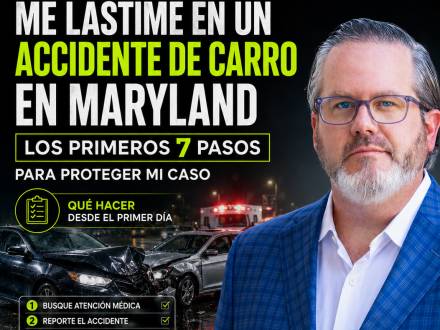
Si te estás preguntando "me lastime en un accidente de carro en Maryland que debo hacer", probablemente estás en uno de los momentos más confusos y estresantes de tu vida. El choque ya pasó, pero la presión apenas comienza: el dolor físico, las llamadas del seguro, el miedo a perder dinero y la incertidumbre sobre qué decisiones pueden afectar tu futuro.
En estas primeras horas, muchas personas en la comunidad hispana cometen un error común: pensar que lo más importante es "resolver rápido". En realidad, lo más importante es no tomar decisiones apresuradas que puedan debilitar tu caso sin que te des cuenta.
Lo que casi nadie te explica es que desde el primer momento después del accidente, cada acción —o inacción— puede tener un impacto directo en tu compensación. Incluso detalles pequeños, como lo que dices en la escena o cómo documentas el accidente, pueden cambiar completamente el resultado.
Este artículo no solo te dice qué hacer. Te ayuda a entender por qué estas primeras decisiones son críticas ahora mismo, y cómo protegerte antes de que la evidencia desaparezca o el seguro empiece a construir su versión de los hechos.
La meta es simple: darte claridad, control y un camino seguro en medio del caos
The Core Problem
El problema real no es el accidente, es la confusión inmediata después del choque
Cuando una persona dice "me lastime en un accidente de carro en Maryland que debo hacer", el problema que enfrenta no es solo el impacto del choque. El verdadero problema es algo mucho más crítico: la falta de claridad en el momento exacto donde cada decisión empieza a tener consecuencias legales y financieras.
En ese instante, la mente está dividida. Por un lado, hay dolor físico o preocupación por lesiones que aún no se entienden. Por otro lado, hay presión externa: el otro conductor, la policía, familiares, y especialmente la compañía de seguros que comienza a actuar casi de inmediato.
La mayoría de las víctimas creen que pueden "explicar después lo que pasó" o "arreglarlo con el seguro". Ese es el primer punto ciego.
El error oculto: asumir que el caso empieza cuando haces el reclamo
Uno de los malentendidos más peligrosos es pensar que el caso legal comienza cuando llamas al seguro o cuando visitas a un abogado. En realidad, el caso comienza en la escena del accidente.
Cada palabra, cada foto que no tomas, cada detalle que olvidas documentar puede afectar cómo se interpreta el accidente más adelante. Esto es especialmente importante para quienes buscan "me lastime en un accidente de carro en Maryland que debo hacer" porque creen que todavía "no ha empezado nada serio".
Pero sí ha empezado. Solo que no lo ves.
Presión emocional + decisiones rápidas = resultados débiles
El verdadero núcleo del problema es la combinación de tres factores:
- Dolor físico o shock emocional
- Presión de terceros (seguro, policía, otros conductores)
- Falta de información clara en tiempo real
Esta combinación lleva a decisiones automáticas: hablar demasiado, aceptar culpa indirecta, o evitar documentar la escena por estrés o confusión.
Insight experto: el caso no se construye en la oficina del abogado, se construye contra ti desde el primer minuto
Lo que pocas personas entienden es esto: las compañías de seguros no esperan a que tú "te organices". Empiezan a construir una versión del accidente inmediatamente después del choque, usando cualquier declaración inicial, reporte policial incompleto o falta de evidencia como ventaja estratégica.
Por eso, el mayor riesgo no es el accidente en sí, sino la ventana de tiempo invisible en la que el caso puede debilitarse sin que la persona lo note.
El problema, entonces, no es solo qué hacer después del accidente. Es entender que ya estás dentro de un proceso donde cada decisión temprana define el resultado final.
The Hidden Timing Gap That Most Accident Victims Never See
The "first contact window" that quietly shapes your entire case
One of the most overlooked dynamics after a crash is something most people never recognize: the first 24–72 hours are not neutral—they are an active evaluation window used by insurance companies to shape your claim. This matters directly when someone is thinking "me lastime en un accidente de carro en Maryland que debo hacer" because the urgency to "handle things quickly" often leads to rushed communication.
During this period, insurance adjusters may contact you early, sometimes before you fully understand your injuries. The goal is not necessarily to be aggressive, but to lock in early statements that appear consistent and minimize future liability. Even simple phrases like "I feel okay" or "it wasn’t that bad" can later be interpreted as evidence that injuries are minor.
Why delayed symptoms change everything (and why most people misread them)
A second hidden factor is medical timing. Many injuries—especially whiplash, soft tissue damage, or internal inflammation—do not fully appear immediately. For Spanish-speaking victims under stress, this delay creates a dangerous misunderstanding: if you feel "fine" at the scene, you assume you are fine.
This mismatch between how the body reacts and how the legal system evaluates claims is one of the biggest sources of weakened cases.
According to the U.S. National Highway Traffic Safety Administration, crash injuries can have delayed onset symptoms and should always be medically evaluated even when no immediate pain is felt:
NHTSA Post-Crash Care Guidance
The language and pressure disadvantage many victims face
For many Hispanic victims in Maryland, there is an additional layer: communication pressure. When English is not the first language, conversations with police or insurance representatives can feel rushed or unclear. This increases the risk of agreeing to statements that do not fully reflect what happened.
The result is not just confusion—it is documentation that may not accurately represent the real severity of the accident or injuries.
The core hidden dynamic
The real issue is not just the accident itself. It is this:
your case is being interpreted and shaped before you even understand its full medical and legal reality.
That gap between "what you know" and "what the system records" is where many strong cases quietly weaken.
The Real Stakes When Things Go Wrong After a Car Accident in Maryland
Financial consequences: small early mistakes become long-term debt
When someone searches "me lastime en un accidente de carro en Maryland que debo hacer", they are usually trying to avoid financial collapse—not just paperwork problems. The reality is that mishandling the early stages of a claim can directly reduce or eliminate compensation.
For example, if a victim tells the insurance company they feel "fine" and later discovers they need physical therapy for months, the insurer may argue those injuries are unrelated or exaggerated. That can result in out-of-pocket medical bills, lost wages, and unpaid recovery costs that fall entirely on the victim and their family.
For many working families in Maryland, even a few weeks without income can mean overdue rent, missed car payments, and rising debt that takes years to recover from.
Legal consequences: weakened claims and lost leverage
Legally, the biggest risk is not "losing a lawsuit," but losing negotiating power before a claim even develops. Once early statements, incomplete documentation, or gaps in medical treatment exist, the case becomes significantly harder to prove.
A simple mistake—like not seeking immediate care—can be used to argue that injuries were minor or unrelated to the accident. This is especially important for anyone asking "me lastime en un accidente de carro en Maryland que debo hacer", because early actions shape how liability and damages are evaluated later.
Emotional consequences: prolonged stress and uncertainty
Beyond money and legal outcomes, there is a heavy emotional toll. Victims often experience ongoing stress from medical appointments, insurance calls, and uncertainty about whether they will receive fair compensation.
This emotional pressure is amplified when families depend on a single income. The fear of "what if this gets worse and no one believes me" can linger for months, affecting sleep, focus, and daily life.
Long-term consequences: life after the accident
The most serious risk is long-term instability. Untreated injuries can worsen, leading to chronic pain or reduced ability to work. Financial strain can also delay recovery, creating a cycle where health and income both decline over time.
In many cases, the difference between a stable recovery and long-term hardship comes down to what was done—or missed—in the first days after the accident.
A Clear Framework to Protect Yourself After a Car Accident in Maryland
The "7-Step Protection Path" for accident victims
When someone thinks "me lastime en un accidente de carro en Maryland que debo hacer", the biggest need is structure—not opinions. In high-stress moments, clear steps reduce mistakes and protect both health and legal rights. This framework is designed to guide decisions in the exact order that matters.
Step 1: Stabilize your safety first
Move away from traffic if possible and check for immediate injuries.
Why it matters: Prevents further harm and establishes the seriousness of the incident from the start.
Avoid: Leaving the scene too quickly unless medically necessary.
Step 2: Get official documentation immediately
Call emergency services so a police report is created.
Why it matters: This becomes a neutral record of what happened.
Avoid: Trying to "handle it privately" without documentation.
Step 3: Capture evidence before it disappears
Take photos of vehicles, road conditions, injuries, and surroundings.
Why it matters: Physical evidence changes or disappears quickly.
Avoid: Relying on memory instead of documentation.
Step 4: Separate facts from assumptions
Only share factual information with police and others at the scene.
Why it matters: Prevents misinterpretation of responsibility.
Avoid: Guessing speed, fault, or cause of the crash.
Step 5: Prioritize medical evaluation within 24 hours
Even if symptoms seem minor, get checked.
Why it matters: Some injuries appear later but must be documented early.
Avoid: Delaying care due to work or "feeling okay."
Step 6: Track everything after the accident
Keep records of bills, symptoms, missed work, and communications.
Why it matters: Builds a complete picture of damages over time.
Avoid: Relying on scattered memory or verbal notes.
Step 7: Make informed decisions before accepting anything
Do not agree to settlements or finalize insurance discussions early.
Why it matters: Early offers often do not reflect full long-term costs.
Avoid: Pressure-based decisions from insurance adjusters.
Expert clarity insight
The key principle behind this framework is timing discipline: the quality of your outcome depends less on the accident itself and more on how systematically you respond in the first days afterward.
For additional safety guidance and post-crash procedures, see the Centers for Disease Control and Prevention (CDC) road safety resources:
CDC Road Traffic Safety Information
What a Strong Outcome Looks Like After a Car Accident in Maryland
Two very different paths after the same accident
For someone thinking "me lastime en un accidente de carro en Maryland que debo hacer", the outcome is not determined only by the crash itself. It is shaped by the quality of decisions made in the hours and days that follow.
A strong outcome is not luck—it is structure, timing, and documentation working together.
Strong outcome: stability, clarity, and control
In a strong scenario, the injured person follows a clear process from the beginning. They seek timely medical care, document the scene properly, and avoid early pressure from insurance companies.
Financially, this leads to coverage of medical bills, lost wages, and ongoing treatment costs, instead of unexpected debt. There is clarity about what is being claimed and why, which reduces disputes and delays.
Emotionally, the person feels more in control. Instead of constant uncertainty and stressful calls, there is a structured process guiding each step. Time is also preserved because fewer mistakes mean fewer corrections later.
Most importantly, there is long-term protection—the case is built on consistent evidence, not assumptions or rushed statements. This creates predictability and reduces the risk of future financial shock.
Weak outcome: confusion, pressure, and long-term loss
In a weak scenario, the person responds under stress without a plan. They delay medical care, give unclear statements, or accept early insurance offers.
Financially, this often leads to out-of-pocket expenses, unpaid treatment, and reduced or denied compensation. Instead of stability, there is ongoing financial pressure.
Emotionally, the process becomes draining—multiple follow-ups, uncertainty about outcomes, and frustration over misunderstood facts. Time is lost correcting avoidable mistakes.
Over time, the lack of structure creates lasting vulnerability, especially if injuries worsen or income is disrupted.
The key difference: timing and control
The difference between these outcomes is not intelligence or effort—it is whether the first response is structured or reactive.
According to the National Institutes of Health, early documentation and consistent medical evaluation significantly improve recovery tracking and outcome clarity after traumatic injuries:
NIH Traumatic Injury Recovery Research
The future state the reader is really seeking
The goal for anyone asking "me lastime en un accidente de carro en Maryland que debo hacer" is simple: regain control, protect finances, reduce stress, and move forward without long-term uncertainty.
That outcome is achievable—but only when early decisions are made with structure instead of pressure.
FAQs
1. Me lastime en un accidente de carro en Maryland que debo hacer immediately after the crash?
The first priority is safety and medical attention. Even if you feel "okay," some injuries take hours or days to appear. After that, you should document the scene and contact the police so there is an official report. These early actions matter because they create the foundation of your case before memories fade or evidence disappears.
2. What should I avoid if I me lastime en un accidente de carro en Maryland and the insurance company calls me quickly?
Avoid giving detailed statements or guessing what happened. Insurance companies often contact victims early to record statements that may later be used to limit compensation. You should stay factual and brief, and avoid discussing fault or injury severity before medical evaluation. This helps protect your position while the facts are still developing.
3. Why do I still feel fine after a crash but later get pain if I me lastime en un accidente de carro en Maryland?
This is very common because adrenaline can mask pain immediately after an accident. Injuries like whiplash or soft tissue damage often appear hours or even days later. That is why early medical evaluation is important even if symptoms are not obvious. Waiting too long can make it harder to connect injuries to the accident.
4. What financial mistakes should I avoid after me lastime en un accidente de carro en Maryland que debo hacer situations?
The biggest mistake is accepting early settlement offers without understanding long-term medical costs. Another mistake is not tracking missed work, medical visits, and ongoing symptoms. These details directly affect compensation. Without proper documentation, victims often end up paying out-of-pocket for expenses that should have been covered.
5. How long do I have to take action after I me lastime en un accidente de carro en Maryland
While every case is different, acting quickly is always important. Evidence can disappear within days, and delays in medical treatment can weaken your claim. The longer you wait, the harder it becomes to prove the full impact of the accident. Early action helps preserve both legal and medical clarity.
6. Can I still have a strong case if I did not document everything when I me lastime en un accidente de carro in Maryland?
Yes, but it becomes more challenging. Other forms of evidence like medical records, witness statements, or police reports can still help. However, missing early documentation can reduce clarity about what happened. The key is to act quickly after realizing what was missed.
7. Why is talking too much at the scene risky after me lastime en un accidente de carro en Maryland que debo hacer?
Because statements made under stress are often incomplete or misunderstood. Saying things like "I’m fine" or guessing fault can be used later in ways you did not intend. It is better to stick to basic facts and let the investigation determine responsibility. This reduces the risk of misinterpretation.
8. What role does medical treatment play after I me lastime en un accidente de carro en Maryland?
Medical treatment is essential because it connects your injuries directly to the accident. It also ensures your health is properly evaluated, even for hidden injuries. Delaying care can create gaps in your record, which insurance companies may question later. Early treatment strengthens both recovery and documentation.9. What happens if I delay action after me lastime en un accidente de carro en Maryland que debo hacer?
Delays can weaken your case significantly. Evidence may disappear, witnesses may become harder to contact, and medical records may no longer clearly link injuries to the crash. Insurance companies may also argue that your injuries are unrelated or less severe. Acting early helps avoid these risks.
10. How do I stay in control emotionally after me lastime en un accidente de carro en Maryland?
Staying in control comes from structure. Following a clear step-by-step process reduces confusion and emotional stress. Knowing what to do next replaces panic with direction. This helps you make better decisions while protecting both your health and financial future.
Conclusion
After a crash, the biggest challenge is not just the accident itself—it is the uncertainty that follows. When someone asks "me lastime en un accidente de carro en Maryland que debo hacer", what they are really looking for is clarity in a moment where everything feels unstable.
As this article has shown, the real risk is not always visible at first. Early statements, delayed medical care, and rushed decisions can quietly shape the entire outcome of a case. Insurance companies begin evaluating the situation immediately, while most victims are still trying to understand their injuries and options. That gap creates vulnerability.
The stakes are real: financial pressure, medical uncertainty, and long-term stress that can affect both the individual and their family. But there is also a clear path forward. When decisions are structured, evidence is preserved, and timing is respected, the situation becomes far more manageable and predictable.
The difference comes down to this choice: staying in confusion and reacting under pressure, or moving forward with clarity, awareness, and informed steps that protect your future.
If you are currently dealing with a situation like this, a confidential conversation can help you understand your options before making decisions that may be difficult to reverse later. Contacting the firm is not about pressure—it is about gaining clarity, protecting your rights, and making sure you do not face insurance companies or legal uncertainty alone at a time when every decision matters.
Kisner Law Scholarship Program


Kisner Law is Committed to Bettering Your Future.
Please complete the form below or contact us at 240-459-0097 for a free consultation.
 The use of the Internet or this form for communication with the firm or any individual member of the firm does not establish an attorney-client relationship. Confidential or time-sensitive information should not be sent through this form.
I have read and understand the Disclaimer and Privacy Policy.










Free Consultations 240-459-0097
From our office in Hyattsville, Maryland, Kisner Law represents injury victims and their families throughout the Anne Arundel, Montgomery County, and Prince George's County areas, including, but not limited to Annapolis, Beltsville, Bowie, College Park, Crofton, Greenbelt, Landover, Lanham, Laurel, Largo, Mount Rainier, Riverdale Park, Silver Spring, Takoma Park, and Upper Marlboro. We also serve clients across the bordering counties as well as those in Washington, D.C.
Results listed are not a guarantee or indication of future case results.
Kisner Law
8401 Corporate Drive, Suite 650, Hyattsville, MD 20785
240-459-0097



Follow us on Social Media: