


- Home
- About
- Personal Injury
- Car Accidents
- Truck Accidents
- Motorcycle Accidents
- Pedestrian Accidents
- Defective Products
- Premises Liability
- Catastrophic Injuries
- Medical Malpractice
- Nursing Home Negligence
- Sexual Abuse
- Educational Abuse
- Wrongful Death
- Scooter Accidents
- Underinsured Motorist Accidents
- Uninsured Motorist Accidents
- Workers’ Compensation
- Case Results
- Scholarship
- Blog
- Contact
Slipped and Fell in a Store? Do These 6 Things Before You Leave the Building
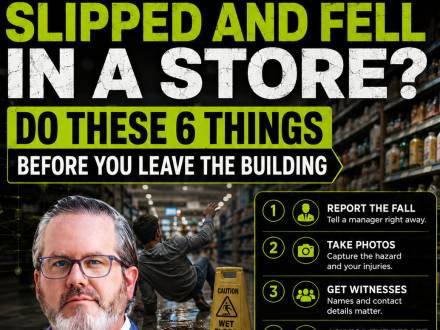
if you are searching for what to do right after I slipped and fell in a store, you are likely in a moment of confusion that feels both physical and mental. You may still be in pain, trying to understand what just happened, while also deciding whether it is "serious enough" to take action. Most people in this situation underestimate how quickly the next few minutes can shape everything that follows.
A fall inside a retail store or restaurant is often treated as a minor accident at first. Staff may appear helpful, and the environment quickly shifts back to normal activity. But what is not obvious in that moment is that key details—like the exact condition of the floor, witness memory, and even internal store reports—start changing almost immediately.
The real challenge is not the fall itself. It is the loss of clarity after the fall. People often delay reporting, avoid taking photos, or assume someone else will document what happened. That hesitation is understandable, especially when you feel embarrassed or unsure whether you "should" make a complaint.
Seldom discussed in most legal explanations is this: store incident evidence is not static. It is time-sensitive, informal, and often controlled by the business unless you act quickly and deliberately. That makes the immediate response more important than most people realize.
This guide focuses on the six practical things you should do before leaving the building—so you can protect your health, preserve facts, and avoid the most common mistakes that weaken otherwise valid claims.
The Core Problem
The real issue is not the fall—it is what gets lost immediately after it
When people search for what to do right after I slipped and fell in a store, they usually believe they are dealing with a simple question of reporting an accident. But the deeper problem is not the fall itself. It is the rapid disappearance of reliable, usable evidence in the minutes that follow.
In a retail or restaurant setting, everything is designed to return to "normal" quickly. Floors are cleaned, staff move on to the next customer, and the moment becomes part of a busy day. For the injured person, this creates a dangerous blind spot: the assumption that the truth of what happened will naturally remain intact.
Why most people misjudge the situation in real time
The AVATAR—everyday shoppers and diners—typically operates under three assumptions:
- "The store will handle the documentation fairly."
- "Someone must have seen what happened."
- "If I’m injured, it will be obvious later."
These assumptions feel reasonable in the moment, especially when you are embarrassed, shaken, or trying not to cause disruption. But they overlook how quickly control of the narrative shifts to the store environment unless you intervene.
This is where hesitation becomes costly. People often delay reporting or downplay their pain because they are still processing the shock. That delay is not just emotional—it directly affects what can be proven later.
Semantic reality: the same problem under different searches
Whether someone is searching for "what to do after slipping in a grocery store," "immediate steps after a restaurant fall," or what to do right after I slipped and fell in a store, they are really trying to solve one core issue: how to protect facts before they fade or are reframed.
Expert insight most people overlook
A critical but rarely understood dynamic is this: the first version of the incident is often the most influential one.
That means the initial store report, employee notes, and even casual verbal descriptions can quietly shape how the incident is interpreted later—sometimes more than the injured person’s own later account. If you are not actively documenting what happened, you are effectively allowing someone else to define it for you.
The real decision moment
At the center of this problem is a pressure point: you are injured, trying to stay composed, and being guided back into normal customer flow. That combination creates hesitation. And that hesitation is exactly where most cases weaken—not because the injury wasn’t real, but because the immediate evidence wasn’t secured.
Understanding this shift is the first step toward taking control of what happens next.
The Hidden Timing Shift That Most People Never Notice
The store is not recording your story—it is recording risk
One of the most overlooked realities behind what to do right after I slipped and fell in a store is that the business does not document incidents to preserve your experience. It documents them to manage its own liability exposure. This creates a quiet but powerful shift in how your case is shaped from the very beginning.
The moment a manager is informed of your fall, an internal process often begins immediately. An incident report may be created, not as a detailed narrative of what happened, but as a structured record designed to answer internal compliance questions: where it happened, whether a hazard was present, and whether staff followed procedure.
This is where a semantic variation like "immediate steps after slipping in a grocery store" becomes important. Most people assume reporting is simply about "telling what happened." In reality, it starts two parallel versions of the event: your personal memory and the store’s official documentation.
The hidden timing factor: records are shaped before you even leave
What most shoppers do not realize is that the most influential version of the incident often begins forming within minutes. Surveillance footage may be flagged for retention or deletion cycles. Staff may be instructed to clean the area quickly for safety reasons. And internal notes may be written while details are still fresh—but only from the employee’s perspective.
This matters because once these records exist, they become reference points later, especially during insurance review or legal evaluation. For everyday AVATAR shoppers and restaurant customers, this creates pressure they do not see: the system is already moving even while they are still processing pain or embarrassment.
Expert insight: documentation is procedural, not neutral
A key misunderstanding is assuming that an incident report is an objective record of truth. In practice, it is a procedural document designed for risk management. That means it may emphasize compliance steps rather than contextual detail, especially details that favor the injured person’s perspective.
Public health research consistently shows how quickly injury contexts can be altered or forgotten when not immediately documented, particularly in busy environments with high foot traffic and shifting conditions. For example, the CDC highlights the importance of timely reporting and awareness in injury prevention contexts due to how rapidly environments change after incidents occur:
https://www.cdc.gov/falls/index.html
Why this matters for your decision moment
For someone trying to figure out what to do right after I slipped and fell in a store, this creates a critical but invisible pressure point. You are not just reacting to an accident—you are reacting at the exact moment when structured records about that accident begin to form without your input.
Understanding this hidden timing shift is what separates passive experience from controlled documentation.
Why Small Mistakes After a Store Fall Become Big Consequences
Financial consequences: when "minor" injuries turn into major costs
If you misunderstand what to do right after I slipped and fell in a store, the most immediate impact is often financial. Many AVATAR shoppers assume they can "deal with it later," especially if pain feels manageable at first. But slip-and-fall injuries frequently worsen over time—turning a simple strain into weeks of physiotherapy, imaging tests, or missed work.
For example, a retail worker or parent running errands may initially walk out of the store thinking they are fine. Days later, back pain or knee swelling makes it difficult to stand for long shifts or manage household responsibilities. Without early documentation, those medical costs often fall entirely on the individual.
Legal consequences: weak evidence creates weak claims
From a legal standpoint, the biggest risk is not having a clear record of what happened. A semantic variation like "steps after slipping in a grocery store accident" highlights a critical issue: timing shapes credibility.
If there is no incident report, no photos, and no witnesses identified early, the situation becomes harder to reconstruct later. The store may rely on internal records that emphasize procedure compliance, while your version relies only on memory—something insurance companies often treat as less reliable without supporting evidence.
Emotional consequences: doubt replaces certainty
There is also a psychological cost that is rarely discussed. Many people begin to question themselves:
- "Did I miss something obvious?"
- "Should I have said something at the store?"
- "Will anyone believe me now?"
This uncertainty can be especially heavy for individuals already balancing work pressure, childcare, or financial stress. Instead of focusing on recovery, they become stuck in doubt and second-guessing.
Long-term consequences: future limitations and missed recovery opportunities
In more serious cases, untreated injuries can develop into long-term mobility issues or chronic pain. What could have been documented and managed early becomes a prolonged recovery process with fewer support options.
A simple slip in a restaurant or store can therefore shift from a short-term inconvenience into a long-term disruption of work, income stability, and daily life—especially when early steps were not taken.
The core reality
The true risk is not just the fall itself. It is the gap between what happened and what can later be proven, explained, or recovered.
A Clear Decision Framework for What to Do Before You Leave the Store
The 6-Step "Before You Walk Out" Safety Framework
If you are still processing what to do right after I slipped and fell in a store, the key is not to overthink—it is to follow a simple, structured sequence. This framework is designed for real-world conditions where you are injured, under pressure, and dealing with store staff who want to return to normal operations quickly.
Step 1: Make the incident official (Don’t rely on verbal acknowledgment)
Ask for an incident report to be created before you leave.
Why it matters: This anchors your fall in the store’s formal records, not just memory.
Avoid: Leaving after a casual apology or informal conversation.
Step 2: Capture the exact condition of the area
Take clear photos or a short video of the hazard (wet floor, spilled food, broken tile, poor lighting).
Why it matters: Conditions change quickly once cleanup begins.
Avoid: Assuming staff will preserve the scene for later review.
Step 3: Identify witnesses immediately
Collect names and contact details of anyone who saw the fall or the hazard.
Why it matters: Human memory fades fast, especially in busy retail or restaurant environments.
Avoid: Relying on "someone at the store probably saw it."
Step 4: Control your statements
Describe facts only. Do not speculate or accept blame.
Why it matters: Early statements can be repeated later in official records.
Avoid: Saying "I wasn’t watching" or minimizing your injury.
Step 5: Get checked medically—even if you feel "okay"
Pain can develop hours or days later.
Why it matters: Medical records create an objective timeline of injury.
Avoid: Waiting to see if it "goes away."
Step 6: Write down your own account immediately
Record time, location, conditions, and how the incident occurred.
Why it matters: Your memory is strongest right after the event.
Avoid: Relying on recall days later when details blur.
Expert insight: structure reduces uncertainty under pressure
Research in injury response behavior shows that people under stress make better decisions when they follow a simple sequence rather than improvising. The CDC emphasizes early injury reporting and documentation as a key part of reducing long-term harm in fall-related incidents:
https://www.cdc.gov/falls/index.html
How to use this framework in real time
For anyone asking what to do after slipping in a grocery store or restaurant, the goal is not perfection—it is completeness. If you complete these six steps before leaving, you significantly reduce the risk of missing critical evidence and increase clarity for any future decisions.
The framework works because it removes emotion from the process and replaces it with structure.
A Strong Outcome Actually Looks Like After a Store Fall
The difference is not luck—it is timing, clarity, and control
A strong outcome after a store accident does not begin in a courtroom or even in a formal claim process. It begins in the first 10–20 minutes after the fall, when decisions are still simple and evidence is still intact. For someone searching what to do right after I slipped and fell in a store, the real goal is to understand what "good handling" actually produces in the real world.
Strong outcome: clarity replaces confusion
In a well-handled case, the person leaves the store with a clear record of what happened:
- The incident is officially reported
- The hazard is documented with photos or video
- Witnesses are identified
- Medical evaluation begins early
This creates something most people underestimate: certainty. Instead of second-guessing what happened, the injured person has structured facts to rely on. That clarity reduces emotional stress and prevents the common spiral of doubt that often follows retail or restaurant falls.
A semantic variation like "proper steps after slipping in a grocery store accident" reflects this same idea—structured action leads to structured outcomes.
Weak outcome: uncertainty becomes the default
In contrast, a weak outcome usually looks like this:
- No incident report was filed
- The scene was cleaned before documentation
- No witnesses were recorded
- Pain appears later with no clear timeline
This creates financial and emotional instability. Medical bills become harder to connect to the incident, the store’s version of events dominates the record, and the injured person is left trying to reconstruct facts after the moment has already passed.
What the AVATAR actually gains from doing it right
For retail and restaurant shoppers, the real value is not just financial compensation—it is control and predictability:
- Financial stability through documented injury support
- Time saved by avoiding disputes over basic facts
- Reduced emotional burden from uncertainty or blame
- Long-term protection if symptoms develop later
When handled correctly, the incident becomes a structured event rather than a confusing memory.
Expert insight: early structure determines long-term outcomes
Public safety research consistently shows that early reporting and documentation improve the reliability of injury outcomes and reduce disputes over causation. The National Institutes of Health highlights how timely injury documentation improves both clinical and legal clarity in accident-related cases:
https://www.nih.gov/
The future state the reader is aiming for
The ideal outcome is simple: you know what happened, you can prove what happened, and you are not left guessing months later. Instead of emotional uncertainty, there is a clear record. Instead of reactive stress, there is informed control.
That is the real difference between a strong outcome and a weak one after a store slip-and-fall.
FAQs
1. What should I do right after I slipped and fell in a store if I feel embarrassed or not seriously injured?
Even if you feel embarrassed or only slightly hurt, you should still treat the situation seriously. Many injuries from store falls—like sprains or soft tissue damage—do not fully show symptoms immediately. The most important step is to report the incident and document the scene before leaving. Waiting can lead to loss of key details that support your version of events.
2. What is the first thing to do after slipping in a grocery store accident?
The first step is to make sure the incident is officially recorded by store staff. This creates a formal reference point for what happened. After that, you should document the area and your injuries as clearly as possible. These early actions protect you if the situation becomes disputed later.
3. Why is it important to act immediately after a store slip and fall?
Immediate action matters because conditions in the store can change quickly. Floors get cleaned, hazards are removed, and witnesses leave. If you delay, it becomes harder to show exactly what caused the fall. Acting early preserves the facts while they are still fresh and verifiable.
4. What happens if I don’t report my fall before leaving the store?
If you do not report it immediately, there may be no official record of the incident. This can create challenges later if your injury worsens and you try to explain what happened. Stores may rely on internal notes or lack of documentation. That makes it harder to clearly establish the situation.
5. Can I still take action later if I didn’t know what to do right after I slipped and fell in a store?
Yes, you can still take action later, but it may be more complicated. The absence of immediate documentation can make it harder to reconstruct events. You may need additional evidence such as medical records or witness statements. Early action is always stronger, but delayed action is not automatically invalid.
6. What are common mistakes people make after a store fall?
Common mistakes include leaving without reporting the incident, not taking photos of the hazard, and downplaying the injury. Another major mistake is assuming store staff will automatically document everything accurately. These errors often reduce clarity and make later steps more difficult. Avoiding these mistakes improves control over the situation.
7. How do I know if my slip and fall injury is serious?
You may not know immediately because some injuries develop over time. Pain, stiffness, or swelling can appear hours or even days later. That is why medical evaluation is recommended even when symptoms seem minor. Early assessment helps connect the injury to the incident clearly.
8. What should I avoid saying after slipping in a store?
Avoid making statements that suggest blame, such as saying it was your fault or that you were distracted. Stick only to what you observed and experienced. These statements can sometimes be recorded and referenced later. Keeping communication factual protects your position.
9. Why does timing matter so much in what to do right after I slipped and fell in a store?
Timing matters because evidence is strongest immediately after the incident. The condition of the floor, witness memory, and store records are most accurate at that moment. As time passes, details can change or disappear. Acting quickly ensures your account is supported by real-world conditions.
10. What is the safest mindset to have after a store slip and fall?
The safest mindset is to stay calm but treat the situation as time-sensitive. Focus on clarity rather than emotion or embarrassment. Prioritize documentation, reporting, and medical attention. This approach reduces confusion and helps protect your long-term interests.
Conclusion
Knowing what to do right after I slipped and fell in a store is ultimately about more than reacting to an accident—it is about protecting clarity at a moment when confusion is most likely. The real problem is not just the fall itself, but how quickly key details begin to disappear or get reshaped once the store returns to normal activity. Small decisions in those first minutes can determine whether the situation stays clear and supported by facts, or becomes uncertain and difficult to explain later.
As this article has shown, there are hidden dynamics most people miss: evidence changes fast, internal reports are created immediately, and witness memory fades sooner than expected. The stakes are not only financial, but also emotional and practical—affecting medical recovery, peace of mind, and long-term stability. Without early structure, people often find themselves trying to reconstruct events after the moment has already passed.
The difference is clear. Staying uncertain often leads to missed documentation, growing doubt, and weaker support for your experience. Moving forward with clarity means taking simple but deliberate steps that preserve facts, reduce confusion, and give you a stronger foundation for any future decisions.
If you are in a situation like this now, or recently experienced a fall in a store or restaurant and are unsure whether you handled it correctly, it may help to speak with someone who can help you understand your options in a clear and confidential way. Reaching out is not about pressure—it is about making informed decisions, protecting your position, and avoiding avoidable mistakes while the details are still fresh.
Kisner Law Scholarship Program


Kisner Law is Committed to Bettering Your Future.
Please complete the form below or contact us at 240-459-0097 for a free consultation.
 The use of the Internet or this form for communication with the firm or any individual member of the firm does not establish an attorney-client relationship. Confidential or time-sensitive information should not be sent through this form.
I have read and understand the Disclaimer and Privacy Policy.










Free Consultations 240-459-0097
From our office in Hyattsville, Maryland, Kisner Law represents injury victims and their families throughout the Anne Arundel, Montgomery County, and Prince George's County areas, including, but not limited to Annapolis, Beltsville, Bowie, College Park, Crofton, Greenbelt, Landover, Lanham, Laurel, Largo, Mount Rainier, Riverdale Park, Silver Spring, Takoma Park, and Upper Marlboro. We also serve clients across the bordering counties as well as those in Washington, D.C.
Results listed are not a guarantee or indication of future case results.
Kisner Law
8401 Corporate Drive, Suite 650, Hyattsville, MD 20785
240-459-0097



Follow us on Social Media: