


- Home
- About
- Personal Injury
- Car Accidents
- Truck Accidents
- Motorcycle Accidents
- Pedestrian Accidents
- Defective Products
- Premises Liability
- Catastrophic Injuries
- Medical Malpractice
- Nursing Home Negligence
- Sexual Abuse
- Educational Abuse
- Wrongful Death
- Scooter Accidents
- Underinsured Motorist Accidents
- Uninsured Motorist Accidents
- Workers’ Compensation
- Case Results
- Scholarship
- Blog
- Contact
The Real Reason Insurance Companies Blame Bikers First, and How Maryland Riders Fight Back
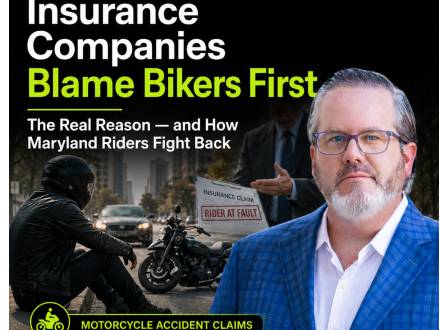
If you’re a motorcycle rider, you’ve likely felt it before—that immediate shift in tone after a crash. Before anyone even looks closely at the evidence, there’s often an unspoken assumption that you "must have done something wrong." This is exactly why so many riders end up searching for why insurance companies blame me as a rider after a crash that was not my fault.
What makes this situation especially frustrating is that it doesn’t match your experience of what actually happened. You know the road conditions, you know your speed, and you know you were riding responsibly. Yet the claims process can feel like you’re already on the defensive from the very first phone call.
This matters right now because the earliest moments after a crash often shape everything that follows—medical coverage, repair approval, and even how your story is recorded. Once an initial narrative forms, it can quietly influence decisions long before a full investigation is complete.
Seldom discussed in standard legal explanations is this: insurance companies often rely on early assumptions built from incomplete information, not final facts. That gap between assumption and reality is where many riders lose ground without even realizing it.
This article breaks down why that bias exists, how it develops so quickly, and what Maryland riders can do immediately after a crash to protect themselves from being unfairly blamed.
The core Problem: Why Riders Are Put on the Defensive From the Start
The surface problem vs. the real problem
Most riders think the issue begins after the insurance company reviews the accident. In reality, the problem starts much earlier—at the moment the crash is framed inside the insurance system.
This is the core reason behind the experience of asking why insurance companies blame me as a rider after a crash that was not my fault. It feels personal, but it is usually structural: the system is designed to form an early working theory of fault before all facts are available.
Why riders are mentally positioned as "higher risk" from the start
Motorcycle riders face a hidden disadvantage in claims processing. Because crashes involving bikes tend to result in more severe injuries, insurers subconsciously (and sometimes procedurally) treat rider cases as higher scrutiny files.
This creates a subtle but powerful effect:
-
The rider’s version of events is treated as "one input," not the default truth
-
The early focus shifts to whether the rider could have avoided the crash
-
Responsibility is explored before neutrality is established
For riders, this feels like blame. In reality, it is premature fault filtering—but the outcome often looks the same.
The blind spot most riders don’t realize they have
In the stress of a crash, riders often assume that telling the full story immediately will protect them. But this instinct can actually backfire.
Why? Because early statements are often:
-
Taken while you are injured, stressed, or disoriented
-
Recorded without full knowledge of road evidence
-
Used later as a fixed reference point, even if incomplete
This creates a mismatch between lived reality and recorded narrative—the moment where the system starts drifting away from what actually happened.
Expert insight most people overlook
Here’s what most riders never realize: insurance companies do not wait for a complete truth—they build a "working version of truth" within hours.
That working version is not final, but it becomes influential. Once it is written into internal notes, every later piece of evidence is interpreted through that early lens.
This is the hidden mechanism behind why insurance companies blame me as a rider after a crash that was not my fault: the first narrative often becomes the reference point, not the conclusion.
Why this creates pressure at the exact wrong moment
At the decision moment—right after the crash—riders are dealing with pain, confusion, and urgency. Insurance systems, however, are already beginning classification, documentation, and liability sorting.
That imbalance creates the core problem:
-
Riders are reacting emotionally and physically
-
Insurers are categorizing and framing the event procedurally
This mismatch is where most unfair assumptions begin to form—and where riders unintentionally lose control of their own story.
The Timing Gap Most Riders Never See (and How It Shapes Blame Early)
The hidden factor: two clocks running at the same time
One of the least discussed realities in motorcycle crash claims is that there are two different timelines running in parallel—but they do not move at the same speed.
On one side, there is your reality as a rider:
-
Injury recovery
-
Emotional shock
-
Reconstructing what actually happened
On the other side, there is the insurance system:
-
Rapid claim intake
-
Early fault coding
-
Internal risk classification
This mismatch in timing is a major reason riders later ask why insurance companies blame me as a rider after a crash that was not my fault. It is not always about what happened—it is about what gets recorded first.
The overlooked mechanism: "early coding" of fault
What most riders never realize is that claims often receive an initial liability direction very early in the process. This does not mean the case is decided, but it does mean the file is already being organized around a presumed direction.
Once that early direction exists:
-
New evidence is filtered through it
-
Statements are interpreted in that context
-
Contradictions are seen as "uncertainty," not correction
This is how a temporary assumption can quietly influence the entire trajectory of a claim.
Why silence or delay can unintentionally work against riders
Many riders assume that taking time before giving a full statement is safe. But in practice, delays can sometimes be misread as missing or incomplete information.
At the same time, rushed explanations given under stress can later be treated as fixed facts. This creates a difficult balance where neither speed nor delay fully protects you without strategy.
This is where the real pressure builds—because riders are forced to communicate while still processing what happened.Expert insight most legal explanations skip
A key but rarely discussed dynamic is this: insurance systems prioritize consistency over completeness in the early stages of a claim.
That means an early version of events—however incomplete—can feel more "usable" internally than a later, more accurate but more complex explanation. Once consistency is established, later corrections may be treated as uncertainty rather than clarification.
This is one of the hidden reasons riders experience bias even when they are confident they were not at fault.
Why this matters for Maryland riders specifically
For riders dealing with Maryland insurance claims, this timing gap becomes especially important because early documentation often determines how aggressively a claim is investigated—or dismissed.
Understanding this dynamic does not just explain frustration. It explains why the system can feel locked before you even get your full say.
What Happens When Riders Misread the System
Financial consequences: the slow drain most riders don’t expect
When a rider misunderstands how early fault assumptions form, the financial impact rarely shows up all at once. Instead, it builds quietly.
For example, a Maryland commuter riding to work who is wrongly flagged as partially at fault may face:
-
Delayed bike repairs while liability is "reviewed"
-
Medical bills that are only partially covered or postponed
-
Out-of-pocket rental or transportation costs for weeks
This is where why insurance companies blame me as a rider after a crash that was not my fault becomes more than frustration—it becomes a cash-flow problem that affects rent, family expenses, and job stability.
Legal consequences: losing ground without realizing it
One of the most damaging mistakes riders make is assuming the truth alone will correct the situation later.
But when early statements, police notes, or insurer summaries are not carefully managed, they can:
-
Shape how liability is interpreted
-
Limit how effectively new evidence is received
-
Make it harder to reopen or challenge fault decisions
A common scenario: a rider casually says "I think I might have braked late" during an early call. Even if later evidence shows otherwise, that phrase can become part of the claim narrative.
Emotional consequences: frustration turning into self-doubt
Riders often begin with confidence in what happened. But repeated questioning, delays, and partial blame can slowly shift that mindset.
Instead of focusing on recovery, many start asking:
-
"Did I miss something?"
-
"Could I have prevented it?"
-
"Why does it feel like no one believes me?"
This emotional pressure is not accidental—it is a byproduct of an unclear, slow-moving process that forces riders into repeated justification.
Long-term consequences: the "future rider" cost
The most overlooked impact is what happens months or years later.
A single mismanaged claim can lead to:
-
Higher insurance premiums for years
-
Difficulty proving clean riding history
-
Reduced confidence in challenging unfair decisions
Even worse, riders may begin accepting unfair outcomes just to "move on," which sets a pattern for future claims.
Real-world scenario: what this looks like in practice
Imagine a delivery rider or daily commuter in Maryland who depends on their motorcycle for income. A crash occurs that wasn’t their fault, but early assumptions shift partial blame onto them.
Instead of returning to work quickly, they face:
-
Extended downtime
-
Income disruption
-
Mounting stress about whether the system will correct itself
This is the hidden cost of misunderstanding how early blame develops—it turns a single accident into a long financial and emotional disruption.
A Clear Response Framework for Riders After a Crash
Why a structured response matters more than instinct
When a motorcycle crash happens, most riders respond based on instinct—talking quickly, trying to explain everything, or assuming the truth will naturally come out later. But this is exactly where the process begins to tilt, especially when dealing with why insurance companies blame me as a rider after a crash that was not my fault.
To regain control, riders need a structured approach that replaces emotional reaction with clear, timed decisions.
The R.I.D.E. Framework (Riders’ Immediate Decision & Evidence System)
1. R — Record everything immediately
Take photos, videos, and note road conditions, vehicle positions, skid marks, and weather.
Why it matters:
Early evidence is often the strongest because it captures the scene before it changes.
Avoid:
Relying only on memory or verbal descriptions.
2. I — Identify witnesses and independent proof
Look for bystanders, nearby drivers, CCTV cameras, or dashcams.
Why it matters:
Independent evidence reduces reliance on conflicting statements.
Avoid:
Assuming police reports alone will fully reflect what happened.
3. D — Delay detailed statements until stable
Give only basic facts early. Avoid speculation about speed, fault, or assumptions.
Why it matters:
Early stress can distort wording, which may later be interpreted as admission.
Avoid:
Guessing or trying to "fill in gaps" during insurance calls.
4. E — Evaluate all communication carefully
Track every call, message, and document from insurers. Respond consistently and factually.
Why it matters:
Consistency protects you from narrative shifts that can influence liability decisions.
Avoid:
Informal or emotional explanations that cannot be supported by evidence.
How this framework changes outcomes
Using this structure helps riders shift from reactive to controlled decision-making. Instead of wondering why insurance companies blame me as a rider after a crash that was not my fault, the focus moves to controlling what gets recorded, verified, and preserved.
It also reduces the risk of early misclassification, which is often where long-term claim problems begin.
Expert insight most riders overlook
Insurance systems do not rely on a single piece of information—they rely on patterns of consistency across time. The more structured your early response is, the harder it becomes for an inaccurate narrative to take hold.
Source: National Highway Traffic Safety Administration (NHTSA) – Crash Data and Safety Information
Strong Outcome Actually Looks Like for Riders
The difference between being controlled by the process vs. controlling it
For most riders, the outcome of a crash is shaped in the first few days without them realizing it. This is where the contrast becomes clear between a weak outcome and a strong one—especially when dealing with situations like why insurance companies blame me as a rider after a crash that was not my fault.
A weak outcome is not just about being blamed. It is a chain reaction:
-
Financial uncertainty builds as repairs and medical costs stall
-
Communication becomes confusing and inconsistent
-
The rider feels pressured to "accept" partial responsibility just to move forward
-
Time is lost in back-and-forth clarification instead of resolution
-
Emotional stress increases because the situation feels uncontrollable
In this scenario, the rider is constantly reacting, not deciding.
What a strong outcome actually looks like in real life
A strong outcome looks very different—and far more stable:
-
Financial stability: Claims are processed based on clear, documented facts, reducing delays and unexpected out-of-pocket expenses
-
Clarity and control: The rider’s version of events remains consistent, supported by evidence gathered early
-
Time efficiency: Less back-and-forth with insurers because the case is structured from the beginning
-
Emotional relief: The rider is not constantly defending themselves or second-guessing what they said
-
Long-term protection: Insurance records accurately reflect what actually happened, preventing future penalties or premium spikes based on incorrect assumptions
Instead of being trapped in uncertainty, the rider moves through the process with predictable steps and fewer surprises.
Why timing and preparation change everything
The key difference between weak and strong outcomes is not luck—it is timing. Riders who document early, communicate carefully, and avoid rushed statements significantly reduce the chance of being misclassified.
This is especially important when addressing motorcycle accident insurance disputes in Maryland, where early claim handling can heavily influence how liability is interpreted.
The stronger outcome is not about "winning an argument." It is about ensuring the system receives a complete and accurate picture before assumptions harden.
Future state: what riders are really trying to reach
At its core, every rider wants the same thing: to move past the crash without losing financial stability, time, or peace of mind. A strong outcome restores that balance by ensuring the rider is evaluated fairly, based on evidence—not early assumptions.
Source: Centers for Disease Control and Prevention (CDC) – Transportation Safety
FAQs
1. Why do insurance companies blame me as a rider after a crash that was not my fault?
Insurance companies often begin with early assumptions based on limited information, especially in motorcycle accidents where injury severity is higher. This does not mean you are actually at fault—it means the system temporarily prioritizes risk assessment over full investigation. Riders are often placed under closer scrutiny until evidence clearly proves otherwise. Understanding this helps you avoid panic and focus on documentation instead of reaction.
2. Is it normal for insurers to question my version of a motorcycle crash?
Yes, it is common for insurers to review a rider’s statement carefully, especially in cases involving conflicting accounts. When searching why insurance companies blame me as a rider after a crash that was not my fault, many riders discover that scrutiny is procedural, not personal. The key is to ensure your version remains consistent and supported by evidence. The stronger your documentation, the less room there is for misinterpretation.
3. What is the biggest mistake riders make after a crash?
The most common mistake is giving detailed or emotional statements too early. Riders often try to explain everything immediately, but early stress can lead to unclear wording that later gets used against them. Instead, focus on basic facts and preserve evidence first. This prevents misunderstandings that can shift how fault is viewed.
4. Can early statements really affect my insurance claim outcome?
Yes, early statements can significantly influence how your claim is initially categorized. Even if later evidence proves otherwise, early wording may still shape internal claim notes. This is one reason riders feel confused when asking why insurance companies blame me as a rider after a crash that was not my fault. Careful, minimal communication at the start helps avoid this risk.
5. What should I avoid saying to insurance after a motorcycle accident?
Avoid guessing fault, estimating speed, or making uncertain statements like "I think I might have…" These phrases can be interpreted as partial admissions even if they are not meant that way. Stick to factual observations only. This protects you from unnecessary complications later in the process.
6. How long does it take for insurance companies to decide fault?
Fault determination can begin within days but may take weeks depending on evidence availability. Initial assessments often happen quickly, while full investigations take longer. Riders should understand that early impressions are not final decisions. Patience combined with proper documentation usually leads to more accurate outcomes.
7. Why does it feel like the system is biased against motorcycle riders?
It often feels that way because motorcycle crashes involve higher risk and more complex injury outcomes. This leads to more detailed scrutiny during claims review. When riders search why insurance companies blame me as a rider after a crash that was not my fault, they are often reacting to this increased level of questioning. The key is recognizing it as process-driven, not personal bias.
8. What evidence helps prevent being wrongly blamed in a motorcycle crash?
Strong evidence includes photos of the scene, witness statements, video footage, and consistent documentation of events. Physical evidence often carries more weight than memory-based explanations. The earlier this information is collected, the stronger your position becomes. This reduces the risk of misinterpretation during the claim process.
9. Should I accept the first settlement offer from insurance?
Not always. Early settlement offers may be based on incomplete information or preliminary assessments. Riders dealing with motorcycle insurance disputes should carefully review whether all damages and injuries are fully accounted for. Accepting too early can limit your ability to recover full costs later.
10. How can I reduce the risk of being blamed after a crash?
The most effective way is to control the flow of information early on. Document everything, avoid speculative statements, and ensure consistency in all communications. Riders who manage the early stage carefully are less likely to face unfair fault assumptions. This directly addresses the concern behind why insurance companies blame me as a rider after a crash that was not my fault.
Conclusion
When riders ask why insurance companies blame me as a rider after a crash that was not my fault, the real answer is rarely about a single mistake or moment. It is about how quickly early assumptions form, how information is recorded under pressure, and how those early records can quietly shape the entire claim.
The hidden dynamics throughout this process are consistent: insurers move quickly to organize information, while riders are still trying to understand what happened. That timing gap is where misunderstandings form, evidence gets overlooked, and unfair blame can begin to take shape. The stakes are not just procedural—they affect your finances, recovery time, and long-term insurance record.
Staying in uncertainty often means reacting too late, correcting misunderstandings after they’ve already influenced decisions, and carrying unnecessary financial and emotional stress. Moving forward with clarity means understanding how the system works early, documenting properly, and making decisions with structure instead of pressure.
For Maryland riders, this difference can determine whether a claim feels overwhelming and unfair—or controlled and predictable.
If you’ve been in a crash and feel unsure about how your claim is being handled, it’s important not to wait while assumptions take shape. A confidential conversation can help you understand where things stand, what risks may already be forming in your case, and how to protect yourself from avoidable financial or procedural setbacks.
Kisner Law Scholarship Program


Kisner Law is Committed to Bettering Your Future.
Please complete the form below or contact us at 240-459-0097 for a free consultation.
 The use of the Internet or this form for communication with the firm or any individual member of the firm does not establish an attorney-client relationship. Confidential or time-sensitive information should not be sent through this form.
I have read and understand the Disclaimer and Privacy Policy.










Free Consultations 240-459-0097
From our office in Hyattsville, Maryland, Kisner Law represents injury victims and their families throughout the Anne Arundel, Montgomery County, and Prince George's County areas, including, but not limited to Annapolis, Beltsville, Bowie, College Park, Crofton, Greenbelt, Landover, Lanham, Laurel, Largo, Mount Rainier, Riverdale Park, Silver Spring, Takoma Park, and Upper Marlboro. We also serve clients across the bordering counties as well as those in Washington, D.C.
Results listed are not a guarantee or indication of future case results.
Kisner Law
8401 Corporate Drive, Suite 650, Hyattsville, MD 20785
240-459-0097



Follow us on Social Media: