


- Home
- About
- Personal Injury
- Car Accidents
- Truck Accidents
- Motorcycle Accidents
- Pedestrian Accidents
- Defective Products
- Premises Liability
- Catastrophic Injuries
- Medical Malpractice
- Nursing Home Negligence
- Sexual Abuse
- Educational Abuse
- Wrongful Death
- Scooter Accidents
- Underinsured Motorist Accidents
- Uninsured Motorist Accidents
- Workers’ Compensation
- Case Results
- Scholarship
- Blog
- Contact
Will Filing an Uninsured Motorist Claim Raise Your Rates? The Myth Keeping Maryland Victims From the Money They're Owed
Will Filing an Uninsured Motorist Claim Raise Your Rates? The Myth Keeping Maryland Victims From the Money They're Owed
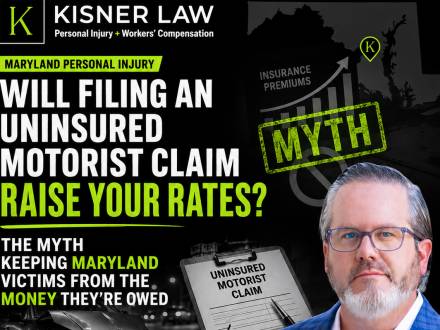
After being hit by an uninsured or underinsured driver, most people in Maryland are dealing with more than just vehicle damage—they’re suddenly facing medical bills, transportation stress, and a sense that the system is working against them. In that moment, one question tends to dominate everything else: will my own rates go up if I use my uninsured motorist coverage after being hit?
For many victims, this fear becomes a silent barrier. Even when they are clearly entitled to compensation, they hesitate because they assume filing a claim through their own insurance will be treated like they caused the crash. That assumption often leads to delayed claims, unpaid medical treatment, and unnecessary financial strain.
What is rarely explained clearly is that uninsured motorist coverage is designed specifically for situations like this—where the other driver cannot pay. Yet most people are never told how insurers actually categorize these claims or how that classification affects premiums (and in many cases, it doesn’t in the way people expect).
The real problem isn’t just the accident. It’s the misinformation that turns a protection meant to help victims into something they fear using.
This article breaks down what actually drives insurance rate decisions, what most victims misunderstand in the critical first days after a crash, and how to make a clear, informed choice when everything feels uncertain.
The Core Problem
The Real Issue Isn’t the Claim — It’s the Assumption Behind It
At first glance, the question will my own rates go up if I use my uninsured motorist coverage after being hit sounds like a simple insurance concern. But the real issue is deeper: most victims are not reacting to facts—they are reacting to fear shaped by incomplete understanding of how insurance actually works.
After an accident with an uninsured driver, people instinctively assume one rule applies to all claims: if I use insurance, I will be punished for it. That belief feels logical in a stressful moment, especially when the accident wasn’t their fault but the financial burden suddenly is.
This is where the first major misunderstanding begins.
The Hidden Blind Spot: Treating All Claims as "At-Fault Events"
Victims often mentally group every type of claim into one category. To them, a claim is a claim—something that might raise premiums. But insurance systems do not work that way.
Uninsured motorist coverage is fundamentally different because it is triggered when someone else causes harm and cannot pay for it. Yet many people still interpret it through the lens of collision claims, where fault and risk are tied to the policyholder.
This confusion leads to hesitation at the exact moment action is needed most.
Why Fear Overrides Logic in the Decision Moment
In the hours and days after an accident, victims are not thinking in legal categories. They are thinking in survival terms:
- "Can I afford this?"
- "Will this make things worse?"
- "Am I about to hurt my financial record?"
That emotional pressure often overrides rational decision-making. As a result, many delay or avoid filing valid claims, even when uninsured motorist coverage exists specifically to protect them.
Expert Insight Most People Miss
Here is the critical dynamic that is rarely understood: insurance companies don’t simply "penalize claims"—they classify risk based on fault patterns, not every use of coverage.
That means the real question is not whether a claim was filed, but whether the claim signals that you are a recurring financial risk. In uninsured motorist cases, that risk signal is usually absent because the accident itself does not reflect your driving behavior.
This distinction is what most victims miss—and it is exactly what shapes whether the fear behind will my insurance go up if I file an uninsured motorist claim is justified or misplaced.
The problem, therefore, is not the claim itself. It is the misunderstanding of how risk is actually evaluated behind the scenes.
The Hidden Timing Effect Most Victims Never Consider
Why "When You File" Can Matter More Than "Whether You File"
Most discussions about insurance focus on whether a claim will raise your rates. But a far less understood factor is timing. In real-world insurance systems, the moment you file a claim can matter almost as much as the claim itself—especially when asking will my own rates go up if I use my uninsured motorist coverage after being hit.
What victims don’t see is that insurance companies operate on reporting cycles tied to policy renewals, internal risk reviews, and aggregated "loss history" snapshots. These systems don’t evaluate you instantly. Instead, they evaluate patterns over time.
So a UM claim may not impact your premium immediately—but it can appear later during a renewal review, when your entire risk profile is reassessed in bulk.
The Overlooked Mechanism: Claim "Visibility Lag"
Here is the dynamic most people miss: when a claim is filed, it enters internal insurance systems as a data point. But that data point does not always influence pricing right away. Instead, it often sits in what insurers call a loss history file, which is reviewed during:
- Policy renewal periods
- Annual underwriting updates
- Risk model recalibrations
This creates a "lag effect," where the financial impact—if any—is delayed and bundled with other factors rather than triggered instantly.
Why This Matters for Uninsured Motorist Claims
For victims dealing with uninsured drivers, this timing delay can create confusion. They may assume:
"Nothing happened to my rates right after filing, so I’m safe."
But the real reality is more structured. The system may simply not have reached the evaluation stage yet.
Importantly, consumer-facing regulatory guidance from the National Association of Insurance Commissioners highlights that insurers use broader underwriting data rather than single-event penalties when adjusting premiums:
https://content.naic.org
The Pressure Victims Feel During This Gap
This delay period is where fear grows. Victims often second-guess their decision, worry unnecessarily, or delay necessary medical and financial recovery steps because they assume hidden consequences are already in motion.
In reality, the system is slower, more structured, and more segmented than most people realize—especially when evaluating claims tied to someone else’s negligence.
Understanding this timing gap reframes the core question behind will my insurance go up if I file an uninsured motorist claim: the issue is not immediate punishment, but delayed, aggregated evaluation that depends on broader risk patterns—not isolated claims.
The Real Stakes Behind Waiting, Guessing, or Getting It Wrong
Why Misunderstanding This Decision Creates a Chain Reaction
For victims of uninsured and underinsured drivers, the question will my own rates go up if I use my uninsured motorist coverage after being hit often leads to hesitation. That hesitation may feel harmless in the moment, but it can quietly trigger a series of consequences that are far more damaging than any possible insurance adjustment.
The real risk is not just about premiums—it is about what happens while you are trying to "be careful."
Financial Consequences: Small Delays Become Large Debts
When victims delay or avoid filing a UM claim, they often shift costs onto themselves without realizing it:
- Emergency room bills paid out-of-pocket
- Physical therapy sessions postponed or skipped
- Vehicle repairs delayed, increasing long-term damage costs
For example, a working parent relying on a daily commute may try to "wait and see" before filing a claim. In that waiting period, they may end up renting a vehicle or missing work shifts. What seemed like caution turns into compounding financial strain.
Legal Consequences: Lost Time Can Limit Recovery
Insurance and injury claims are time-sensitive. Evidence fades, medical documentation weakens, and filing deadlines approach faster than most people expect.
A common scenario is a victim assuming they can decide later, only to discover that:
- Certain expenses are no longer fully recoverable
- Documentation gaps weaken their claim value
- The insurer disputes delayed treatment as unrelated to the accident
This is where misunderstanding does using UM coverage affect insurance rates can indirectly lead to reduced compensation—not because of premiums, but because of timing.
Emotional Consequences: Stress That Multiplies Quietly
The emotional burden often escalates in silence:
- Constant uncertainty about bills
- Anxiety about "doing the wrong thing" with insurance
- Pressure to avoid conflict with insurers
For someone already recovering from an accident, this mental load can slow healing and increase long-term stress.
Long-Term Consequences: The Cost of "Trying to Avoid a Cost"
The most serious risk is future instability. Victims who avoid or delay filing often find themselves months later:
- Paying debt they should not carry
- Still dealing with unresolved injuries
- Wondering if they unknowingly sacrificed compensation rights
In reality, the attempt to avoid a possible premium increase often creates a far greater and more permanent financial loss.
A Clear Decision Framework for Filing an Uninsured Motorist Claim
The Goal: Replace Fear With a Simple, Repeatable Decision Path
When someone is asking will my own rates go up if I use my uninsured motorist coverage after being hit, the real problem is not lack of information—it’s lack of structure. In high-stress moments, people need a clear sequence, not assumptions. This framework is designed to turn uncertainty into a logical decision process.
Step 1: Confirm the Type of Accident (Fault vs. No Fault Reality Check)
What to do:
Identify whether the other driver was uninsured or underinsured and confirm you were not at fault.
Why it matters:
This determines whether your UM/UIM coverage is the correct tool.
What to avoid:
Don’t assume all claims are treated the same. Collision and UM claims follow different logic.
Step 2: Verify Your Coverage Scope
What to do:
Check your policy for uninsured motorist (UM) or underinsured motorist (UIM) coverage limits.
Why it matters:
Many victims underestimate how much protection they actually already have.
What to avoid:
Don’t delay verification. Time gaps can complicate documentation and claim clarity.
Step 3: Separate Emotion From Insurance Logic
What to do:
Ask a structured question: Does this claim reflect my driving behavior or someone else’s negligence?
Why it matters:
This directly influences whether insurers classify it as risk-related or non-risk-related.
What to avoid:
Avoid assuming that filing automatically affects premiums—this is where most confusion begins around does filing uninsured motorist coverage increase insurance rates.
Step 4: Act Within a Controlled Time Window
What to do:
File the claim promptly while medical and accident evidence is still fresh.
Why it matters:
Stronger documentation leads to smoother claim evaluation and fewer disputes.
What to avoid:
Do not wait for "perfect certainty." Delay is one of the most costly mistakes.
Step 5: Use External Standards to Understand Insurance Structure
Insurance systems are regulated, not arbitrary. Understanding broader frameworks helps reduce fear-driven decisions.
Reference guidance from the Insurance Information Institute:
https://www.iii.org/article/understanding-auto-insurance
Outcome of Following This Framework
By following these steps, victims replace emotional uncertainty with structured decision-making. Instead of asking only will my insurance go up if I file a UM claim, they begin evaluating coverage correctly, acting within safe timelines, and protecting their financial recovery.
A Strong Outcome Actually Looks Like
The Difference Between a Protected Recovery and a Financial Setback
For victims of uninsured drivers, the outcome is not only about whether compensation exists—it is about whether life stabilizes afterward. The question will my own rates go up if I use my uninsured motorist coverage after being hit often reflects a deeper concern: Will this decision create more problems than it solves?
A strong outcome answers that fear with clarity, structure, and financial control.
Strong Outcome: Stability, Clarity, and Controlled Recovery
In a well-handled uninsured motorist claim, the victim experiences a sequence of stabilization:
- Medical bills are covered without draining personal savings
- Vehicle repairs or replacement are handled without long delays
- Lost wages are recovered in a structured, predictable way
- Communication with the insurer is clear, documented, and non-confrontational
Most importantly, the victim understands that using UM coverage does not automatically translate into premium punishment, which removes the emotional burden of uncertainty.
This creates something rare after an accident: decision confidence. The victim no longer second-guesses whether they made the right choice.
Weak Outcome: Confusion, Delay, and Hidden Financial Pressure
In contrast, a weak outcome often begins with hesitation driven by fear of rate increases:
- Delaying the claim while medical bills accumulate
- Paying out-of-pocket for expenses that should have been covered
- Returning to work too early due to financial pressure, worsening injuries
- Living with ongoing uncertainty about whether filing was a mistake
In these situations, the cost is not just financial—it is psychological. The constant question of does uninsured motorist coverage increase insurance rates after accident becomes a source of stress that lingers long after the crash itself.
Why Timing and Structure Change Everything
The strongest outcomes consistently come from three factors:
- Prompt filing while evidence is still fresh
- Clear understanding of coverage before acting
- Separation of emotional fear from insurance classification logic
When these align, victims preserve both financial stability and long-term predictability in their insurance profile.
Future State: What Success Actually Feels Like
A well-managed UM claim leads to a quieter kind of recovery:
- No lingering debt from an accident you did not cause
- No uncertainty about hidden insurance penalties
- No emotional exhaustion from unresolved financial stress
According to the National Safety Council, motor vehicle crash costs in the U.S. exceed hundreds of billions annually, much of which falls on individuals without proper coverage utilization:
https://www.nsc.org/road-safety/safety-topics/economic-costs
This is why understanding how to correctly use uninsured motorist coverage is not just a legal issue—it is a financial protection strategy.
In the best-case scenario, the victim moves forward with control, not confusion.
FAQs
1. Will my own rates go up if I use my uninsured motorist coverage after being hit?
In most cases, filing an uninsured motorist claim does not automatically cause your insurance rates to increase. This is because the claim is based on someone else’s fault, not your driving behavior. However, insurers can review overall claim history during renewals. The key factor is whether the claim signals a pattern of risk, not a single incident. Understanding this helps reduce unnecessary fear when deciding whether to file.
2. Does uninsured motorist coverage increase insurance rates after an accident?
Many people assume any claim raises premiums, but uninsured motorist coverage is treated differently from at-fault claims. It is designed to protect you when another driver cannot pay. While policies vary, this type of claim is generally not treated as a surcharge event. The confusion comes from mixing UM claims with collision claims, which are handled differently.
3. If I file an uninsured motorist claim, will it be treated like I caused the accident?
No, an uninsured motorist claim is based on the other driver’s fault, not yours. Insurance companies investigate liability separately before approving payment. The purpose of UM coverage is to ensure you are not financially punished for someone else’s negligence. This distinction is critical when evaluating whether filing will impact your premiums.
4. Should I avoid filing a UM claim to protect my insurance record?
Avoiding a valid claim can actually create more financial harm than benefit. Medical bills, repair costs, and lost wages can quickly exceed what people expect. The belief that will my insurance go up if I file a UM claim is often outweighed by the real cost of paying out-of-pocket. In most cases, delaying or avoiding a claim creates greater long-term financial pressure.
5. How quickly should I file an uninsured motorist claim after an accident?
It is generally best to file as soon as possible after the accident. Early filing helps preserve evidence, documentation, and witness information. Delays can weaken your claim or make it harder to prove medical and financial losses. Acting quickly also reduces uncertainty during an already stressful period.
6. Can my insurance company cancel me for using uninsured motorist coverage?
Using uninsured motorist coverage alone is not typically a reason for cancellation. Insurance companies usually base cancellations on repeated high-risk behavior or fraud concerns. A single legitimate claim is not usually treated as a policy violation. The key is that the claim must be properly documented and truthful.
7. Why do people worry that uninsured motorist claims will raise premiums?
This fear comes from misunderstanding how insurance categories work. People often assume all claims are treated equally, but insurers distinguish between fault-based and non-fault-based claims. Because of this confusion, many victims incorrectly assume does uninsured motorist coverage affect insurance rates after accident in the same way as collision claims.
8. What happens if I delay filing a UM claim?
Delaying a claim can create several problems, including missing documentation deadlines and weakening medical evidence. Insurance companies may question whether injuries are related to the accident if too much time passes. Financial stress can also increase during the delay. Acting early helps protect both your legal and financial position.
9. Will filing a UM claim affect my future insurance applications?
In most cases, a single uninsured motorist claim does not heavily impact future applications. Insurers typically focus on driving history and at-fault accidents. However, repeated claims over time may influence risk assessments. The key factor is overall pattern, not isolated incidents.
10. What is the biggest mistake people make with uninsured motorist coverage?
The biggest mistake is not using it when it is needed due to fear of premium increases. This hesitation often leads to paying expenses personally that should have been covered. Misunderstanding does filing uninsured motorist coverage increase insurance rates causes many victims to delay or avoid rightful compensation. Acting based on fear instead of facts is the most costly error.
Conclusion
The question will my own rates go up if I use my uninsured motorist coverage after being hit reflects a deeper conflict between fear and financial protection. Most victims are not unsure about the accident—they are unsure about the system responding fairly. That uncertainty often leads to hesitation at the exact moment action is needed.
As this article has shown, the real issue is not simply whether rates increase, but how insurance systems classify claims, evaluate risk over time, and distinguish between fault and non-fault situations. Hidden timing effects, misunderstanding of claim categories, and emotional pressure all combine to create unnecessary delay and financial exposure.
The difference between staying in uncertainty and moving forward with clarity is significant. Uncertainty leads to delayed claims, unpaid expenses, and long-term stress. Informed action leads to structured recovery, financial protection, and peace of mind.
If you are facing this decision now, the most important step is not guessing—it is understanding your rights before you act.
If you are still unsure whether filing a claim could affect your situation, reaching out for a confidential discussion can help you make a clear, informed decision based on your specific circumstances. The goal is not pressure—it is protection, clarity, and avoiding costly mistakes before they happen.
Kisner Law Scholarship Program


Kisner Law is Committed to Bettering Your Future.
Please complete the form below or contact us at 240-459-0097 for a free consultation.
 The use of the Internet or this form for communication with the firm or any individual member of the firm does not establish an attorney-client relationship. Confidential or time-sensitive information should not be sent through this form.
I have read and understand the Disclaimer and Privacy Policy.










Free Consultations 240-459-0097
From our office in Hyattsville, Maryland, Kisner Law represents injury victims and their families throughout the Anne Arundel, Montgomery County, and Prince George's County areas, including, but not limited to Annapolis, Beltsville, Bowie, College Park, Crofton, Greenbelt, Landover, Lanham, Laurel, Largo, Mount Rainier, Riverdale Park, Silver Spring, Takoma Park, and Upper Marlboro. We also serve clients across the bordering counties as well as those in Washington, D.C.
Results listed are not a guarantee or indication of future case results.
Kisner Law
8401 Corporate Drive, Suite 650, Hyattsville, MD 20785
240-459-0097



Follow us on Social Media: