


- Home
- About
- Personal Injury
- Car Accidents
- Truck Accidents
- Motorcycle Accidents
- Pedestrian Accidents
- Defective Products
- Premises Liability
- Catastrophic Injuries
- Medical Malpractice
- Nursing Home Negligence
- Sexual Abuse
- Educational Abuse
- Wrongful Death
- Scooter Accidents
- Underinsured Motorist Accidents
- Uninsured Motorist Accidents
- Workers’ Compensation
- Case Results
- Scholarship
- Blog
- Contact
Your Child Was Hurt in a Car Accident: What Happens to Their Settlement in Maryland, and Why It's Locked Until 18
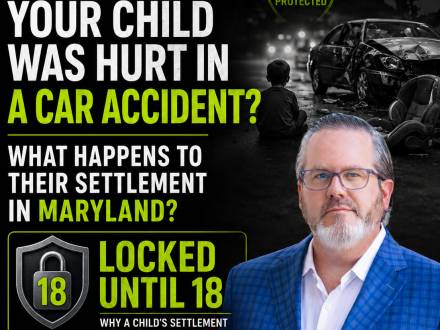
If you’re searching "my child was hurt in a car accident in Maryland what happens to the settlement," you’re likely trying to make sense of something that already feels overwhelming—medical visits, insurance calls, and the constant worry about whether your child will fully recover.
In the middle of all that pressure, the settlement becomes more than just money. It starts to feel like a lifeline for future care, therapy, or stability. So when you learn that the funds are not immediately accessible—or that they are "locked" until your child turns 18—it can feel confusing, even frustrating.
Here is what most parents are not told early enough: a child’s settlement in Maryland is not treated like a typical payout. It is legally separated from the parent’s control, not because trust is lacking, but because the system is designed to protect the child from financial risk, misuse, or premature spending decisions made under stress.
This article will break down what is actually happening behind the scenes, why courts structure these settlements the way they do, and what that means for your family right now—not years later. We will also uncover a seldom-discussed reality: even "approved" settlements can vary significantly in how and when they can be used, depending on court structure and case details.
Understanding this process now is not just about legal clarity—it’s about regaining a sense of control during one of the most uncertain moments a parent can face.
The Core Problem
The real issue is not the settlement—it is control under uncertainty
When parents ask "my child was hurt in a car accident in Maryland what happens to the settlement," the surface question is about money. But the deeper issue is something more urgent: who gets to make decisions when everything already feels out of control.
After a serious accident, parents are operating under pressure—medical decisions, time off work, insurance uncertainty, and fear about long-term recovery. In that state, it feels natural to assume the settlement should move directly into your hands. That assumption becomes a blind spot.
The hidden legal reality most parents miss
In Maryland, a child’s settlement is not treated as family funds. It is treated as the child’s legal property, even though the parent brings the claim forward. This separation is where most confusion begins.
So the real problem is not whether the money exists, but why the system removes immediate access even from well-meaning parents. The law is designed around a protective principle: children cannot legally make financial decisions, and courts assume that even parents—under stress, grief, or urgency—should not have unrestricted control over large sums tied to injury compensation.
This is why settlements are often placed into restricted accounts or structured arrangements instead of being released directly.
Seldom-discussed expert insight: protection can feel like restriction
One of the most misunderstood dynamics is this: the legal system prioritizes error prevention over convenience.
That means the court is not asking, "What does the family need right now?" in a purely practical sense. Instead, it is asking, "How do we ensure this money is still safe in five, ten, or fifteen years?"
This creates a gap between expectation and reality. Parents expect access to solve immediate pressure points—medical bills, lost income, or rehabilitation costs. But the legal structure is intentionally designed to slow that access, not speed it up.
Why this feels so emotionally difficult
At the decision moment, parents are not thinking in legal categories—they are thinking in survival terms. That is why the restriction often feels like loss, even though it is actually control redistribution.
Understanding this distinction is the first step toward making sense of what is happening beneath the surface of a child injury settlement.
A Hidden Dynamic or Overlooked Factor
The timing gap no one warns parents about
One of the least discussed realities in a child injury case is that the settlement process and the money’s real-world usefulness do not move at the same speed. This is especially important for parents trying to understand "my child was hurt in a car accident in Maryland what happens to the settlement" or its close variation, minor car accident settlement Maryland outcomes.
On paper, a settlement may look "resolved" once an agreement is reached. In reality, the usable funds often sit in legal and administrative layers for weeks or even months afterward.
Why approval is only the beginning—not the payout
After court approval, several steps still happen behind the scenes: structuring the funds, resolving medical liens, coordinating insurance reimbursements, and setting up restricted accounts or annuities. Each step is designed to protect the child, but together they create a deliberate delay between resolution and access.
What most parents don’t anticipate is that this delay can directly overlap with the very period when financial pressure is highest—rehabilitation, follow-up treatment, and time off work.
The overlooked financial friction point
A key hidden dynamic is the mismatch between medical billing timelines and settlement disbursement timelines. Hospitals and insurers often demand payment or reimbursement long before settlement funds are actually accessible.
This creates a stressful overlap where families may feel "settled" legally but still financially strained in practice.
According to the National Highway Traffic Safety Administration, crash-related injuries often require ongoing treatment and long-term recovery planning rather than one-time care, which increases the importance of timing in financial recovery planning:
National Highway Traffic Safety Administration – Traffic Safety Facts
Why this matters for parents under pressure
For families navigating a child’s recovery, this timing gap can feel like a contradiction. The case is "over," yet the financial relief has not arrived in a usable form.
The key insight is this: a settlement is a legal event, but financial recovery is a staged process. Courts and insurers are not delaying help—they are sequencing it. But from a parent’s perspective, that sequence can feel like delay, uncertainty, or even instability.
Understanding this hidden timing structure helps parents anticipate pressure points instead of being surprised by them.
The Stakes and Consequences
When misunderstanding the settlement creates avoidable pressure
For parents trying to understand "my child was hurt in a car accident in Maryland what happens to the settlement," the biggest risk is not the legal process itself—it is misinterpreting what control you actually have and when it exists. That misunderstanding can quietly create financial and emotional strain at the worst possible time.
Financial consequences: short-term pressure becomes long-term debt
If parents assume settlement funds will be immediately available, they may delay other financial decisions—like adjusting work schedules, arranging alternative care, or planning for therapy costs. When the reality of restricted access sets in, families often turn to credit cards, personal loans, or savings withdrawals to bridge the gap.
For a working parent already missing income due to caregiving responsibilities, this can quickly turn a temporary recovery phase into long-term debt accumulation.
Legal consequences: delays and stricter oversight
Misunderstanding the structure of a minor settlement can also lead to procedural mistakes—such as informal attempts to access funds or miscommunication about approved uses. Even well-intentioned errors can result in stricter court oversight or additional approval requirements for future withdrawals.
This is especially important in minor car accident settlement Maryland cases, where courts prioritize safeguarding the funds over flexibility.
Emotional consequences: stress that compounds recovery
Parents often underestimate the emotional toll of financial uncertainty during recovery. Instead of focusing on the child’s healing, attention becomes divided between medical needs and financial survival.
In households where both parents work, this can also create tension—one parent may prioritize immediate spending needs while the other focuses on long-term preservation of funds.
Long-term consequences: future instability for the child
The most overlooked risk is the long-term impact. If funds are mismanaged early or eroded through avoidable financial pressure, the child may reach adulthood with significantly reduced resources for education, rehabilitation, or independence.
What begins as confusion about a settlement can quietly turn into a reduced financial foundation for the child’s future.
The key takeaway is simple: misunderstanding the process does not stop the system—it only shifts the cost back onto the family in more stressful and less visible ways.
Provide a Framework or Guidance Path
A clear decision framework for understanding a child’s settlement in Maryland
When parents search "my child was hurt in a car accident in Maryland what happens to the settlement," what they really need is not more information—but a clear sequence for what happens next and how to respond without mistakes. The following framework helps you stay grounded, reduce risk, and make informed decisions at each stage.
Step 1: Confirm the legal status of the claim (Control Checkpoint)
Before thinking about money use, confirm whether the case is still in negotiation, pending court approval, or already settled.
Why it matters:
Each stage determines whether you can influence timing, structure, or documentation.
What to avoid:
Assuming funds are "available" once a number is agreed upon.
Step 2: Understand the protection structure (Structure Checkpoint)
In most minor car accident settlement Maryland cases, funds are placed into one of three systems: restricted accounts, structured settlements, or court-supervised arrangements.
Why it matters:
This determines when and how money can be accessed.
What to avoid:
Expecting full, immediate access after approval.
Step 3: Map out real expenses vs. legal access timing (Pressure Checkpoint)
List immediate needs: medical bills, therapy, transportation, and lost income. Then compare them with when funds are actually released.
Why it matters:
This prevents financial gaps caused by timing mismatches.
What to avoid:
Relying solely on settlement funds for urgent short-term costs.
Step 4: Use court-approved pathways for urgent needs (Safety Checkpoint)
If immediate child-related expenses arise, they may require formal approval or structured withdrawals through the court system.
Why it matters:
Prevents violations and protects long-term eligibility.
What to avoid:
Informal or undocumented use of settlement funds.
Step 5: Plan for the "18 transition point" (Future Checkpoint)
The settlement is typically locked until adulthood, meaning long-term planning is essential from the beginning.
Why it matters:
Ensures funds remain intact and purposeful for education, recovery, or independence.
What to avoid:
Treating the settlement as short-term relief money.
High-authority reference for context
For broader understanding of child protection and legal safeguards in financial decision-making, see:
U.S. Department of Health & Human Services – Child Welfare Information Gateway
Core takeaway
This framework helps parents shift from emotional reaction to structured thinking. Instead of asking only what happens to the settlement, the more powerful question becomes: how do I navigate each stage without putting the child’s future at risk?
Understanding this structure reduces stress, prevents costly assumptions, and brings clarity during a highly emotional time
Show What a Strong Outcome Looks Like
What a strong settlement outcome actually looks like for families in Maryland
For parents asking "my child was hurt in a car accident in Maryland what happens to the settlement," the ideal outcome is not just receiving compensation—it is achieving long-term stability without ongoing financial confusion or emotional strain.
In a strong outcome, everything is structured clearly from the start. The settlement is properly approved, placed into a secure system, and aligned with the child’s future needs. There are no surprises about access, no misunderstandings about timing, and no hidden financial pressure on the family.
Strong outcome vs. weak outcome
Financial stability
A strong outcome ensures funds are protected and preserved for long-term needs like education, rehabilitation, or transition into adulthood. The money grows or remains stable depending on structure.
A weak outcome often happens when families misunderstand timing or assume flexibility that does not exist, leading to unnecessary borrowing, debt, or premature depletion of personal savings.
Clarity and control
In a strong outcome, parents understand each stage of the process. They know what is locked, what is pending, and what is accessible only with court approval.
In a weak outcome, confusion dominates. Parents feel like they are waiting without answers, often revisiting decisions under stress.
Time and emotional load
Strong outcomes reduce repeated calls, uncertainty, and financial panic. Parents can focus on the child’s recovery instead of administrative stress.
Weak outcomes create ongoing emotional strain, where financial uncertainty competes with caregiving responsibilities.
Long-term protection
A properly structured minor car accident settlement Maryland case ensures that when the child reaches adulthood, the funds are intact, documented, and ready for meaningful use.
A poorly managed path risks reduced funds, missed opportunities for growth, and limited financial flexibility for the child’s future.
Why timing and structure change everything
According to the Consumer Financial Protection Bureau, structured financial planning improves long-term financial stability and reduces risk exposure for vulnerable beneficiaries, especially minors:
Consumer Financial Protection Bureau – Financial Protection Guidance
The future state families actually want
The strongest outcome feels simple: no financial uncertainty, no legal confusion, and no emotional second-guessing. Parents know the settlement is secure, the child’s needs are protected, and the future is financially stable—even if access is delayed.
That clarity, more than anything else, is what transforms a difficult situation into a manageable one.
FAQs
1. If my child was hurt in a car accident in Maryland what happens to the settlement money?
The settlement does not go directly to the parent or child for immediate use. Instead, it is placed under court supervision in a protected account or structured arrangement. This is done to ensure the money is preserved for the child’s long-term benefit. Parents usually cannot freely access it until the child turns 18, except in limited, approved situations.
2. Why is a minor car accident settlement in Maryland locked until age 18?
The system is designed to protect children from financial harm before they are legally able to manage money. Courts assume large sums should not be spent impulsively or under emotional pressure. Even though parents bring the claim, the funds belong to the child. This restriction is meant to preserve financial stability for adulthood.
3. Can parents use settlement money for medical bills or therapy?
Sometimes, but not automatically. In most cases, court approval is required before using settlement funds for expenses. The court must be satisfied that the spending directly benefits the child’s recovery or well-being. Without approval, accessing funds can create legal complications or delays.
4. How long does it take to receive a child injury settlement in Maryland?
Even after agreement, it can take weeks or months before funds are fully set up and usable in their protected structure. Court approval, paperwork, and account setup all take time. Many parents underestimate this delay, especially when immediate medical costs are involved. The process is structured for protection, not speed.
5. What mistakes do parents make with a child settlement in Maryland?
One common mistake is assuming the settlement functions like regular compensation that can be used immediately. Another is not planning for the gap between approval and actual access. These misunderstandings can lead to unnecessary financial pressure. The key is understanding timing and restrictions early in the process.
6. Who controls the settlement if my child was hurt in a car accident in Maryland?
Control usually rests with a court-approved guardian or trustee, not the parents alone. Even though parents manage day-to-day care decisions, financial control is legally separated. This ensures that the funds are protected from misuse. The court remains the ultimate authority over distribution.
7. What happens to unused settlement money when the child turns 18?
Once the child reaches adulthood, they typically gain full legal access to any remaining funds. This includes the ability to withdraw, invest, or use the money as they choose. The goal is to ensure they enter adulthood with financial resources intact. Proper structuring during childhood determines how much remains available.
8. Can a child’s settlement be changed after court approval?
Changes are possible but limited and usually require strong justification and court approval. Courts are cautious about altering settlements because they are designed for long-term protection. Any modification must still prioritize the child’s best interests. This is why initial structuring is so important.
9. Why do families feel financial pressure even after settling a case?
Because settlement approval does not always mean immediate access to funds. There is often a delay due to legal structuring and court processes. During this time, families may still face medical or living expenses. This creates a gap between "legal resolution" and "financial relief."
10. What is the biggest risk families face after a child injury settlement in Maryland?
The biggest risk is misunderstanding how the system works and making financial decisions based on incorrect assumptions. This can lead to debt, stress, or poor planning during a critical recovery period. The settlement itself is usually secure—the challenge is navigating timing and access correctly. Awareness early in the process prevents most long-term issues.
Conclusion
When parents ask "my child was hurt in a car accident in Maryland what happens to the settlement," they are usually trying to regain a sense of control in a situation that already feels overwhelming. The core reality is that the settlement is not simply a payout—it is a protected financial structure designed to secure a child’s future, not provide immediate relief.
Behind the scenes, the system is shaped by two key dynamics: court supervision and timing delays. These are not random barriers—they are intentional safeguards that determine when and how funds can be accessed. While this structure can feel restrictive, it is built around long-term protection rather than short-term convenience.
The real stakes are not just legal. They are financial stability, emotional pressure on the family, and the child’s future security. Misunderstanding how the process works often leads to unnecessary stress, poor financial decisions, and avoidable gaps during recovery.
Staying in uncertainty leaves parents reacting to problems as they appear—often under pressure. Moving forward with clarity allows families to anticipate timing, avoid financial missteps, and make decisions that protect both immediate needs and long-term outcomes.
If you are navigating a minor car accident settlement Maryland situation and feeling unsure about what comes next, the most important step is getting clear, accurate guidance tailored to your specific circumstances. A short, confidential conversation can help you understand what is happening in your case, what risks to avoid, and how to protect your child’s financial future without adding unnecessary stress.
Kisner Law Scholarship Program


Kisner Law is Committed to Bettering Your Future.
Please complete the form below or contact us at 240-459-0097 for a free consultation.
 The use of the Internet or this form for communication with the firm or any individual member of the firm does not establish an attorney-client relationship. Confidential or time-sensitive information should not be sent through this form.
I have read and understand the Disclaimer and Privacy Policy.








Free Consultations 240-459-0097
From our office in Hyattsville, Maryland, Kisner Law represents injury victims and their families throughout the Anne Arundel, Montgomery County, and Prince George's County areas, including, but not limited to Annapolis, Beltsville, Bowie, College Park, Crofton, Greenbelt, Landover, Lanham, Laurel, Largo, Mount Rainier, Riverdale Park, Silver Spring, Takoma Park, and Upper Marlboro. We also serve clients across the bordering counties as well as those in Washington, D.C.
Results listed are not a guarantee or indication of future case results.
Kisner Law
8401 Corporate Drive, Suite 650, Hyattsville, MD 20785
240-459-0097



Follow us on Social Media: