


- Home
- About
- Personal Injury
- Car Accidents
- Truck Accidents
- Motorcycle Accidents
- Pedestrian Accidents
- Defective Products
- Premises Liability
- Catastrophic Injuries
- Medical Malpractice
- Nursing Home Negligence
- Sexual Abuse
- Educational Abuse
- Wrongful Death
- Scooter Accidents
- Underinsured Motorist Accidents
- Uninsured Motorist Accidents
- Workers’ Compensation
- Case Results
- Scholarship
- Blog
- Contact
Your Child Was Injured in a Crash: How Long You Actually Have to File in Maryland
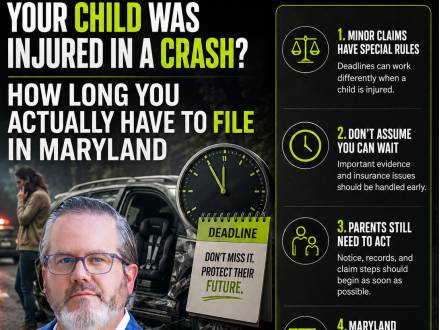
When a child is injured in a car accident, time stops in every meaningful emotional way—but legally, it keeps moving. In the middle of hospital visits, scans, recovery plans, and sleepless nights, most parents are not thinking about deadlines. Yet one of the most important questions quietly begins to matter almost immediately: how long do I have to file a car accident injury claim in Maryland?
This question is not just legal—it is practical and urgent. Maryland law sets strict time limits for taking action, and those limits do not pause while a family focuses on healing. Many parents assume they can "deal with the legal side later," or that speaking with an insurance company is enough to protect their rights. That assumption is one of the most common—and costly—misunderstandings.
What is rarely explained clearly is this: the legal clock starts ticking from the moment of the crash, not from when life feels stable again. Evidence fades, witnesses become harder to reach, and details that seem obvious today can become uncertain within months.
For parents, this creates a painful tension—protecting a recovering child while also protecting their future rights. Understanding the timeline early is not about rushing decisions; it is about preserving options when clarity is needed most.
The Core Problem: Why the Real Issue Isn’t the Crash, It’s the Delay in Understanding Time Limits
The Surface Problem Parents See vs. the Real Legal Problem
After a child is injured in a crash, most parents believe the main issue is medical: treatment, recovery, and stability. Everything else feels secondary. This is where the real problem begins. The legal system does not measure urgency by emotional readiness—it measures it by fixed deadlines. So while parents focus on healing, the law quietly tracks time in the background.
This is why the question how long do I have to file a car accident injury claim in Maryland becomes critical much earlier than most families realize.
The Hidden Misunderstanding: Recovery Time Is Not Legal Time
A common blind spot is assuming legal action can wait until life "settles down." Parents often think they are safe as long as insurance adjusters are communicating or medical bills are being processed. But those activities do not pause or extend filing deadlines.
The real issue is not inaction—it is misaligned timing. Emotional recovery and legal deadlines operate on completely different clocks.
Why Parents Miss the Risk Without Realizing It
In the early stages, families are overwhelmed with urgent responsibilities:
-
Hospital decisions feel more immediate than paperwork
-
Insurance calls feel like "progress"
-
The idea of lawsuits feels distant or unnecessary
-
The child’s recovery naturally takes priority
Because of this, legal urgency gets mentally postponed. Not ignored—but deprioritized. And that delay creates risk without any obvious warning signs.
Expert Insight: The Clock Starts Quietly, Not Loudly
One of the most overlooked realities in Maryland car accident cases is that the legal timeline does not announce itself. There is no reminder, no warning letter, and no visible countdown. The deadline simply runs in the background from the date of the crash.
This is why many families only realize the importance of Maryland car accident injury statute timing when it is already too late to act fully.
The Core Problem in One Sentence
The real issue is not understanding the crash—it is misunderstanding that legal protection begins immediately, even when life still feels like it is in survival mode
The Hidden Dynamic: Why Insurance Communication Can Quietly Mask Legal Urgency
The Misconception That Creates False Security
One of the least discussed realities in Maryland injury cases is that ongoing communication with an insurance company can feel like progress, even when no legal protection is actually being secured. For parents searching how long do I have to file a car accident injury claim in Maryland, this creates a dangerous illusion: if the insurer is "handling things," then there must be no immediate legal pressure.
But that assumption is not how deadlines work.
The Hidden Timing Gap Between "Processing" and "Protecting Rights"
Insurance companies often take time to evaluate injuries, request records, or "review the claim." During this period, families are understandably focused on their child’s recovery and assume everything is being managed in parallel. However, there is a critical gap:
-
Insurance review timelines are flexible and internal
-
Legal filing deadlines are fixed and non-negotiable
-
One does not pause or extend the other
This means a family can be actively engaged in an insurance process while unknowingly moving closer to the legal cutoff for filing a Maryland car accident injury claim.
Why This Dynamic Affects Parents of Injured Children More Intensely
Parents are especially vulnerable to this misunderstanding because they are managing emotional and medical stress simultaneously. When a system feels "responsive" (like insurance adjusters returning calls or requesting documents), it reduces urgency psychologically—even if the legal clock continues unchanged.
Another overlooked factor is how medical documentation evolves over time. Early reports may be incomplete, and later complications may not be fully captured unless the case is properly tracked from the beginning.
For families navigating a Maryland car accident injury statute of limitations, this delay between perception and legal reality can significantly impact outcomes.
Expert Insight: Administrative Activity Is Not Legal Protection
A key misunderstanding is assuming that cooperation with insurance equals protection of legal rights. In reality, administrative activity is separate from formal legal filing. Without proper legal action within required timelines, rights can expire even while discussions are ongoing.
High-Authority Context Source
Understanding how injuries are tracked and evaluated over time is essential in public health systems as well:
USA.gov – Official Information on Car Accidents and Reporting
Why This Matters Right Now
For parents, the danger is not negligence—it is delay disguised as engagement. The system can feel active while the legal window quietly narrows in the background.
The Stakes and Consequences: What’s Really on the Line When Time Runs Out
Why Delay Doesn’t Feel Dangerous—Until It Suddenly Is
For many parents, nothing feels urgent in the early weeks after a child’s crash except recovery. That is exactly what makes the legal consequences so easy to miss. The system does not wait for emotional readiness. If you are still asking how long do I have to file a car accident injury claim in Maryland, the answer is already tied to a ticking legal clock that does not slow down for family stress.
When that timeline is misunderstood, the consequences are not abstract—they are permanent.
Financial Consequences: The Costs Don’t Pause, Even If the Case Does
Medical bills often continue for months or years after a serious injury. Surgeries, therapy, follow-ups, and medications add up quickly. If legal deadlines are missed or weakened due to delay, families may be left relying heavily on personal income or insurance alone.
For a typical household already managing rent, school expenses, and daily living costs, this can create long-term financial strain that compounds over time. What starts as a single accident can quietly become a multi-year financial burden.
Legal Consequences: Losing the Right to Act
One of the most severe outcomes of misunderstanding a Maryland car accident injury statute of limitations is simple but final: the right to bring a claim can expire completely.
Even if the injury is serious, even if liability is clear, and even if evidence exists—missing the deadline can eliminate the ability to pursue compensation through the legal system. There are no partial protections once the window closes.
Emotional Consequences: Regret Becomes the Hardest Weight
Parents often describe a specific kind of regret in these situations—not about the accident itself, but about not understanding the timeline sooner.
Common emotional outcomes include:
-
Feeling responsible for "not acting in time"
-
Anxiety about whether more could have been done
-
Ongoing stress tied to unresolved medical costs
-
A sense of lost control during an already difficult period
This emotional burden often lasts longer than the physical recovery itself.
Long-Term Consequences: The Future Impact Nobody Plans For
As children grow, unresolved financial and medical issues can affect education savings, housing stability, and family planning. What feels like a short-term delay in legal action can evolve into long-term limitations on opportunity and security.
Core Reality
The real danger is not the crash alone—it is misunderstanding how quickly legal time moves compared to real life recovery.
A Clear Framework for Protecting Your Child’s Injury Claim in Maryland
The Goal: Turn Uncertainty Into a Clear Action Path
When a child is hurt, parents don’t need more information—they need structure. The confusion around how long do I have to file a car accident injury claim in Maryland often comes from not knowing what to do first, what matters most, and what can safely wait. This framework is designed to remove that uncertainty and replace it with clear, practical steps.
Step 1: Stabilize Medical Care, But Start Documentation Immediately
Focus on your child’s treatment first, but do not separate care from documentation.
What to do:
-
Keep every medical report, discharge summary, and prescription record
-
Take note of symptoms as they evolve over time
Why it matters:
Track key milestones (hospital visits, diagnoses, surgeries)
Why it matters:
In Maryland car accident injury claims, medical records are the foundation of the case. Early documentation prevents gaps that later become difficult to explain.
Step 2: Lock in the Timeline Early
Even if you are not ready to take legal action, you should understand the timing.
What to do:
-
Identify the accident date as the starting point
-
Understanding the Maryland car accident injury statute of limitations early prevents accidental delay while focusing on recovery.
Step 3: Preserve Evidence Before It Fades
Evidence does not remain stable over time.
What to do:
-
Save photos of the scene, injuries, and vehicle damage
-
Collect witness names and contact details
-
Keep police reports and insurance correspondence
What to avoid:
-
Relying on memory alone
-
Assuming insurance companies will preserve everything for you
Step 4: Separate Insurance Activity from Legal Protection
Insurance processing and legal filing are not the same system.
What to do:
-
Treat insurance communication as financial handling, not legal protection
-
Do not assume negotiations pause legal deadlines
Step 5: Use Public Safety Data to Understand Risk Context
Understanding crash impact trends helps frame urgency realistically.
https://www.nih.gov
Why This Framework Works
This step-by-step approach works because it aligns with how real-life decisions are made under stress: stabilize first, document consistently, understand timing early, and separate systems that appear connected but are legally independent.
For parents trying to understand Maryland car accident injury claim deadlines, this structure reduces emotional overload and replaces it with controlled, sequential action.
Core Takeaway
Clarity does not come from doing everything at once—it comes from knowing exactly what matters now, what matters next, and what cannot wait.
Strong Outcome Looks Like: When Timing, Clarity, and Protection Work Together
The Difference Between Reacting and Being Prepared
For parents dealing with a child’s injury after a crash, the outcome often depends less on the accident itself and more on how early they understand the system around it. The question how long do I have to file a car accident injury claim in Maryland is not just about deadlines—it is about whether a family stays in control or slowly loses options without realizing it.
A strong outcome is not luck. It is timing, documentation, and informed decisions working together from the beginning.
Strong Outcome: Stability, Control, and Predictability
In a strong outcome, parents are not guessing what comes next. They understand the timeline early and act with structure instead of urgency.
Financial Stability
-
Medical expenses are documented and strategically managed
-
Long-term treatment costs are anticipated rather than reacted to
-
The family avoids absorbing preventable financial pressure alone
Clarity and Control
-
Parents know where they stand legally at each stage
-
Insurance communication does not create confusion or false confidence
-
Decisions are made with information, not panic
Time Efficiency
-
Evidence is preserved early, reducing later complications
-
No scrambling to reconstruct facts months after the crash
-
The process moves forward without avoidable delays
Emotional Relief
-
Reduced uncertainty about whether something important was missed
-
Less second-guessing or regret
-
More focus on the child’s recovery instead of legal anxiety
Weak Outcome: Confusion, Delay, and Lost Options
In weaker outcomes, patterns are consistent:
-
Families assume insurance handling equals legal protection
-
Medical recovery takes priority while deadlines quietly approach
-
Evidence becomes harder to collect over time
-
Eventually, parents discover that legal options are limited or gone
The result is not just financial strain—it is emotional exhaustion paired with a sense of irreversible loss.
Why Timing Creates Everything
Understanding Maryland car accident injury statute timing early creates a structural advantage. It ensures that legal rights remain intact while the family focuses on healing, rather than discovering too late that important options expired during recovery.
Future State: What Parents Actually Want
At its core, a strong outcome looks like this:
-
Your child receives proper care without added financial fear
-
You are not overwhelmed by uncertainty or missed deadlines
-
You maintain control over decisions instead of reacting to pressure
-
The legal process supports recovery instead of disrupting it
For families, that stability is often the most valuable result of all.
https://www.cdc.gov/safechild/index.html
Bottom Line
When timing is understood early, outcomes shift from reactive damage control to structured protection—giving families both clarity and peace of mind when they need it most.
FAQs — Maryland Child Injury Claims and Filing Deadlines
1. How long do I have to file a car accident injury claim in Maryland after my child is injured?
The answer depends on Maryland’s legal filing rules, which set strict deadlines based on the date of the crash. In most situations, the clock starts immediately after the accident, not after your child finishes treatment. This is why many parents searching for how long do I have to file a car accident injury claim in Maryland are surprised to learn they may have less flexibility than expected. Acting early helps protect your legal rights while you focus on recovery.
2. Does my child get more time to file a car accident injury claim in Maryland?
In some cases involving minors, the law may allow extended time compared to adult claims. However, this does not mean you should wait. Evidence, witness memory, and medical documentation become weaker over time. Even when extra time exists, early action significantly improves the strength and value of the claim.
3. What happens if I wait too long to file a Maryland car accident injury claim?
If you wait beyond the legal deadline, you may permanently lose the right to pursue compensation through the court system. This can happen even if the injury is serious or the other driver was clearly at fault. Many parents don’t realize this risk until it is too late, especially when focused on their child’s recovery.
4. Is talking to the insurance company enough to protect my child’s claim?
No. Insurance communication is separate from legal filing requirements. Many parents assume cooperation with insurance adjusters protects their rights, but it does not stop legal deadlines from running. This is one of the most common misunderstandings in Maryland car accident injury statute timing cases.
5. When should I start worrying about legal deadlines after my child’s accident?
You should think about deadlines immediately after the crash, even if you do not plan to take action right away. The legal timeline begins early, while recovery often feels like the only priority. Understanding this balance helps prevent accidental delays that could affect your child’s future options.
6. Can medical treatment delay the filing deadline for a car accident injury claim in Maryland?
No, ongoing medical treatment does not pause legal deadlines. Even if your child requires months of therapy or follow-up care, the filing timeline continues separately. This is why documenting injuries early is important while treatment is still ongoing.
7. What if I don’t know the full extent of my child’s injuries yet?
It is very common not to understand the full medical impact immediately after a crash. However, waiting for complete clarity before thinking about legal timing can create risk. The safer approach is to begin tracking and documenting everything early while the medical picture develops over time.
8. How do I know if I’m already running out of time to file in Maryland?
If months have passed since the accident and no formal legal steps have been taken, you may already be closer to critical deadlines than you realize. Many parents only discover timing risks when they start asking detailed questions about filing limits. That is why early awareness is essential.
9. What is the most common mistake parents make with Maryland injury claims?
The most common mistake is assuming that recovery time and legal time move together. Parents naturally prioritize their child’s healing and postpone legal concerns. Unfortunately, the legal system does not pause for recovery, which is why delays often lead to avoidable complications.
10. Why is understanding filing timing so important for parents of injured children?
Understanding timing protects your child’s long-term financial and legal options. It ensures that decisions are made with clarity instead of pressure or regret. When parents understand Maryland car accident injury claim deadlines early, they can focus more on recovery and less on uncertainty about whether they acted too late.
Conclusion — Why Timing, Not Just Recovery, Protects Your Child’s Future
When a child is injured in a crash, parents naturally focus on healing first. That instinct is right—but it often leads to overlooking a separate system running quietly in the background: legal deadlines that continue regardless of recovery. Understanding how long do I have to file a car accident injury claim in Maryland is not just about rules; it is about protecting your child’s long-term financial and legal stability while life is still uncertain.
The core issue is not a lack of care from parents—it is the gap between emotional recovery and legal timing. Insurance communication can feel like progress, and treatment can feel like the only priority, but neither pauses the legal clock. That hidden timing dynamic is what causes many families to lose clarity at the exact moment they need it most.
The stakes are significant. Delays can limit options, reduce leverage, and create financial pressure that extends far beyond the accident itself. In contrast, early awareness creates structure, preserves evidence, and allows decisions to be made calmly instead of under pressure.
Staying in uncertainty often leads to reactive choices and missed opportunities. Moving forward with clarity means understanding timelines early and making informed, deliberate decisions that protect your child’s future.
If you are unsure where you stand or whether important time limits may already be approaching, reaching out for a confidential conversation can help bring clarity. It is not about rushing decisions—it is about making sure nothing important is missed while you focus on your child’s recovery and well-being.
Kisner Law Scholarship Program


Kisner Law is Committed to Bettering Your Future.
Please complete the form below or contact us at 240-459-0097 for a free consultation.
 The use of the Internet or this form for communication with the firm or any individual member of the firm does not establish an attorney-client relationship. Confidential or time-sensitive information should not be sent through this form.
I have read and understand the Disclaimer and Privacy Policy.










Free Consultations 240-459-0097
From our office in Hyattsville, Maryland, Kisner Law represents injury victims and their families throughout the Anne Arundel, Montgomery County, and Prince George's County areas, including, but not limited to Annapolis, Beltsville, Bowie, College Park, Crofton, Greenbelt, Landover, Lanham, Laurel, Largo, Mount Rainier, Riverdale Park, Silver Spring, Takoma Park, and Upper Marlboro. We also serve clients across the bordering counties as well as those in Washington, D.C.
Results listed are not a guarantee or indication of future case results.
Kisner Law
8401 Corporate Drive, Suite 650, Hyattsville, MD 20785
240-459-0097



Follow us on Social Media: