


- Home
- About
- Personal Injury
- Car Accidents
- Truck Accidents
- Motorcycle Accidents
- Pedestrian Accidents
- Defective Products
- Premises Liability
- Catastrophic Injuries
- Medical Malpractice
- Nursing Home Negligence
- Sexual Abuse
- Educational Abuse
- Wrongful Death
- Scooter Accidents
- Underinsured Motorist Accidents
- Uninsured Motorist Accidents
- Workers’ Compensation
- Case Results
- Scholarship
- Blog
- Contact
Your Parent Fell at Their Assisted Living Facility. When Maryland Law Says It's Not "Just an Accident"
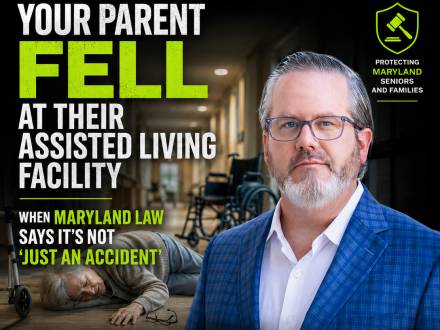
If you are asking "my parent fell at an assisted living facility in Maryland are they responsible," you are likely dealing with more than just a medical emergency—you are dealing with uncertainty, urgency, and a quiet fear that something may have gone wrong in a place you were told was safe.
A fall in an assisted living facility is often explained away as "something that just happens with age." But in Maryland, that explanation is not always the full story. Many families only later discover that falls can signal deeper issues—missed supervision, incomplete care planning, or safety procedures that were not followed as closely as they should have been.
This matters right now because early decisions shape everything that follows. What you assume in the first few days often determines whether key evidence is preserved, whether medical risks are properly addressed, and whether accountability is even possible to evaluate later.
Seldom-discussed in most legal explanations is this reality: facilities may frame incidents quickly to reduce concern, while families—already under emotional stress—often accept that explanation without realizing they still have questions they are entitled to ask.
The goal of this article is to bring clarity at a moment when confusion is common. You will learn how Maryland law actually looks at assisted living falls, what responsibility can mean in practical terms, and how to tell the difference between an unavoidable accident and a preventable breakdown in care.
The Core Problem
The real issue is not the fall—it’s what allowed the fall to happen
When families search "my parent fell at an assisted living facility in Maryland are they responsible," they are usually focused on the moment of impact: the fall itself. But in Maryland assisted living cases, that is rarely where responsibility is determined.
The deeper legal question is simpler and more uncomfortable: Was this fall preventable under the care standards the facility was supposed to follow?
This shift in thinking is important because it moves the conversation away from blame and toward systems, supervision, and safety decisions that were made (or not made) before the incident occurred.
Why families misread the situation in the first place
Adult children often assume that a fall automatically means "normal aging risk." That assumption is understandable—it reduces anxiety in an already stressful moment. But it can also create a blind spot.
Facilities may reinforce this belief by describing the incident as routine or unavoidable. When that framing is accepted too quickly, families stop asking deeper questions such as:
- Was my parent identified as a fall risk before this happened?
- Were staff supposed to be supervising them at that time?
- Were known mobility limitations properly addressed in their care plan?
Without these answers, the situation gets simplified into something it often is not.
The overlooked legal reality in Maryland assisted living cases
A key distinction that most families miss is this: responsibility in assisted living falls is not about presence—it is about prevention.
In other words, even if staff were nearby, the real question is whether the facility had systems in place to reduce foreseeable risk and whether those systems were actually followed.
This is where many cases begin to shift. A fall that looks "accidental" on the surface may actually reflect:
- Missed or outdated care assessments
- Inconsistent supervision routines
- Environmental hazards that were not corrected
- Communication gaps between staff shifts
This is especially important in assisted living fall liability in Maryland, where care plans are meant to be individualized, not generic.
Expert insight most families underestimate
One of the most overlooked dynamics is this: documentation often matters as much as the event itself.
Facilities operate on written records—care plans, risk assessments, and incident reports. If those records do not match the reality of the resident’s condition, or if they are incomplete, it can reveal a gap between what was required and what was actually done.
For families, this means the truth of the situation is rarely found in the verbal explanation given after the fall. It is found in the paperwork created before it.
Connecting the emotional reality to the legal one
For adult children, this moment is often driven by guilt, urgency, and confusion. The instinct is to trust reassurance and focus on recovery. But the core problem is that early assumptions can quietly limit what questions are ever asked.
Understanding the real issue behind "my parent fell at an assisted living facility in Maryland are they responsible" begins with recognizing this: the fall is the outcome, not the cause.
The cause lies in the conditions that allowed it to happen.
The Hidden Timing Dynamic That Most Families Never See
What happens in the first 24–72 hours quietly shapes the entire case
One of the least discussed realities in assisted living cases is that responsibility is often influenced not just by what happened—but by how quickly the story of what happened gets recorded and stabilized inside the facility’s system.
When families ask "my parent fell at an assisted living facility in Maryland are they responsible," they usually assume the facts are fixed at the moment of the fall. In reality, the first few days after the incident are when critical information is documented, interpreted, and sometimes unintentionally reshaped.
This is not about conspiracy—it is about system behavior.
The "documentation lock-in" effect
In many facilities, staff complete incident reports, shift notes, and care updates shortly after a fall. These records become the official version of events. Once written, they are rarely questioned internally unless there is a clear reason to do so.
This creates what can be called a documentation lock-in effect:
- Early assumptions about the cause of the fall become embedded in records
- Later staff rely on those initial notes rather than re-evaluating details
- Families are often given simplified explanations based on early reporting
Over time, the narrative becomes harder to separate from the facts.
Why timing matters more than most families realize
A major overlooked factor in who is responsible when a parent falls in assisted living Maryland is that evidence can degrade quickly:
- Surveillance footage may be overwritten after a short retention period
- Staff recollections become less precise with each passing day
- Environmental conditions (wet floors, misplaced equipment) are corrected immediately, removing visible evidence
At the same time, medical priorities understandably shift toward treatment, not investigation. This means critical context can quietly disappear before anyone realizes its importance.
How federal standards frame the reporting duty
Facilities are expected to document and report significant incidents under federal quality and safety expectations for long-term care environments, which emphasize accurate, timely reporting of resident harm events.
You can review these general safety and reporting standards through the Centers for Medicare & Medicaid Services (CMS):
https://www.cms.gov/medicare/health-safety-standards
Why this hidden dynamic matters for families
For adult children already under emotional pressure, this timing gap is often invisible. The instinct is to focus on recovery, not records. But by the time questions are asked, the "first version" of events has already been set.
This is why two families with similar situations can end up with very different outcomes—not because the falls were different, but because the early narrative formation process was handled differently.
Understanding this dynamic is essential when evaluating my parent fell at an assisted living facility in Maryland are they responsible, because responsibility is often shaped in the hours before families even know what questions to ask.
The Stakes and Consequences of Misunderstanding What Really Happened
Why early assumptions can quietly shape everything that follows
When a family is dealing with the shock of a parent’s fall, it is natural to accept the first explanation and focus on recovery. But in situations like "my parent fell at an assisted living facility in Maryland are they responsible," what gets misunderstood in the first days often determines the outcome for months or even years.
If the situation is incorrectly treated as a routine accident, families may unintentionally miss opportunities to protect both their parent’s health and their legal position.
Financial consequences: costs that escalate without clarity
A fall in assisted living is rarely a single expense. It often triggers a chain reaction:
- Emergency hospital visits and imaging
- Rehabilitation or physical therapy
- Long-term mobility support or higher-level care placement
- Increased monthly facility fees if care needs rise
If responsibility is not properly examined, these costs may fall entirely on the family or insurance without review of whether the facility’s actions contributed to them.
For many adult children balancing jobs, mortgages, and their parent’s care, this can quickly become a long-term financial strain rather than a one-time medical issue.
Legal consequences: lost leverage when time passes
In Maryland assisted living fall cases, timing is critical. When families delay asking questions or requesting records, key information can become harder to access or verify.
For example:
- Incident details may be simplified in internal records
- Witness memories may fade or become less precise
- Physical conditions that contributed to the fall may be corrected
This does not automatically erase legal responsibility, but it can make it significantly harder to evaluate what actually happened.
A common misunderstanding in assisted living fall liability Maryland situations is assuming the facility will voluntarily preserve and present all relevant details without prompting. In reality, documentation often follows internal procedures—not family expectations.
Emotional consequences: guilt, confusion, and misplaced blame
Adult children often carry a quiet emotional burden after a parent falls. If they accept an incomplete explanation too quickly, they may later experience:
- Regret for not asking more questions
- Frustration if new facts emerge later
- Strained trust in the facility or caregivers
- Internal guilt about "not acting fast enough"
These emotional effects can last long after the medical recovery begins.
Long-term consequences: shaping future care decisions
The most overlooked impact is long-term. A single misunderstood incident can influence:
- Whether a parent stays in the same facility
- The level of supervision they receive in the future
- Family confidence in care decisions going forward
In cases involving my parent fell at an assisted living facility in Maryland are they responsible, the real risk is not just the fall itself—it is building future care decisions on incomplete or inaccurate understanding of what caused it.
The core takeaway
The consequences are not limited to one moment in time. They accumulate—financially, emotionally, and practically—based on whether the situation is examined early and clearly or accepted too quickly as "just an accident."
A Practical Framework for Understanding and Responding After a Fall
The "5-Step Clarity Framework" for Maryland assisted living falls
When a parent is injured, families often feel pressured to react quickly without structure. But in situations like "my parent fell at an assisted living facility in Maryland are they responsible," clarity comes from following a simple, repeatable process—not from emotional decision-making alone.
This framework helps families separate facts from assumptions and make decisions that protect both health and accountability.Step 1: Stabilize care, but don’t accept explanations too quickly
Focus first on your parent’s medical condition and safety. Ensure proper treatment is happening.
At the same time, avoid relying solely on verbal explanations from staff about what caused the fall.
Why it matters: Early explanations are often incomplete and based on initial impressions, not full review.
Step 2: Request all immediate records
Ask for:
- Incident report
- Current care plan
- Fall risk assessment (if available)
- Nurse or staff shift notes around the time of the incident
Why it matters: These documents form the foundation for understanding whether this was a preventable event or a true accident.
Step 3: Map the environment and supervision context
Reconstruct what conditions were in place:
- Was assistance required for walking or bathroom use?
- Were mobility aids being used correctly?
- Was supervision required at that time of day?
Why it matters: Responsibility in assisted living fall cases in Maryland often depends on whether supervision matched documented needs.
Step 4: Identify gaps between care plan and reality
Compare what should have happened versus what actually happened.
Even small inconsistencies—like missed assistance or outdated assessments—can be significant.
Why it matters: Liability is often found in gaps between documented care and real-world execution.
Step 5: Preserve evidence immediately
If possible, request preservation of:
- Video footage
- Witness names
- Environmental conditions at the time of the fall
Why it matters: Evidence can disappear quickly, and reconstruction becomes harder over time.
High-authority reference
For baseline expectations around care standards and resident safety protections in long-term care settings, see:
https://www.medicare.gov/care-compare/
Core decision rule for families
If the facts show alignment between care needs and actual supervision, the fall may be accidental.
If there are gaps—between risk, supervision, or safety conditions—then the question "my parent fell at an assisted living facility in Maryland are they responsible" becomes much more serious and requires deeper evaluation.
What to avoid
- Do not rely only on verbal explanations
- Do not delay requesting records
- Do not assume documentation will be preserved automatically
This framework helps families move from emotional reaction to structured clarity, which is essential in the first critical days after a fall.
Strong Outcome Actually Looks Like After a Maryland Assisted Living Fall
When clarity replaces confusion, everything changes
For families dealing with "my parent fell at an assisted living facility in Maryland are they responsible," the strongest outcomes are not defined only by legal conclusions—they are defined by control, clarity, and stability after a chaotic event.
A strong outcome begins the moment the family stops relying on vague explanations and starts working with verified facts. Instead of uncertainty, they gain a structured understanding of what happened, why it happened, and what the facility did or did not do before and after the fall.
Strong outcome vs. weak outcome: what the difference really looks like
Strong outcome (what families experience when they act early and clearly):
- Medical care is stabilized and properly coordinated
- Records and documentation are preserved and reviewed
- Families understand whether the fall was preventable or unavoidable
- Financial exposure is assessed with full information
- Decisions about future care are made calmly, not under pressure
- Emotional burden shifts from confusion to informed control
Weak outcome (what happens when families delay or accept early explanations):
- Key records become incomplete or harder to access
- Families remain uncertain about what actually happened
- Costs increase without clarity about responsibility
- Decisions are made reactively instead of strategically
- Emotional stress continues long after physical recovery begins
The difference is not intelligence or effort—it is timing and structure.
What a strong future actually feels like
In the best-case scenario, the adult child is no longer asking "what really happened?" but instead understands the full picture. They can explain the situation clearly, make informed decisions about care, and protect their parent’s dignity without constant doubt.
Financially, they are not absorbing unexpected long-term costs caused by unanswered questions. Instead, they understand whether responsibility lies with the facility or is part of unavoidable medical risk.
Emotionally, the shift is just as important. Guilt is replaced by clarity. Confusion is replaced by direction. The constant second-guessing fades because the facts are finally organized and understood.
Why timing and preparation define the outcome
In assisted living fall cases, including assisted living fall liability in Maryland, outcomes are heavily influenced by what happens in the first days—not months later. Families who act early preserve options. Families who wait often lose visibility into critical details.
Proper timing does not guarantee a specific result, but it dramatically increases the ability to understand the truth and make informed decisions about next steps.
External reference for context on safety and quality expectations
For broader understanding of quality expectations in long-term care environments, see:
https://www.cdc.gov/longtermcare/index.html
The core takeaway
A strong outcome is not about reacting emotionally—it is about moving from uncertainty to structured understanding. When families approach my parent fell at an assisted living facility in Maryland are they responsible with clarity and timing, they are far more likely to protect both their parent’s wellbeing and their own long-term stability.
FAQs
1. If my parent fell at an assisted living facility in Maryland are they responsible, does that automatically mean the facility was negligent?
No, it does not automatically mean negligence. In Maryland, responsibility depends on whether the facility failed to meet reasonable care and supervision standards. A fall alone is not enough to prove fault. What matters is whether the conditions leading to the fall were preventable. Families often need to look at care plans, supervision levels, and environmental safety before drawing conclusions.
2. What should I do first if my parent falls in assisted living and I’m asking "my parent fell at an assisted living facility in Maryland are they responsible"?
The first step is to ensure your parent receives proper medical care without delay. After that, you should request written records, including the incident report and care plan. Do not rely only on verbal explanations from staff. Early documentation helps clarify whether the fall was an unavoidable event or linked to preventable gaps in care.
3. Can assisted living facilities in Maryland avoid responsibility by calling a fall "an accident"?
Calling something an accident does not determine legal responsibility. Facilities may describe falls as accidental in early reports, but that does not end the inquiry. The key question is whether proper supervision and safety measures were in place. If those were missing or not followed, responsibility may still exist despite the "accident" label.
4. How does timing affect cases where someone searches "my parent fell at an assisted living facility in Maryland are they responsible"?
Timing is critical because early records and evidence shape the entire understanding of the event. Surveillance footage, staff notes, and environmental conditions can change or disappear quickly. If families wait too long, it becomes harder to reconstruct what actually happened. Acting early improves clarity and preserves important details.
5. What financial risks should I be aware of after a fall in assisted living?
Falls can lead to unexpected costs such as hospital stays, rehabilitation, and higher-level care placement. If responsibility is not properly evaluated, families may absorb these expenses without review. Understanding whether the fall was preventable can influence who ultimately bears the financial burden. Many families underestimate how quickly costs escalate after a single incident.
6. Is it common for families to misunderstand responsibility in assisted living fall cases?
Yes, it is very common. Families often assume age alone explains the fall, especially when facilities describe it as unavoidable. However, many falls involve missed supervision or outdated care planning. This misunderstanding can delay important questions and reduce access to key information. Clarifying the facts early is essential.
7. What evidence is most important when evaluating assisted living fall liability in Maryland?
The most important evidence includes care plans, fall risk assessments, incident reports, and any available surveillance footage. Staff shift notes can also provide valuable context. These records help determine whether the facility followed proper procedures. Without them, it becomes difficult to assess responsibility accurately.
8. How do emotional reactions affect decisions after a parent’s fall?
Emotions like fear, guilt, and confusion often lead families to accept the first explanation they hear. This can result in delayed questioning or missed opportunities to gather information. While emotional responses are natural, they can cloud early decision-making. Structured thinking helps balance emotional stress with practical action.
9. What happens if I wait too long to investigate whether my parent’s fall was preventable?
Waiting too long can lead to loss of critical information. Records may become harder to obtain, and physical evidence may no longer exist. Staff recollections also become less reliable over time. This makes it more difficult to determine whether the facility acted appropriately.
10. How can I make better decisions after asking "my parent fell at an assisted living facility in Maryland are they responsible"?
Better decisions come from separating facts from assumptions. Focus on documented evidence rather than verbal explanations. Ask structured questions about supervision, care plans, and environmental safety. Taking a calm, step-by-step approach helps ensure decisions are based on clarity rather than urgency or fear
Conclusion — Moving From Uncertainty to Clarity After a Maryland Assisted Living Fall
When a parent is injured in care, the question "my parent fell at an assisted living facility in Maryland are they responsible" is rarely just about law—it is about trying to understand whether something preventable happened in a place that was supposed to be safe.
As this article has shown, responsibility is not determined by the fall alone. It depends on supervision, care planning, environmental safety, and how the facility documented and responded to the event. The most important—and often overlooked—dynamic is timing: early assumptions, early records, and early explanations can shape everything that follows.
The stakes are real. Families who remain in uncertainty often face rising medical costs, unanswered questions, and emotional strain that lingers long after the injury. Those who move early toward structured clarity are better positioned to understand what actually happened and make informed decisions about their parent’s care and safety.
The difference is not just legal—it is practical and emotional. Staying in uncertainty means relying on incomplete explanations. Moving forward means gaining control, clarity, and the ability to act with confidence instead of doubt.
If your family is currently facing this situation, a careful review of what happened can help you understand whether this was truly an unavoidable accident or something that should be examined more closely. For many families, having a clear, confidential conversation early helps prevent mistakes that are difficult to undo later and ensures decisions are made with full understanding rather than pressure or confusion.
Kisner Law Scholarship Program


Kisner Law is Committed to Bettering Your Future.
Please complete the form below or contact us at 240-459-0097 for a free consultation.
 The use of the Internet or this form for communication with the firm or any individual member of the firm does not establish an attorney-client relationship. Confidential or time-sensitive information should not be sent through this form.
I have read and understand the Disclaimer and Privacy Policy.










Free Consultations 240-459-0097
From our office in Hyattsville, Maryland, Kisner Law represents injury victims and their families throughout the Anne Arundel, Montgomery County, and Prince George's County areas, including, but not limited to Annapolis, Beltsville, Bowie, College Park, Crofton, Greenbelt, Landover, Lanham, Laurel, Largo, Mount Rainier, Riverdale Park, Silver Spring, Takoma Park, and Upper Marlboro. We also serve clients across the bordering counties as well as those in Washington, D.C.
Results listed are not a guarantee or indication of future case results.
Kisner Law
8401 Corporate Drive, Suite 650, Hyattsville, MD 20785
240-459-0097



Follow us on Social Media: